
What you’ll learn in this article…
- South Carolina has four MSN nurse educator programs ranging from fully online to campus based in Greenville.
- The state BOLD Nursing Faculty Loan Program offers forgivable loans now that the federal Nurse Faculty Loan Program has ended.
- Nursing postsecondary teachers in South Carolina earned a median salary of roughly $75,470 according to 2024 BLS data.
- A 74% pass rate on the CNE exam shows strong outcomes for well prepared candidates pursuing certification.
South Carolina's nursing programs turned away qualified applicants again in the 2023-2024 cycle, largely because there aren't enough faculty to teach them. That nursing faculty shortage creates real opportunity for RNs ready to move into education, but the path from bedside to classroom requires choosing the right MSN program from a small field.
Only four universities in the state offer MSN-level nurse educator tracks, and they differ sharply: total credit hours range from 30 to 47, formats span fully online to campus-based, and tuition runs from roughly $12,600 to nearly $17,000 per year depending on the school and residency status. South Carolina's BOLD Nursing Faculty Loan Program adds a financial incentive that few other states can match, making the cost equation worth a closer look.
Best Nurse Educator Programs in South Carolina
South Carolina currently has four universities offering MSN-level nurse educator programs, each with a distinct format, price point, and regional focus. Whether you prefer a fully online path, a campus-based experience in Greenville, or a hybrid model that blends both, these programs prepare you for the Certified Nurse Educator (CNE) exam and align with state-level faculty funding initiatives like the Higher Education Nursing Initiative (HENI). Below, we break down what makes each program stand out so you can match your schedule, budget, and career goals to the right fit. Note that program-level earnings data is not yet available for any of these nursing education tracks, so institution-wide figures are provided where applicable.
- Program format and flexibility
- Tuition and net price
- Institutional graduation and retention rates
- Clinical hours and accreditation
- State workforce alignment
- Independent program research
- Internal program database
- College Scorecard graduate earnings — collegescorecard.ed.gov
- NCES-IPEDS federal institutional data — nces.ed.gov
- #1
University of South Carolina
Columbia, SC · $23,000/yr
Best for: Online learners seeking national recognition
The University of South Carolina in Columbia is the state's flagship research university, boasting a 78.8% institution-wide graduation rate and a 92% retention rate. Its CCNE-accredited MSN in Nursing Education is delivered fully online with local practicum options, making it accessible to working nurses across and beyond South Carolina. U.S. News ranks the program No. 3 nationally for online nursing education, and the university reports a median institution-wide debt of $21,500 and median earnings of $62,177 ten years after enrollment.
View program
- Fully online, asynchronous format with 7- or 15-week terms
- 39 credit hours completed across 5 semesters
- 504 clinical hours with local practicum placements
- Rolling admissions with summer, fall, and spring starts
- No GRE required; 3.0 minimum GPA
- Total estimated program tuition of $35,973
- Prepares graduates for the NLN CNE certification exam
- One on-campus immersion for Advanced Health Assessment
- #2
Clemson University
Clemson, SC · $20,000 – $25,000/yr
Best for: Upstate nurses wanting in-person training
Clemson University combines a strong 86.6% institution-wide graduation rate with a focused campus-based MSN Nursing Educator concentration delivered at its Greenville satellite site. The program emphasizes educational technology, simulation, and research integration, positioning graduates to lead curriculum innovation in South Carolina's expanding nursing programs. Institution-wide, Clemson reports median graduate debt of $21,500 and ten-year median earnings of $71,513.
View program
- Campus-based program at Clemson's Greenville, SC location
- 600+ required clinical practice hours with simulation
- Summer (May) start with February 15 application deadline
- Minimum 3.25 GPA and three recommendation letters
- Active South Carolina RN licensure required
- CCNE accredited with educational technology emphasis
- Integrates research-driven teaching methodologies
- #3
Anderson University
Anderson, SC · $24,000/yr
Best for: Working RNs preferring small cohort mentorship
Anderson University is a private institution in Anderson, SC, offering a hybrid MSN with a Nurse Educator concentration that pairs online coursework with brief three-day, on-campus sessions each semester. With a 13:1 student-to-faculty ratio and instructors who are all practicing nurses, the program provides personalized mentorship rooted in a Christian worldview. The institution-wide graduation rate is 65.7%, median graduate debt is $26,700, and ten-year median earnings are $42,101.
View program
- Hybrid format: online classes plus three-day campus sessions
- 47 total credit hours with cohort-based structure
- Full-time and part-time scheduling available
- Bridge courses available for ADN-prepared applicants
- 3.0 GPA minimum; two letters of recommendation
- Prepares for national nurse educator certification
- All instructors are practicing nurse educators
- #4
Coker University
Hartsville, SC · $20,000/yr (net price)
Coker University in Hartsville delivers a compact, fully online MSN with an Education track designed for working nurses in rural and underserved areas of South Carolina. At just 30 credit hours with eight-week course terms, it is the shortest program in the state, though its institution-wide graduation rate (39.5%) and retention rate (69%) are notably lower than peer schools. The median institution-wide debt is $26,000 and ten-year median earnings are $40,117. Coker holds NLN CNEA pre-accreditation status.
View program
- Fully online, asynchronous eight-week course terms
- 30 total credit hours, the fewest in South Carolina
- 50 required internship/clinical hours
- No campus visits required at any point
- NLN CNEA pre-accreditation status
- 3.0 GPA minimum with active nursing license required
- Prepares for academic, staff, or community educator roles
- Capstone project required for graduation
How Much Do Nurse Educator Programs in South Carolina Cost?
Tuition, net price, and graduate debt can vary significantly across South Carolina's four nurse educator programs. The figures below reflect institution-level data from IPEDS and the College Scorecard. Keep in mind that net price is an institution-wide average for undergraduate students receiving financial aid, so your actual graduate-level costs will differ based on your enrollment status, residency, and financial aid package. Program-level earnings data is not yet available for these nursing education tracks, so the ROI ratio shown uses each institution's overall median earnings ten years after enrollment.
| School | In-State Tuition | Out-of-State Tuition | Avg. Net Price | Median Graduate Debt | Median Earnings (10 yr) | ROI Ratio (Earnings to Debt) |
|---|---|---|---|---|---|---|
| Clemson University | $12,646 | $24,798 | $22,253 | $21,500 | $71,513 | 3.3x |
| Anderson University | $13,759 | $13,759 | $23,544 | $26,700 | $42,101 | 1.6x |
| University of South Carolina | $14,134 | $30,160 | $22,811 | $21,500 | $62,177 | 2.9x |
| Coker University | $16,960 | $16,960 | $20,286 | $26,000 | $40,117 | 1.5x |
Questions to Ask Yourself
Online vs. Campus Nurse Educator Programs in South Carolina
South Carolina's four ranked nurse educator programs span a range of delivery formats, so you can match a program to your schedule and learning style. Here is a quick breakdown of what each format offers and what to watch for, especially when it comes to practicum requirements.
Pros
- Online programs (University of South Carolina, Coker University) let working RNs complete asynchronous coursework on their own schedule, making it easier to keep clinical employment while earning your MSN.
- Fully online delivery opens the door to competitive out-of-state options as well; just confirm the school holds state authorization to operate in South Carolina before enrolling.
- Hybrid programs like Anderson University blend online coursework with brief, scheduled in-person sessions each semester, giving you both flexibility and face-to-face interaction with faculty mentors.
- Campus-based programs such as Clemson University's Greenville cohort offer structured practicum coordination, hands-on teaching lab experiences, and strong local networking with faculty and peers.
- In-person and hybrid formats often simplify clinical site placement because the school maintains established partnerships with nearby healthcare facilities and nursing programs.
Cons
- Even fully online programs require in-person practicum hours completed in your local area. Expect anywhere from 50 to 600 clinical or teaching hours depending on the school; the University of South Carolina, for example, requires roughly 500 hours.
- Online students sometimes need to arrange their own practicum sites, which can take extra lead time, particularly in rural parts of the state.
- Campus-based programs like Clemson's typically admit only once a year (fall start), limiting flexibility if your timeline does not align with that cycle.
- Some online programs still include synchronous components: the University of South Carolina requires at least one on-campus immersion, and Anderson University schedules three-day in-person sessions each semester.
- If you enroll in an out-of-state online program, you must verify that it holds proper state authorization in South Carolina, or your practicum hours and financial aid eligibility could be affected.
Related Articles
How to Become a Nurse Educator in South Carolina
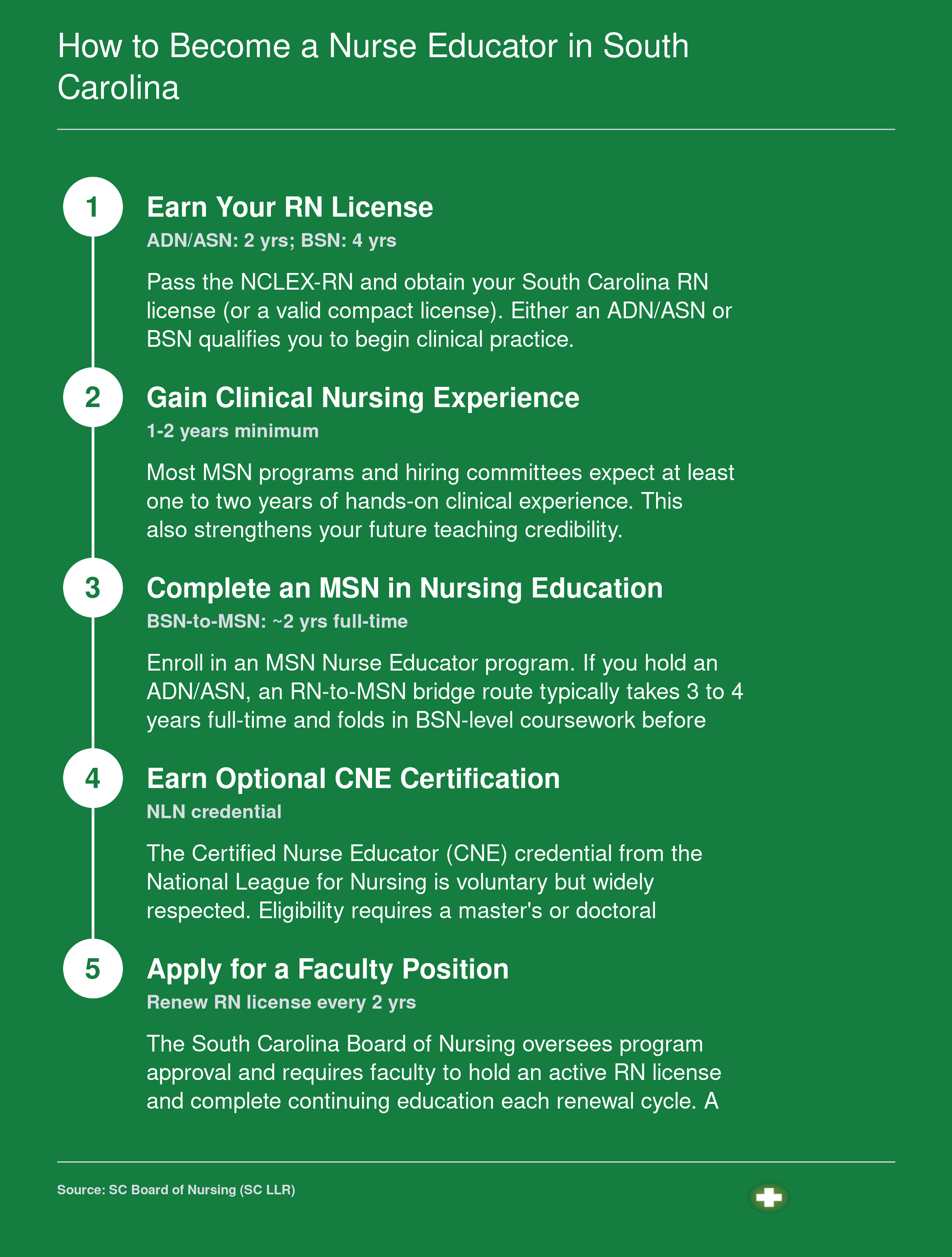
South Carolina does not require a separate educator license or a doctoral degree to teach in nursing programs, but you will need an active RN license and an advanced degree. Here is the typical pathway from bedside nurse to faculty role, including a bridge option for ADN/ASN-prepared nurses.
Nurse Educator Salary and Job Outlook in South Carolina
Choosing between a higher-paying clinical nursing role and a rewarding career in education often leaves nurses weighing immediate income against long-term professional fulfillment. In South Carolina, nurse educators earn competitive wages that reward advanced degrees and teaching expertise, while the state's pressing faculty shortage creates unusually strong job prospects for new graduates.
South Carolina Nurse Educator Salary Overview
According to the Bureau of Labor Statistics, the 1,040 nursing instructors and teachers employed in South Carolina earned a median annual wage of $79,990 as of May 2024.1 The middle half of earners fell between $62,430 (25th percentile) and $104,190 (75th percentile), with the top 10 percent earning above $130,880.1 Even entry-level positions paid above the state's average for all occupations, with the 10th percentile wage reaching $52,260. This range reflects the value placed on advanced nursing degrees and clinical experience in academic settings.
Comparing South Carolina's Wages to National and Regional Figures
South Carolina's median salary for postsecondary nursing teachers sits slightly below the national median, which typically falls in the low-to-mid $80,000 range. For a detailed breakdown, see our analysis of highest paid nurse educators across all 50 states. Neighboring states with larger metropolitan healthcare systems, such as North Carolina and Georgia, often report higher median wages, attributable to a greater concentration of major teaching hospitals and higher costs of living. Still, South Carolina's lower cost of living offsets some of the wage gap, making the effective purchasing power more attractive. Salary growth in the field remains steady, with annual increases tied to institutional budgets and rising demand for faculty.
What MSN Graduates from Notable Programs Can Expect
While statewide averages provide a helpful benchmark, new MSN-prepared nurse educators may enter the field below the median until they gain teaching experience. Program-specific earnings data for recent graduates of South Carolina's nurse educator programs, such as those at Clemson University, University of South Carolina, Anderson University, and Coker University, are not yet publicly available through federal scorecard metrics. This reporting lag is common for specialized master's level tracks. However, the strong reputation of these programs and the active clinical practicum components suggest graduates are well positioned to secure faculty roles quickly. Contacting individual schools for job placement rates and starting salary ranges can provide the most current picture.
Faculty Shortage Fuels Demand in South Carolina
South Carolina, like the rest of the nation, faces a critical nursing faculty shortage. This gap directly impacts the pipeline of new nurses: statewide, nursing programs have reported turning away qualified applicants due to insufficient instructors, clinical placements, and resources. The shortage creates a job-seeker's market for qualified nurse educators, with many colleges, universities, and technical schools actively recruiting MSN-prepared faculty. This demand translates into enhanced job security, competitive offers, and opportunities for those willing to teach in rural or underserved areas where the need is greatest. You can explore which states have the highest demand for nurse educators to see how South Carolina compares.
How Your Work Setting Affects Pay
- Academic institutions: Tenure-track or full-time community college roles typically align with the salary percentiles above. Public universities often offer predictable step increases and benefits.
- Hospital-based education: Clinical nurse educators working within health systems may earn salaries more closely tied to clinical nursing wages, often higher than academic averages, but may lack the traditional academic schedule.
- Continuing education and staff development: These roles, found within large hospitals, professional organizations, or private companies, can offer project-based pay or hybrid work arrangements, with earnings varying widely based on the employer and scope of responsibility.
Given the robust outlook and multiple entry points into the field, South Carolina offers a promising landscape for nurses ready to transition from the bedside to the classroom.
In 2023, U.S. nursing schools turned away 78,191 qualified applicants from baccalaureate and graduate programs, with faculty shortages cited as a primary reason, according to the American Association of Colleges of Nursing. That gap is exactly why South Carolina needs more MSN-prepared nurse educators entering the pipeline.
South Carolina BOLD Nursing Faculty Loan Program and Other Funding
With the federal Nurse Faculty Loan Program eliminated as of May 20255, South Carolina's homegrown BOLD initiative now carries even more weight for aspiring nurse educators. The state is actively investing millions to build its nursing faculty pipeline, and understanding how to layer funding streams can turn a five-digit MSN price tag into a manageable, or nearly zero, cost.
What the BOLD Loan Program Covers
The SC BOLD (Building Our Largest Demand) Nursing Faculty Loan Program offers up to $30,000 per academic year, with a lifetime maximum of $90,000.1 The minimum award is $2,000.2 Funds can be used for tuition, fees, books, and living expenses while you pursue an MSN, DNP, or PhD in nursing education at an approved institution.3 In exchange, you commit to a full-time nurse educator role at a South Carolina nursing program for two years for every year you receive the loan. The loan sits in forbearance during your service; once the obligation is met, the debt is forgiven entirely.1 As of the latest data, the program has enrolled 152 students and committed $3.79 million in tuition reimbursement since its initial $10 million state appropriation, which was later bolstered by an additional $5 million.4
Applications run on an annual cycle tied to the academic year. While exact deadlines shift, materials typically open in early spring with a submission window closing in mid-summer. Checking the SC Commission on Higher Education website for the current year's timeline is essential, as funding is limited and awarded on a first-come basis.
Which Ranked Programs Qualify?
Not every school on our list is BOLD-eligible. The state has approved five institutions: Anderson University, Charleston Southern University, Claflin University, Coker University, and Limestone University for the current cycle.3 Among the four programs we reviewed, only Anderson University and Coker University are included. That means if you're considering the University of South Carolina or Clemson University, you'll need to lean on other funding sources to shrink your net cost. For students torn between a BOLD-eligible school and a non-eligible one, the loan forgiveness can tip the scales: an MSN at Anderson or Coker could effectively cost nothing after a few years of in-state teaching, while the same degree at a non-eligible institution might leave you carrying the full balance, even if the sticker price looks comparable.
Beyond BOLD: Stackable Aid Options
Though the federal Nurse Faculty Loan Program (NFLP) stopped accepting new applications in May 20255, several other pathways remain available to nurse educators in South Carolina. If you are also weighing the DNP route, our guide to affordable nurse educator DNP programs covers cost-effective options nationwide.
- Graduate assistantships: Many MSN programs, especially at research-oriented universities like USC and Clemson, offer stipends and tuition waivers in exchange for teaching or research work. These can cut per-term costs significantly while building your CV.
- Employer tuition reimbursement: Major hospital systems, such as Prisma Health, MUSC Health, and Lexington Medical Center, routinely provide up to $5,250 per year in tax-free tuition assistance for RNs advancing their education. That figure alone can cover a large slice of an in-state, part-time MSN.
- Public Service Loan Forgiveness (PSLF): Nurse educators employed full-time at public or nonprofit institutions, which includes every school on our list and most SC hospitals, may qualify for tax-free forgiveness of remaining federal student loans after 120 qualifying payments. PSLF pairs especially well with income-driven repayment plans during the early years of faculty service.
Real-World Cost Reduction
Stacking these tools dramatically reduces the effective price of a nurse educator MSN. For an Anderson or Coker student who secures a $30,000 BOLD loan each year and adds employer reimbursement, the out-of-pocket spend during school can drop to near zero. Even at a non-BOLD school, a graduate assistantship combined with tuition reimbursement can slash a $35,000 total program cost by 30% or more. And when PSLF is layered on top, any remaining federal loans incurred for a program at a qualifying public university may be forgiven after a decade of teaching. You can also explore best online MSN nurse educator programs to compare tuition across state lines. In short, the sticker price you see in our tuition comparison is rarely the final number. The real financial picture depends on how aggressively you combine state, institutional, and employer support, and for the two ranked programs inside the BOLD circle, that combination can make the difference between graduating with significant debt or with a clean slate.
Nurse Educator Licensing and CNE Certification in South Carolina
With a 74% pass rate on the most recent Certified Nurse Educator (CNE) exam, candidates who prepare thoroughly have a strong chance at earning this respected credential.1
No Separate License Required
South Carolina does not issue a distinct nurse educator license.4 To teach nursing in academic or clinical settings, you need an active South Carolina RN license and the appropriate graduate degree, typically a Master of Science in Nursing (MSN) with a focus in education. The CNE certification, offered by the National League for Nursing (NLN), is entirely voluntary, but many employers view it as a mark of excellence.2
NLN CNE Certification: Eligibility and Exam
The NLN offers two eligibility pathways for the CNE exam.2 Option A requires a master's or doctoral degree in nursing with an emphasis on education, covering topics like curriculum development, teaching strategies, and assessment. Option B accommodates nurses who completed a non-education graduate program but have sufficient teaching experience in an academic nursing program, as outlined in the CNE Handbook.3
The computer-based exam can be taken at a test center or through remote proctoring. It contains 150 multiple-choice questions (130 of which are scored), and you have 180 minutes to finish.3 The NLN does not publicly report a specific passing score, but the most recent published CNE exam pass rate stands at 74%.1
Why CNE Matters for Your Career in South Carolina
Holding the CNE credential signals advanced competency in nursing education and can strengthen your position during salary negotiations or job applications. In South Carolina, where competition for nurse faculty roles can vary by region, a CNE may help you stand out for roles at community colleges, universities, or hospital-based education departments.
CNE Preparation in South Carolina Programs
Many MSN nurse educator programs in South Carolina design their curricula around the NLN's core competencies, which naturally aligns with what the CNE exam tests. While not every school explicitly advertises CNE exam preparation, these programs offer courses in curriculum design, evaluation methods, and teaching practicums that build exactly the knowledge tested on the exam. If you are still comparing options, consider whether to pursue the CNE vs. CNEcl certification based on your career goals. Reaching out to program advisors about their graduates' CNE pass rates can give you a clearer picture of how well each program prepares students for certification.
Renewal and Continuing Education
CNE certification is valid for five years.3 The renewal deadline falls on October 1 of the expiration year, and you must meet NLN continuing education requirements focused on nursing education topics during the cycle. Staying certified demonstrates a commitment to lifelong learning, a core value in nursing education.
Frequently Asked Questions About Nurse Educator Schools in South Carolina
Below you will find answers to the most common questions prospective nurse educators ask about South Carolina programs, costs, credentials, and career outlook. Where possible, each answer references specific data covered earlier in this guide.