
What you’ll learn in this article…
- OHSU is Oregon's primary in-state option for a Master of Nursing Education degree.
- Oregon postsecondary nursing instructors earn above the national median salary according to BLS data.
- No separate state teaching license is required; Oregon nurse educators maintain an active RN license through the OSBN.
- Multiple nationally available online MSN programs accept Oregon residents and offer flexible scheduling for working nurses.
Oregon's nursing programs have been turning away qualified applicants for years, not for lack of classroom space, but for lack of faculty. The Oregon Employment Department projects 18% growth for nursing instructors through 2032, yet community college and university departments report dozens of unfilled instructor positions. This persistent nurse educator shortage mirrors national trends but hits Oregon's smaller programs especially hard.
Most Oregon nurses pursuing an educator path enroll in online programs based outside the state; only Oregon Health & Science University offers a dedicated master's in nursing education on the ground in Portland. That means weighing national online options against the local networks OHSU provides.
Nursing instructor salaries in Oregon sit above the national median, but program-level earnings remain unpublished, so nurses filter options by cost, accreditation, and clinical placement support.
Best Online Nurse Educator Programs for Oregon Students
No Oregon-based institutions appeared in our ranked set of online nurse educator programs, so the schools below are nationally available online programs open to Oregon residents. Each is ordered by a quality composite that weighs tuition, institutional graduation rates, and available outcome data. Because all of these schools sit outside Oregon, out-of-state tuition figures are highlighted. Program-level earnings after completion are not yet available for these specific nurse educator tracks, so institution-wide metrics are shown instead. Oregon nurses can complete most or all coursework remotely, though some hybrid programs require limited on-site components.
Behind these rankings
- Online delivery and accessibility
- Out-of-state tuition affordability
- Institutional graduation rate
- Graduate outcome indicators
- Program format flexibility
- Independent program research
- Internal program database
- NCES-IPEDS federal institutional data — nces.ed.gov
- College Scorecard graduate earnings — collegescorecard.ed.gov
- #1
University of Washington-Bothell Campus
Bothell, WA · $12,000/yr
Best for: Pacific Northwest nurses seeking regional placement
Located just across the border in Washington state, UW Bothell is the most regionally relevant option for Oregon nurses. Its Master of Nursing with a nurse education track is a 50-credit hybrid program that blends online coursework with 100 hours of fieldwork, which students may be able to arrange at Oregon clinical or academic sites. As part of the broader University of Washington system and the WICHE regional ecosystem, UW Bothell graduates frequently enter Pacific Northwest educator roles, and Oregon residents should ask the Graduate School whether Western Regional Graduate Program tuition rates apply.
View program
- 50-credit hybrid program with CCNE accreditation
- 100 hours of faculty-led fieldwork in hospitals or nursing schools
- Capstone project applying theory to real-world challenges
- Curriculum aligned with AACN Essentials standards
- Focus on health disparities and social justice in education
- Elective options available across all UW campuses
- Out-of-state tuition approximately $32,757 per year
- #2
Florida State University
Tallahassee, FL · $11,000/yr
Best for: RNs wanting a fully asynchronous MSN pathway
Florida State University delivers a fully online MSN with a Nursing Education concentration, making it one of the most accessible options for Oregon-based RNs. All courses run asynchronously with no campus visits, a meaningful advantage for nurses who cannot travel. The GRE is waived, and financial support includes tuition waivers and the federal Nurse Faculty Loan Program. FSU carries an institution-wide graduation rate of 85.6%.
View program
- Fully online, asynchronous delivery with no campus visits
- GRE waiver applied for all applicants
- Nurse Faculty Loan Program eligibility
- Requires BSN, 3.0 GPA, and active RN license
- Out-of-state tuition approximately $26,707 per year
- Pursuing CCNE accreditation
- Prepares graduates for academic and clinical educator roles
- #3
The University of Texas at Austin
Austin, TX · $20,000/yr
Best for: Practicing nurses adding focused teaching credentials
UT Austin offers a compact 9-credit-hour Teaching Nursing certificate designed for practicing nurses who want educator skills without committing to a full master's degree. The hybrid format uses asynchronous online classes paired with teaching-skill development. UT Austin boasts a strong institutional graduation rate of 88.9%, though its primary audience is Texas-based nurses. Oregon residents should confirm clinical or practicum logistics before applying.
View program
- 9-credit-hour graduate certificate program
- Asynchronous online coursework with hybrid components
- Enhances pedagogy and instructional design skills
- Designed for nurses already in clinical practice
- Out-of-state tuition approximately $22,954 per year
- Institutional graduation rate of 88.9%
- #4
University of Central Florida
Orlando, FL · $10,000/yr
UCF's 12-credit Nurse Educator Certificate is a fully online, asynchronous program completable in three semesters on a part-time schedule. No GRE is required. However, Oregon nurses should note that the program requires an active Florida RN license, which may limit eligibility for those licensed only in Oregon. The institution-wide graduation rate is 78%.
View program
- 12-credit online certificate, completable in three semesters
- Fully asynchronous with no entrance exam required
- Part-time schedule with fall and spring start dates
- Requires BSN, 3.0 GPA, and Florida RN license
- Out-of-state tuition approximately $28,657 per year
- Covers curriculum design, assessment, and instructional technology
- #5
University of Wisconsin-Madison
Madison, WI · ~$17,000/yr (est.)
UW-Madison's Nurse Educator Certificate is a 9-credit hybrid program that can be finished in one to two years. The curriculum prepares graduates to sit for the NLN Certified Nurse Educator Examination and includes an immersive teaching practicum. With a 89.5% graduation rate, Wisconsin-Madison is one of the strongest research universities on this list. Oregon students should verify whether hybrid components can be arranged remotely.
View program
- 9-credit hybrid certificate, completable in 1 to 2 years
- Prepares for NLN Certified Nurse Educator Examination
- Immersive teaching practicum with experienced preceptors
- Full-time and part-time options with spring and fall starts
- Asynchronous online classes plus on-site elements
- Out-of-state tuition approximately $25,651 per year
- Curriculum covers development, simulation, and classroom teaching
- #6
Homestead Schools
Torrance, CA · $16,000/yr (net price)
Homestead Schools, a private California institution, offers an MSN program with a nurse educator focus. The 37-credit-hour curriculum includes clinical practicum and a capstone project. It posts an unusually high completion rate of 93.3%. However, the program requires California residency for admission, so Oregon nurses would need to establish residency before enrolling.
View program
- 37 credit hours with 967.5 total clock hours
- Online and residential delivery options
- Clinical practicum and capstone project required
- California residency required for admission
- Federal student loans available for eligible students
- Covers nursing theory, research, health policy, and ethics
- #7
CUNY Hunter College
New York, NY · $3,000/yr
Hunter College's Advanced Certificate in Nursing Education is an online post-master's program for licensed RNs who already hold a graduate degree. The 16 to 28-credit curriculum includes a 105-hour educator residency, and courses meet synchronously in the evening. Out-of-state tuition sits at roughly $20,828, among the lowest on this list. Oregon nurses should confirm that the residency practicum can be completed outside New York.
View program
- 16 to 28 credit post-master's certificate
- Online delivery with synchronous evening sessions
- 105-hour nurse educator residency practicum
- Prepares for NLN and SSH certification exams
- Part-time format, typically completed in two years
- Out-of-state tuition approximately $20,828 per year
- Designed for licensed RNs holding a master's degree
- #8
Ohio State University
Columbus, OH · $17,000/yr (net price)
Ohio State's Doctor of Nursing Education is a fully online doctoral program for master's-prepared nurses, available in two-year full-time or three-year part-time formats. It offers two tracks: Academic Nursing Education and Nursing Professional Development. Field immersion hours are arranged locally, so Oregon-based students could potentially use Oregon institutions as their immersion sites. OSU notes that state authorization restrictions may apply, so Oregon residents should verify eligibility before applying.
View program
- Online doctoral program with synchronous class sessions
- Academic Nursing Education or Professional Development tracks
- Full-time completion in 2 years, part-time in 3 years
- Field immersion hours arranged in student's local area
- Accredited by NLN CNEA
- Out-of-state tuition approximately $42,740 per year
- No clinical hours required, capstone final project instead
- #9
Duke University
Durham, NC · ~$30,000/yr (est.)
Duke's Nursing Education Post-Graduate Certificate is a hybrid program for nurses who already hold a master's degree. It emphasizes educational technology, curriculum design, and clinical teaching strategies, capped by a hands-on synthesis course in the final semester. Duke's 96.8% graduation rate is the highest among all schools on this list. The tuition of $66,523 reflects Duke's private-university pricing, though financial aid and scholarships are available.
View program
- Hybrid post-graduate certificate with rolling admissions
- ACEN and CCNE dual accreditation
- Hands-on synthesis course in the final semester
- Small cohorts with expert faculty mentorship
- Financial aid and scholarship opportunities available
- Tuition is $66,523 per year (same for all students)
- Prepares for academic, clinical, and corporate education roles
- #10
California State University-San Bernardino
San Bernardino, CA · $5,000/yr (net price)
Cal State San Bernardino offers a 20-unit Nurse Educator Post-Graduate Certificate in a hybrid format. The curriculum covers curriculum development, assessment methods, and instructional technology, culminating in an advanced role practicum. Out-of-state tuition is approximately $19,692, making it one of the more affordable options. The program is designed for nurses with existing graduate degrees who want to transition into teaching roles.
View program
- 20-unit hybrid certificate with 7 courses
- Covers curriculum design, assessment, and instructional technology
- Advanced role practicum included
- Out-of-state tuition approximately $19,692 per year
- Designed for nurses holding graduate degrees
- Institutional graduation rate of 54.9%
- Prepares for academic and clinical educator positions
MSN Nurse Educator Programs in Oregon (Including RN-To-MSN)
Choosing between a traditional MSN and an accelerated RN-to-MSN pathway often comes down to how quickly you want to enter the educator role versus the time and cost savings of building on your existing credentials.
What to Expect from an MSN Nurse Educator Track
The MSN in Nursing Education is widely recognized as the standard entry credential for nurse educators. In Oregon, these programs typically require a Bachelor of Science in Nursing (BSN) and a minimum 3.0 GPA.1 You’ll complete 30-40 credits covering advanced topics such as curriculum design, assessment strategies, and teaching methodologies, along with 150-300 hours of supervised teaching practicum.2 Graduates are eligible to sit for the National League for Nursing’s Certified Nurse Educator (CNE) exam.3
Two programs in Oregon offer distinct pathways. Oregon Health & Science University (OHSU) in Portland provides an MSN in Nursing Education with concentrations in Community Health Nursing Education and Gerontological Nursing Education.1 The University of Portland also offers an MSN , Nurse Educator degree, preparing nurses for academic and clinical teaching roles.1
RN-to-MSN Bridge Pathways for ADN-Prepared Nurses
If you hold an Associate Degree in Nursing (ADN) or a nursing diploma, an RN-to-MSN bridge allows you to earn an MSN without first completing a separate BSN. These programs condense undergraduate and graduate coursework into 50-70 credits, often completed in 30-36 months of full-time study. Admission typically requires a 3.0 GPA, an active RN license, and one to two years of clinical experience.2 OHSU offers an RN-to-MSN bridge track that leads to the same MSN , Nursing Education degree, with a slightly longer timeline of 36-45 months for those on a diploma track.4
DNP & PHD Nurse Educator Programs in Oregon
Should I earn a DNP or a PhD in nursing to advance my educator career in Oregon? That question often surfaces once you have your MSN and start mapping out long-term goals. Understanding the two doctoral routes helps you decide which path aligns with your professional identity.
DNP with Nursing Education Emphasis
A Doctor of Nursing Practice (DNP) is a practice-focused terminal degree. In Oregon, you can pursue a DNP with a concentration in nursing education, which prepares you for applied educator roles, academic leadership, and program development.1 Coursework blends advanced clinical science with curriculum design, assessment strategies, and evidence-based teaching methods. The DNP culminating project typically addresses a real-world educational or clinical problem rather than generating new theory.
- Best for: Nurses who want to teach while staying closely connected to practice, lead nursing education departments, or shape workforce development.
- Oregon programs: Oregon Health & Science University (OHSU) in Portland offers a D.N.P. with opportunities to tailor electives toward nursing education.2 The University of Portland also confers a Doctor of Nursing Practice that can incorporate education-focused practicum experiences.3
PhD in Nursing for Academic and Research Careers
A PhD in Nursing is a research-intensive degree geared toward generating new knowledge. Oregon’s main provider is OHSU, which offers a Ph.D. in Nursing.1 The curriculum emphasizes nursing theory, advanced research methods, and scholarly inquiry. PhD candidates complete a dissertation that contributes original research to the discipline. Graduates often pursue faculty positions at research universities, lead clinical investigations, or assume policy-shaping roles.
- Best for: Nurses drawn to theory development, long-term academic appointments, funded research, or scholarly publication.
- Oregon program: OHSU School of Nursing Ph.D. program, located in Portland, with faculty mentors across multiple research areas.1
Is a Doctorate Necessary for Oregon Nurse Educators?
Most nurse educator roles in Oregon require only an MSN, so a doctorate is optional unless you are targeting university faculty, academic leadership, or research positions.1 Many clinical educators, staff development specialists, and community college instructors hold an MSN and advance through experience and certification. A DNP or PhD becomes a strategic move when you aim for tenure-track appointments, department chair roles, or want to lead nursing education research.1
Post-Master's Certificate in Nursing Education in Oregon
If you already hold a master's degree in nursing, a post-master's certificate in nursing education is the shorter, more focused route. It allows Oregon nurses who earned their MSN in another specialty (nurse practitioner, administration, informatics, or others) to add a teaching credential without repeating an entire graduate degree.
What the Certificate Covers
Post-master's certificate programs in nursing education typically require about 12 to 18 credits of graduate-level coursework. Most students finish in roughly 12 months of part-time study. The curriculum focuses on skills you may not have covered in your original MSN track:
- Curriculum design: Developing syllabi, mapping course outcomes, and aligning content with accreditation standards.
- Assessment and evaluation: Building exams, clinical rubrics, and program evaluation plans.
- Teaching practicum: A supervised clinical teaching experience in which you plan and deliver instruction under a faculty mentor. Oregon's nurse faculty standards specify that a qualifying certificate must span at least two semesters or three quarters, so expect the practicum to run across multiple terms.
- Educational technology: Strategies for simulation, online instruction, and hybrid course delivery.
Why It Matters in Oregon
Oregon's State Board of Nursing recognizes a post-master's certificate as a valid nurse faculty credential when paired with a master's degree in a related field and the program meets minimum duration requirements. This means the certificate can position you for faculty roles at community colleges, BSN programs, and clinical training sites across the state.
CNE Exam Eligibility
Completing a post-master's certificate in nursing education also satisfies the academic preparation requirement for the National League for Nursing's Certified Nurse Educator (CNE) examination.2 The CNE credential, or the clinical-focused CNE-cl, signals specialized teaching expertise and is increasingly preferred by hiring committees at Oregon institutions.
Choosing a Program
Because relatively few Oregon-based universities offer a standalone post-master's certificate in nursing education, many Oregon nurses enroll in accredited online programs from out-of-state institutions. Credit requirements at the national level range from roughly 9 to 30, so compare curricula carefully. Look for programs that include a supervised teaching practicum, not just didactic coursework, because the practicum is essential for both Oregon faculty eligibility and CNE exam readiness.
For a broader look at how these certificates work nationwide, including admissions requirements, typical costs, and program comparisons, explore the post-master's certificate in nursing education guide.
In-State Vs. Online Program Options for Oregon Nurses
Oregon nurses weighing advanced education face a classic tradeoff: should you stay close to home for built-in local connections, or cast a wider net with a flexible online program?
OHSU's Master of Nursing Education: Oregon's Primary In-State Option
For many, the choice centers on Oregon Health & Science University's Master of Nursing Education (MNE). It is the state's flagship nurse educator degree, accredited by the Commission on Collegiate Nursing Education, and open to both Oregon residents and out-of-state students.1
The program uses a hybrid format: most coursework is online, but a required in-person summer lab at the Portland campus grounds you in hands-on teaching practice. At 46 credits, it provides depth without overloading. Tuition for the 2025-2026 academic year runs $700 per credit for Oregon residents and $908 for non-residents.1 Applications are submitted through NursingCAS, and the portal reopens in August 2026.
- Format: Hybrid, with one in-person lab residency.
- Accreditation: CCNE-accredited.
- Cost: 46 credits × $700 in-state = $32,200 total; out-of-state totals roughly $41,768.
- Timeline: Applications accepted for the next cohort starting in 2027.
MSN with Nurse Educator Concentration vs. OHSU's MNE Degree
Outside Oregon, most nurse educator pathways are MSN programs with a concentration. OHSU's MNE is different: it is a focused, education-specific master's degree rather than a generalized MSN with an added focus. In practice, both paths prepare you for the Certified Nurse Educator exam and are widely accepted by employers. The distinction matters most if you want a degree name that instantly communicates your teaching specialty or if you plan to pursue doctoral-level education leadership later. If you already hold a BSN and know you want to teach, the MNE cuts straight to the point. You can compare it against best online MSN nurse educator programs to see how other schools structure their curricula.
Practicum Placements for Online Students in Oregon
Clinical teaching hours are non-negotiable. In OHSU's program, the practicum is built into the curriculum and supported by faculty, often arranged through OHSU's extensive Oregon clinical partnerships. For students in national online MSN-educator programs, the process is more do-it-yourself: you typically identify a local preceptor and a suitable teaching site, then the program approves the arrangement. Many online schools have placement coordinators who help with paperwork and site requirements, but the legwork of finding a willing nurse educator at a nearby college or hospital-based program still falls on you. Oregon students often tap community colleges, hospital education departments, or OHSU itself. Understanding the benefits of online nurse educator program options can help you weigh the flexibility trade-offs involved.
State Authorization: Ensuring Your Online Program is Legit
Any nationally accredited online program you consider must be authorized to enroll Oregon residents. The easiest confirmation is NC-SARA membership, which governs reciprocity among participating states. All programs ranked on this site that accept Oregon students hold this status or direct Oregon-specific approval. If a program cannot produce a clear authorization letter, cross it off your list. It also protects your clinical placement eligibility.
Post-Master's Nurse Educator Certificates for Oregon Nurses
If you already have an MSN in another specialty, you do not need a full second master's. A post-master's certificate in nursing education can be completed in as few as 9 to 15 credits and often fully online. While OHSU does not currently advertise a standalone post-master's educator certificate, several nationally recognized online programs welcome Oregon applicants and design the curriculum to lead directly to CNE eligibility. This route preserves your original MSN while giving you the educator skills employers want.
Questions to Ask Yourself
How to Become a Nurse Educator in Oregon
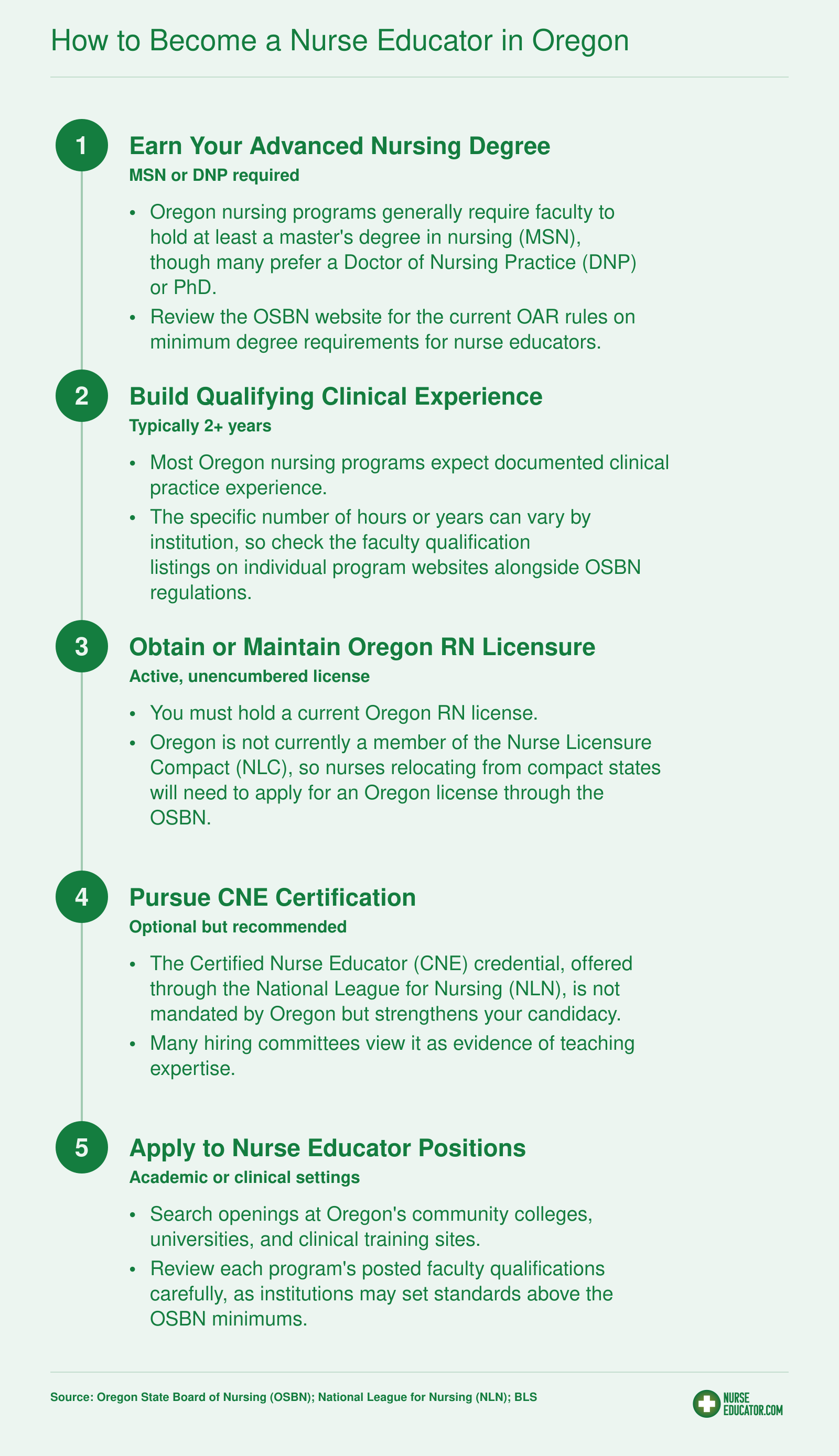
Moving from clinical practice to a teaching role takes deliberate planning. The pathway below outlines the major milestones Oregon nurses typically follow. Because individual nursing programs may interpret Oregon Administrative Rules (OAR) differently, always verify specific faculty qualification requirements directly with the institution and the Oregon State Board of Nursing (OSBN).
Nurse Educator Licensing and Certification in Oregon
Nurse educators in Oregon do not hold a separate state license for teaching. Instead, they maintain an active registered nurse (RN) license through the Oregon State Board of Nursing (OSBN) and meet faculty qualification standards set by that board. Certification, while not mandatory, can strengthen your credentials and align with employer preferences.
OSBN Requirements for Nursing Faculty
The OSBN requires nursing faculty in approved programs to hold at least a master's degree in nursing. Faculty must also demonstrate clinical competence in the areas they teach, which typically includes recent direct patient care experience or ongoing practice. While the OSBN does not prescribe a fixed number of continuing education hours solely for faculty, RN license renewal in Oregon involves meeting continuing competency requirements. Many schools expect faculty to stay current through professional development, and some may mandate additional coursework or workshops. The board's focus is on ensuring that nursing instructors possess the education and practice background needed to prepare safe, effective nurses.
The Certified Nurse Educator (CNE) Credential
The National League for Nursing (NLN) offers the Certified Nurse Educator (CNE) designation for academic nurse educators.1 It is a specialty credential, not a legal requirement in Oregon, but many employers list it as a preferred qualification. Eligibility can be met in one of two ways: - Graduate degree with nursing education content: A master's or doctorate in nursing that includes an emphasis in education, a post-master's certificate in nursing education, or at least nine graduate-level credit hours in nursing education.1 - Graduate degree plus teaching experience: A graduate degree in nursing combined with two years of full-time employment in an academic nursing program within the last five years.1
Candidates must meet eligibility at the time of application. The computer-based exam covers areas like facilitating learning, assessment and evaluation, and curriculum design. Official pass rates are not publicly confirmed.1 The CNE is valid for five years and requires renewal through 100 hours of continuing education, an active RN license, and an active nurse educator role.2 For a deeper look at the full pathway, including education and experience requirements, see our guide on how to become a nurse educator.
Clinical Educator vs. Academic Faculty Expectations
Nurse educators working in clinical settings, such as hospitals, staff development, or community health, face different credential expectations than those in academic nursing programs. A clinical educator often focuses on onboarding, competency validation, and in-service training. These roles may prioritize a nursing professional development certification (through ANPD) over the CNE, though the CNE is still recognized. If you are weighing the two main NLN certifications, our CNE vs. CNEcl certification comparison breaks down the differences. In Oregon nursing schools, OSBN rules apply: all faculty, including clinical instructors, must hold at least a master's in nursing. Academic institutions, however, are free to set higher internal standards.
Degree Level and Institution Type
Whether a master's is sufficient or a doctorate is expected often depends on the type of program. Oregon's community college nursing programs, which confer associate degrees, commonly hire MSN-prepared nurse educators as full-time faculty. In contrast, university-based prelicensure BSN programs and graduate nursing departments may prefer or require a doctoral degree (PhD or DNP) for tenure-track or lead faculty positions. Even where a doctorate is not mandatory, it can improve your competitiveness and open doors to leadership roles within nursing education.
Oregon Nurse Educator Salary and Job Outlook
How much do nursing instructors actually earn in Oregon, and how does pay compare across the state's metro areas?
Oregon stands above the national average for postsecondary nursing instructors and teachers. According to the most recent BLS wage data (May 2025), the Oregon state median annual wage for this occupation is $93,020, compared to the national median of $83,530.1 That roughly $9,500 gap means Oregon-based nurse educators enjoy a meaningful pay premium, even after factoring in the state's higher cost of living.
Oregon Wage Percentiles at a Glance
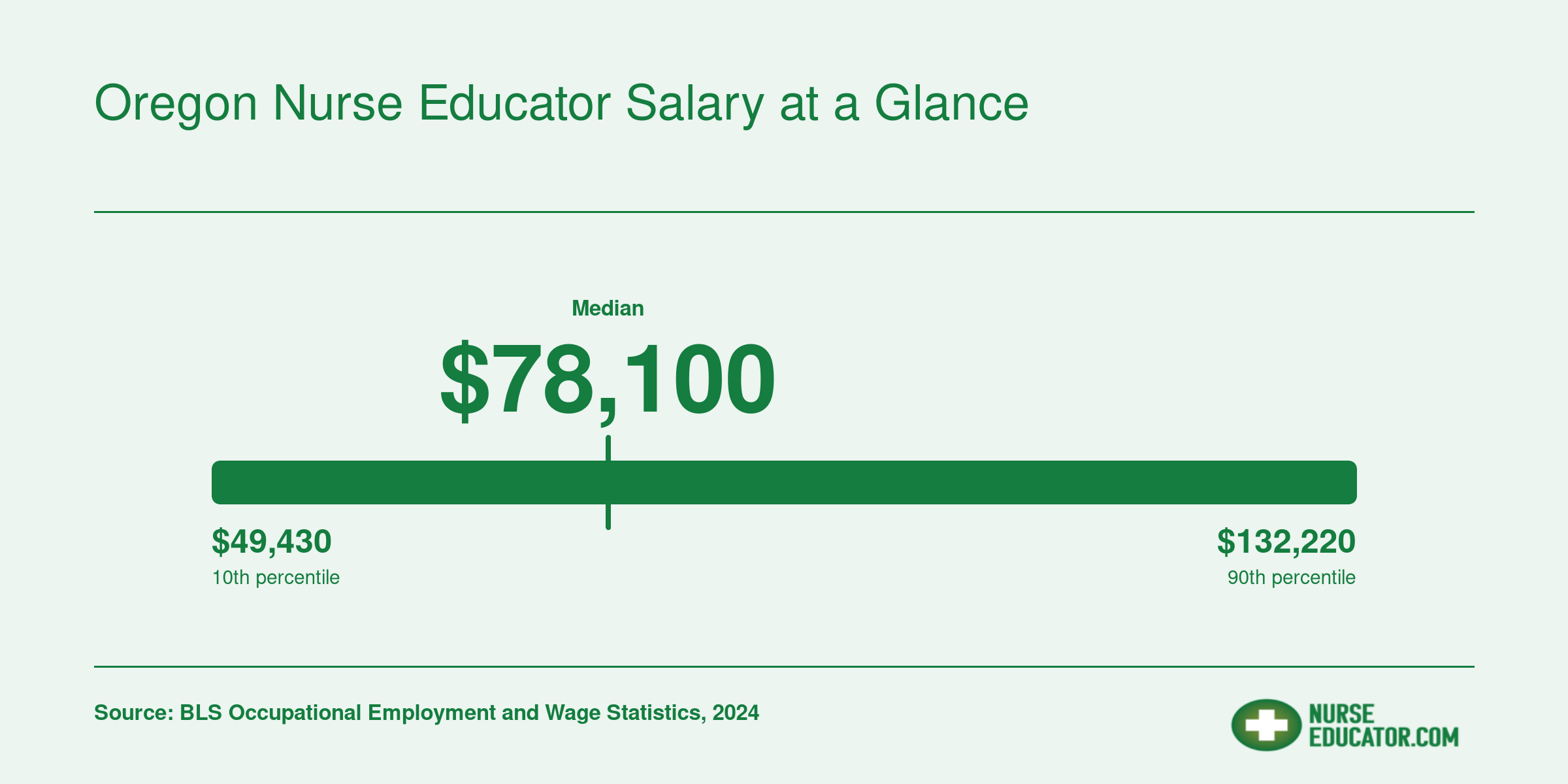
The full wage distribution for nursing instructors and teachers (postsecondary) in Oregon breaks down as follows:1
- 10th percentile: $59,890
- 25th percentile: $73,080
- Median (50th percentile): $93,020
- 75th percentile: $113,840
- 90th percentile: $141,640
Approximately 890 professionals held this role statewide in 2025. Every tier of the Oregon wage scale exceeds the corresponding national percentile, with the gap widening as you move up the pay ladder. For a broader comparison, the nurse educator salary by state breakdown can help you benchmark Oregon against other states.
Metro-Area Salary Differences
Location within Oregon matters. The Portland-Vancouver-Hillsboro MSA reported a median of $95,430, the highest in the state for this occupation, with wages reaching $145,980 at the 90th percentile.2 More than half of the state's nursing instructor positions (520 of 890) are concentrated in that metro area.
The Eugene-Springfield MSA posted a median of $86,790.2 While still above the national median, it trails the Portland metro by nearly $8,600 at the midpoint. The 90th percentile in Eugene-Springfield tops out at $129,440. Wage data specifically for the Salem MSA was not reported in the most recent BLS release.
Faculty Shortage and Job Outlook
Oregon faces the same nursing faculty shortage squeezing programs nationwide. With a relatively small pool of fewer than 900 postsecondary nursing instructors statewide, retirements among senior faculty create openings that are difficult to fill. Oregon's community colleges and smaller BSN programs in rural areas are particularly vulnerable. While a single state-level vacancy rate has not been published in recent workforce reports, nursing program leaders across Oregon have consistently pointed to unfilled faculty lines as a bottleneck limiting student enrollment and, by extension, the broader nursing pipeline.
Clinical Nurse Educators vs. Academic Faculty
Keep in mind that not every nurse educator role falls under the postsecondary teaching category tracked by the BLS. Clinical nurse educators working inside hospitals or health systems, handling staff development, orientation, and in-service training, are typically classified alongside registered nurses rather than postsecondary instructors. Their compensation follows RN wage scales, which can be higher or lower than academic faculty pay depending on employer, shift differentials, and experience. If you are weighing a hospital-based education role against a university appointment, compare the postsecondary instructor wages above with Oregon's RN wage data for a clearer picture.
Oregon Nurse Educator Salary at a Glance
Oregon-based nursing instructors and teachers at postsecondary institutions earn salaries that span a wide range depending on experience, institution type, and workload. The percentile breakdown below shows how pay is distributed across the state, with the national median for this occupation provided as a reference point.
Oregon Nurse Educator Scholarships and Financial Aid
Financial aid for nurse educator students means any combination of scholarships, loan programs, tuition reimbursement, and loan forgiveness that reduces the real cost of a graduate nursing education degree. Oregon nurses pursuing this path have several options worth exploring, though you will likely need to layer multiple sources together for meaningful coverage.
HRSA Nurse Faculty Loan Program
The federal Nurse Faculty Loan Program (NFLP), administered by HRSA, is one of the most valuable funding tools for aspiring nurse educators. Oregon Health & Science University participates in the NFLP, and eligible students enrolled in PhD, DNP, or Master of Nursing Education programs can borrow through the program at favorable terms.1 The standout benefit is that graduates who go on to teach full-time at an accredited school of nursing can have up to 85 percent of their loan balance canceled over four years of service.1 If you are already set on a teaching career, this program essentially converts most of your graduate borrowing into a grant. Students exploring affordable nurse educator DNP programs should factor NFLP eligibility into their cost calculations.
Oregon-Based Scholarships
The Oregon Nurses Foundation (ONF) offers a handful of awards, though most target prelicensure or BSN-level students. The ONF Centennial Education Scholarship ($5,000) is open to students in prelicensure and RN-to-BSN programs, with a May 1 deadline each year.2 The ONF Equity Scholarship ($5,000) is available to students in any Oregon State Board of Nursing-approved program, making it one of the few ONF awards a graduate student might access.2 Graduate-specific scholarship options through ONF remain limited.
OHSU's School of Nursing offers its own internal scholarships for the 2026-2027 academic year, with awards ranging from $1,000 to $12,000 for graduate students.1 OHSU also runs Rural Practice Service Programs that can cover one or more years of tuition and fees for students who commit to serving in underserved areas.1
The Oregon Student Assistance Commission administers dozens of scholarship programs, and several are designated for nursing students. Check their online portal each year, as eligibility criteria and award amounts shift.
Employer Tuition Reimbursement
Do not overlook your current employer. Major Oregon health systems, including OHSU, Providence, Kaiser Permanente Northwest, and Legacy Health, all offer some form of tuition assistance or reimbursement for employees pursuing advanced nursing degrees. Benefit structures vary by system and employment status, so talk with your HR department early. Even partial tuition reimbursement ($3,000 to $5,250 per year is a common range) adds up across a multi-year graduate program. If you are weighing program costs, our guide to affordable online nurse educator MSN programs can help you compare options nationwide.
Loan Forgiveness After Graduation
As of 2026, Oregon does not operate a state-level loan forgiveness program specifically for nurse educators.1 However, the federal Public Service Loan Forgiveness (PSLF) program applies to faculty employed full-time at nonprofit institutions, and most Oregon nursing schools fall into that category. After 120 qualifying monthly payments on an income-driven repayment plan, your remaining federal loan balance is forgiven. The federal Faculty Loan Repayment Program is another option, offering up to $40,000 in loan repayment for a two-year teaching commitment at eligible institutions.1
Layering these resources (NFLP borrowing during school, PSLF or the Faculty Loan Repayment Program after graduation, and employer reimbursement or scholarships along the way) can dramatically reduce the financial burden of becoming a nurse educator in Oregon.
Who Hires Nurse Educators in Oregon?
Academic teaching positions and clinical education roles may look very different on paper, but both draw from the same talent pool of experienced nurses ready to shape the next generation. Understanding where nurse educators work in Oregon can help you target the right employers and the right credential.
Academic Employers: Universities and Community Colleges
Oregon's universities and community colleges form the largest hiring category for nurse educators. OHSU School of Nursing is the state's flagship program and regularly recruits faculty for both its Portland campus and distance-accessible sites. Beyond OHSU, Oregon supports 17 or more community college nursing programs, including well-known options at Portland Community College, Lane Community College, Chemeketa Community College, and others spread across the state. Faculty retirement trends across these programs are creating steady openings. Nationally, nursing schools reported a 7.2 percent faculty vacancy rate during the 2025 to 2026 academic year, with nearly 29.7 percent of those positions unfilled for more than a year.1 The West region has historically posted some of the highest vacancy rates in the country (roughly 10 percent as recently as 2022), which suggests Oregon's community colleges and universities face similar or even more acute hiring pressure.2
Clinical and Health System Roles
Major Oregon health systems hire nurse educators for staff development, patient education, orientation programs, and quality improvement training. Providence Health and Services, Legacy Health, PeaceHealth, and Samaritan Health Services all maintain dedicated education departments. In these settings your title might be clinical nurse educator, professional development specialist, or nurse residency program lead. Hospital-based roles tend to require an MSN at minimum, though some prefer a doctorate for leadership-level education positions. Roles that involve nurse educating patients directly can blend clinical expertise with teaching in rewarding ways.
Simulation Labs and Emerging Roles
Simulation and skills lab settings represent a growing niche. Both academic programs and hospitals invest in high-fidelity simulation, and coordinators who can design scenarios and debrief learners are in demand. Newer roles are also appearing on job boards: telehealth education coordinators who train clinical staff on virtual care workflows, and continuing education program directors who oversee professional development requirements for large nursing teams. These positions blend curriculum design with technology skills, making them a strong fit for nurse educators comfortable with innovation.
Putting It Together
Whether you aim for a tenure-track faculty seat at OHSU, a teaching role at a community college, or a clinical educator position inside a hospital system, Oregon offers multiple pathways. The persistent faculty shortage across the state's nursing programs means nurse educator demand is unlikely to slow any time soon, giving well-prepared candidates real leverage in negotiations around salary, schedule, and workload.
In 2024, U.S. nursing schools turned away more than 80,000 qualified applicants, primarily due to insufficient faculty, according to the American Association of Colleges of Nursing. Oregon shares this urgent need for nurse educators to train the next generation of nurses and expand program capacity.
FAQ: Nurse Educator Programs for Oregon Students
These are some of the most common questions Oregon nurses ask when exploring a transition into nursing education. Answers draw on program details, salary data, and certification requirements covered throughout this guide.
Can I complete a nurse educator program fully online from Oregon?
Yes. Several accredited programs accept Oregon residents for fully online MSN or post-master's study in nursing education. Oregon participates in the NC-SARA agreement, which means most regionally accredited online programs can enroll Oregon students without additional state authorization. Some programs may require a brief on-campus immersion or practicum hours arranged locally, so confirm the clinical component before enrolling.
Does OHSU have an online nurse educator program?
Oregon Health & Science University (OHSU) does not currently offer a standalone online MSN in nursing education. OHSU's graduate nursing programs focus on clinical specialties and DNP pathways. Oregon nurses who want a dedicated nurse educator track typically look to nationally accredited online programs from institutions such as Western Governors University, Purdue University Global, or other CCNE or ACEN accredited schools that enroll Oregon residents.
What is the difference between an MSN and an MNE in nursing education?
An MSN (Master of Science in Nursing) in nursing education is a broad graduate nursing degree with an education concentration. An MNE (Master of Nursing Education) is a specialized degree built entirely around teaching, curriculum design, and educational theory. Both can qualify you for nurse educator roles, but the MNE curriculum is more narrowly focused on pedagogy, while the MSN may offer more flexibility to move between clinical and academic career paths later.
What degree do you need to be a nurse educator in Oregon?
Most Oregon employers require at least an MSN for academic nursing faculty positions. Community colleges sometimes hire candidates with an MSN, while universities increasingly prefer or require a DNP or PhD. For clinical teaching roles, an MSN with relevant clinical expertise is typically sufficient. Earning the CNE (Certified Nurse Educator) credential from the NLN can strengthen your candidacy regardless of degree level.
How much do nurse educators make in Oregon?
According to the Bureau of Labor Statistics, Oregon's mean annual wage for postsecondary nursing instructors and teachers was approximately $82,070 as of the most recent published data. Salaries vary by institution type, geographic area, and experience. Community college roles often pay differently than university positions, and those with doctoral preparation or the CNE credential may command higher compensation.
Are there post-master's nurse educator certificate programs available to Oregon residents?
Yes. If you already hold an MSN in a clinical specialty, several accredited schools offer online post-master's certificates in nursing education that Oregon residents can complete. These programs typically run 12 to 18 credits and cover curriculum development, instructional strategies, and assessment. Completing a certificate also helps you meet eligibility requirements for the NLN's CNE exam.
Do online nurse educator programs help arrange clinical placements in Oregon?
Policies vary by school. Some programs have established clinical partnerships in Oregon and will coordinate practicum placements at hospitals, community colleges, or simulation labs in the state. Others require students to identify their own preceptor and clinical site, then approve the arrangement. Before you enroll, ask the program's clinical placement coordinator specifically about support for Oregon-based students to avoid unexpected delays.
More Online Nurse Educator Programs for Oregon Students
Beyond our top-ranked picks, here are additional online nurse educator programs available to Oregon students. These schools offer flexible remote learning options and are open to out-of-state applicants. Each entry provides key details to help you compare your options.
- Nurse Educator
- Master of Science in Nursing (Nursing Education)
- Nursing Education Graduate Certificate
- Master of Science in Nursing Education
- Graduate Certificate in Nursing Education
- Nurse Educator
- Nurse Educator (Post Master's Certificate)
- Nursing Education Graduate Certificate
- Graduate Certificate in Teaching in Nursing
- Nursing Education
- Nurse Education in Academic and Practice Settings Graduate Certificate
- Master of Science in Nursing Education
- Nursing Education Graduate Certificate
- Master of Science in Nursing: Nurse Educator Specialization
- Nursing Education
- Doctor of Nursing Practice (Nursing Education)
- Graduate Certificate in Nursing Education
- Nurse Educator, M.S.N.
- Graduate Certificate in Nurse Educator