What you’ll learn in this article…
- Iowa offers three accredited MSN Nursing Education pathways through Allen College, Graceland University, and Clarke University.
- Most Iowa programs use a hybrid format combining online coursework with required on-site practicum hours.
- Published per-year graduate tuition across these programs ranges from roughly $11,000 to over $18,000.
- The CNE credential from the National League for Nursing strengthens your competitiveness for Iowa faculty roles.
Iowa's nursing workforce pipeline narrows at a critical point: the classroom. A persistent nurse educator shortage means the state's colleges cannot expand enrollment to meet rising demand for bedside nurses, and that gap starts with too few RNs entering advanced education tracks.
For nurses ready to transition into teaching, the pool of accredited MSN Nursing Education programs in Iowa is small: only two master's-level options and one post-master's certificate meet the Iowa Board of Nursing's standards for faculty preparation.
A program's accreditation, clinical hour requirements, and delivery format directly affect your eligibility to teach in Iowa nursing programs, so deliberate selection is a career necessity, not a convenience.
Best MSN in Nursing Education Programs in Iowa
Iowa's nurse educator landscape is compact but well suited for working RNs ready to move into teaching roles. The programs below span a full MSN, an accelerated MSN concentration, and a post-master's certificate, giving you options whether you need a complete graduate degree or a focused credential to complement one you already hold. All three institutions are private, so tuition is the same regardless of residency. Graduation rates listed are institution-wide figures, and net price reflects an institutional average after aid, not a program-specific cost.
- Program relevance to nursing education
- Institutional graduation and retention rates
- Tuition and net price affordability
- Delivery format flexibility
- Faculty qualifications and class size
- Independent program research
- Internal program database
- NCES-IPEDS federal institutional data — nces.ed.gov
- College Scorecard graduate earnings — collegescorecard.ed.gov
- #1
Mercy College of Health Sciences
Des Moines, IA · $27,000/yr
Best for: Nurses wanting small classes online
Mercy College of Health Sciences is a small, mission-driven institution in Des Moines with a 7:1 student-to-faculty ratio, one of the lowest you will find in the state. Its recently launched MSN in Nursing Education (first cohort started fall 2022) is fully online and accredited by CCNE, combining educational theory with a dedicated Nurse Educator Immersion course that emphasizes applied teaching practice. The college also conducts a holistic admissions review, which can benefit experienced nurses whose older transcripts may not reflect a 3.0 GPA. Out-of-state applicants should contact the nursing department early so the college can verify state authorization before enrollment.
View program
- 37-credit, 5-semester online program (asynchronous)
- CCNE accredited and approved by Iowa Board of Nursing
- Faculty hold doctoral degrees with clinical expertise
- Includes Nurse Educator Immersion applied teaching course
- Prepares graduates for the NLN Certified Nurse Educator exam
- Capstone project required for completion
- Holistic admissions review available for sub-3.0 GPAs
- Fall start only; full-time enrollment expected
- #2
Mount Mercy University
Cedar Rapids, IA · $20,000 – $25,000/yr
Best for: Career changers on an accelerated timeline
Mount Mercy University in Cedar Rapids brings more than 90 years of nursing education heritage to its MSN with a Nurse Education concentration. The 36-credit program uses a cohort model with five-week course blocks, allowing completion in as few as 16 months. Courses are delivered asynchronously online, and the program requires 200 clinical hours split across two Clinical Specialty courses. At a listed rate of $773 per credit (with a 10% discount for employer partners), Mount Mercy offers one of the more transparent pricing structures among Iowa's options. No GRE is required, and military benefits and employer reimbursement are accepted.
View program
- 36 credits; completable in as few as 16 months
- Asynchronous online classes in 5-week course blocks
- $773 per credit with 10% employer partner discount
- 200 clinical hours across two specialty courses
- Cohort-based model with full-time or part-time pacing
- No GRE required for admission
- Capstone project required
- Military benefits and employer reimbursement accepted
- #3
Clarke University
Dubuque, IA · $24,000/yr
Best for: MSN holders adding a teaching credential
Clarke University in Dubuque offers a focused, 12-credit Nursing Education Certificate designed for nurses who already hold a master's degree and want a direct path into collegiate teaching. The entirely online program can be completed in about one year and includes 250 clinical hours, giving graduates substantial supervised teaching experience. It also serves as an add-on track for students pursuing Clarke's Doctor of Nursing Practice. With a 9:1 student-to-faculty ratio, Clarke provides close mentorship throughout the certificate.
View program
- 12-credit, 4-course certificate completable in 1 year
- Fully asynchronous online delivery
- 250 clinical hours focused on collegiate-level teaching
- Prepares graduates for the Certified Nurse Educator exam
- Can be combined with Clarke's DNP program
- Financial aid available for certificate students
- Standalone option or stackable with doctoral studies
MSN Nurse Educator Programs in Iowa (Including RN-To-MSN)
If you're weighing how quickly you can move from bedside RN to classroom faculty against how much prior coursework you want to repeat, the MSN in Nursing Education is where that decision gets made. The MSN is the standard entry credential for nurse educators in Iowa, whether you plan to teach in an ADN program, a hospital-based staff development role, or a BSN faculty position.
What an Iowa MSN Nurse Educator Track Looks Like
Across Iowa programs, expect 33 to 45 credits completed in roughly 16 to 24 months, delivered online or in a hybrid format7. Coursework typically covers curriculum design, instructional strategies, learner assessment, and evaluation, layered on top of the advanced nursing core (theory, research, and role development). A supervised teaching practicum is built in, so you'll log real hours in a classroom, simulation lab, or clinical setting under a faculty preceptor before you graduate.
Specific Iowa options include:
- Mercy College of Health Sciences (Des Moines): CCNE-accredited MSN in Nursing Education; BSN required for entry; graduates are prepared to sit for the NLN Certified Nurse Educator (CNE) exam.1
- Briar Cliff University (Sioux City): 45-credit online MSN Nurse Educator completed in about 24 months.2
- Iowa State University: 36-credit online MSN Nurse Educator, roughly 16 months3, launching fall 20264.
- Northwestern College (Orange City): Online MSN in Nursing Education, about 24 months.5
- Allen College (Waterloo): Admits BSN-prepared RNs, or ADN RNs who also hold a non-nursing bachelor's degree, with a 3.0 minimum GPA.
Once you've earned the MSN and logged qualifying teaching experience, you're eligible to sit for the National League for Nursing's Certified Nurse Educator (CNE) exam1, the credential most Iowa employers recognize for academic faculty roles.
RN-to-MSN Bridge Pathways for ADN and Diploma Nurses
If you're an Iowa RN with an ADN or diploma and no BSN, you don't have to complete a separate bachelor's degree first. RN-to-MSN bridge programs let you fold BSN-level content (community health, leadership, evidence-based practice) into the front end of the MSN, then move directly into the nurse educator core. Plan on 24 to 36 months total, 1 to 2 years of RN work experience, and a minimum 3.0 GPA for admission8. It's the most efficient route from an associate degree to a faculty-ready credential. For a broader look at curriculum, practicum structure, and program formats nationally, see our guide to MSN nurse educator programs.
DNP & PHD Nurse Educator Programs in Iowa
Iowa’s doctoral nursing education paths split along a clear line: the practice-focused Doctor of Nursing Practice (DNP) for hands-on teaching roles, and the research-focused PhD for academic scholarship and theory development.
The Practice-Focused DNP Route
- Best fit: Clinical faculty, simulation instructors, community college educators, or BSN program coordinators.
- Focus: Translating evidence into teaching practice, curriculum design, and educational leadership.
- Clinical hours: 1,000 post-BSN clinical hours are embedded in the DNP curriculum.1
- Schools offering DNP programs in Iowa: Allen College, Briar Cliff University, Clarke University, Graceland University, Morningside University, Mount Mercy University, and the University of Iowa.1
The DNP with a nursing education emphasis prepares you to design and lead courses, mentor students in clinical settings, and shape the next generation of nurses. Because the degree centers on practice application rather than original research, it aligns well with roles that demand teaching excellence and program innovation.
The Research-Focused PhD Route
- Best fit: Tenure-track faculty, research-intensive university positions, and academic leadership.
- Focus: Theory development, original research, and the completion of a dissertation.
- Availability: The University of Iowa in Iowa City is home to the state’s sole PhD in Nursing program.2
A PhD in nursing education is a scholarly pursuit designed for those who want to generate new knowledge in nursing pedagogy, healthcare policy, or clinical education. Graduates often secure faculty roles at research universities where publishing and grant-funded investigatory work are central to career advancement.
Do You Need a Doctorate to Teach?
For the vast majority of nurse educator positions in Iowa, a master’s degree (MSN) meets the minimum requirement.3 A doctorate remains an optional, career-advancing step. Pursuing a DNP or PhD is most strategic when your goals include university-level faculty appointments, department chair positions, or contributing to the academic research community. If your aim is to teach in hospital-based programs or associate-degree nursing schools, an MSN often suffices. For broader exploration, a guide to DNP nurse educator programs offers a national perspective, and PhD in nursing education resources are also available.
Post-Master's Certificate in Nursing Education in Iowa
A post-master's certificate in nursing education is a short, focused graduate program that lets an already-MSN-prepared nurse add the nurse educator credential without earning a second master's degree.3 If you finished your MSN in a clinical specialty (family nurse practitioner, nurse leader, informatics, adult-gero) and now want to teach, this is the shortest academic route to get there.
Who it's designed for
The target student is an Iowa RN who already holds an MSN or higher in another nursing specialty and wants to move into a faculty role at a community college ADN program, a BSN program, or a hospital-based staff development department. Because your master's-level nursing science, research, and advanced pathophysiology coursework is already on your transcript, the certificate strips the curriculum down to what's actually new: teaching and learning theory, curriculum design, assessment and evaluation, and a supervised teaching practicum.
Length, credits, and practicum
- Credits: Roughly 12 to 18 credits1, depending on the school.
- Duration: About 12 months1 of part-time study is typical for working nurses.
- Practicum: Expect a supervised teaching practicum in the 90- to 250-hour clinical or teaching range2, completed in a classroom, lab, simulation, or clinical setting under an experienced faculty preceptor.
CNE exam eligibility
Completing a post-master's certificate in nursing education positions you to sit for the Certified Nurse Educator (CNE) exam through the National League for Nursing2, the credential most academic hiring committees look for on a faculty CV.
For a broader look at how these certificates work nationally, including delivery formats and cost ranges, explore our post master's certificate nursing education guide.
How to Choose the Right Nurse Educator Program in Iowa
Selecting the right nurse educator program is one of the most consequential decisions you will make in your transition from clinical practice to teaching. Iowa offers several pathways, and understanding what to prioritize can save you time, money, and frustration.
Start with accreditation. Any program you consider should hold accreditation from the Commission on Collegiate Nursing Education (CCNE) or the Accreditation Commission for Education in Nursing (ACEN). Accreditation ensures the curriculum meets national standards and that your degree will be recognized by employers and certification bodies alike.
Next, evaluate program format and flexibility. If you are still working bedside shifts or juggling family responsibilities, an online or hybrid program may be the best fit. Many Iowa nurses complete their MSN in nursing education through affordable online nurse educator MSN programs that allow asynchronous coursework paired with local clinical placements. Consider whether synchronous sessions fit your schedule and whether the program offers part-time enrollment.
Curriculum focus matters, too. Look for programs that include coursework in curriculum design, assessment strategies, simulation-based learning, and evidence-based teaching methods. Some programs also embed preparation for the Certified Nurse Educator (CNE) exam, which can strengthen your credentials significantly.
Clinical and practicum requirements deserve close attention. Programs vary widely in the number of practicum hours required and in how those hours are arranged. Iowa-based programs may partner with local community colleges, hospitals, or universities for teaching placements, giving you hands-on experience in the classroom before graduation.
Finally, think about your long-term goals. If you plan to teach at the university level or pursue research, you may want a program that offers a clear pathway to doctoral study. Exploring online nursing education degrees at the EdD or PhD level can help you map that trajectory early. Compare tuition costs, financial aid availability, graduation rates, and alumni outcomes. When possible, connect with current students or graduates from each program to get an honest picture of the experience.
Cost Comparison: Iowa Nurse Educator Programs
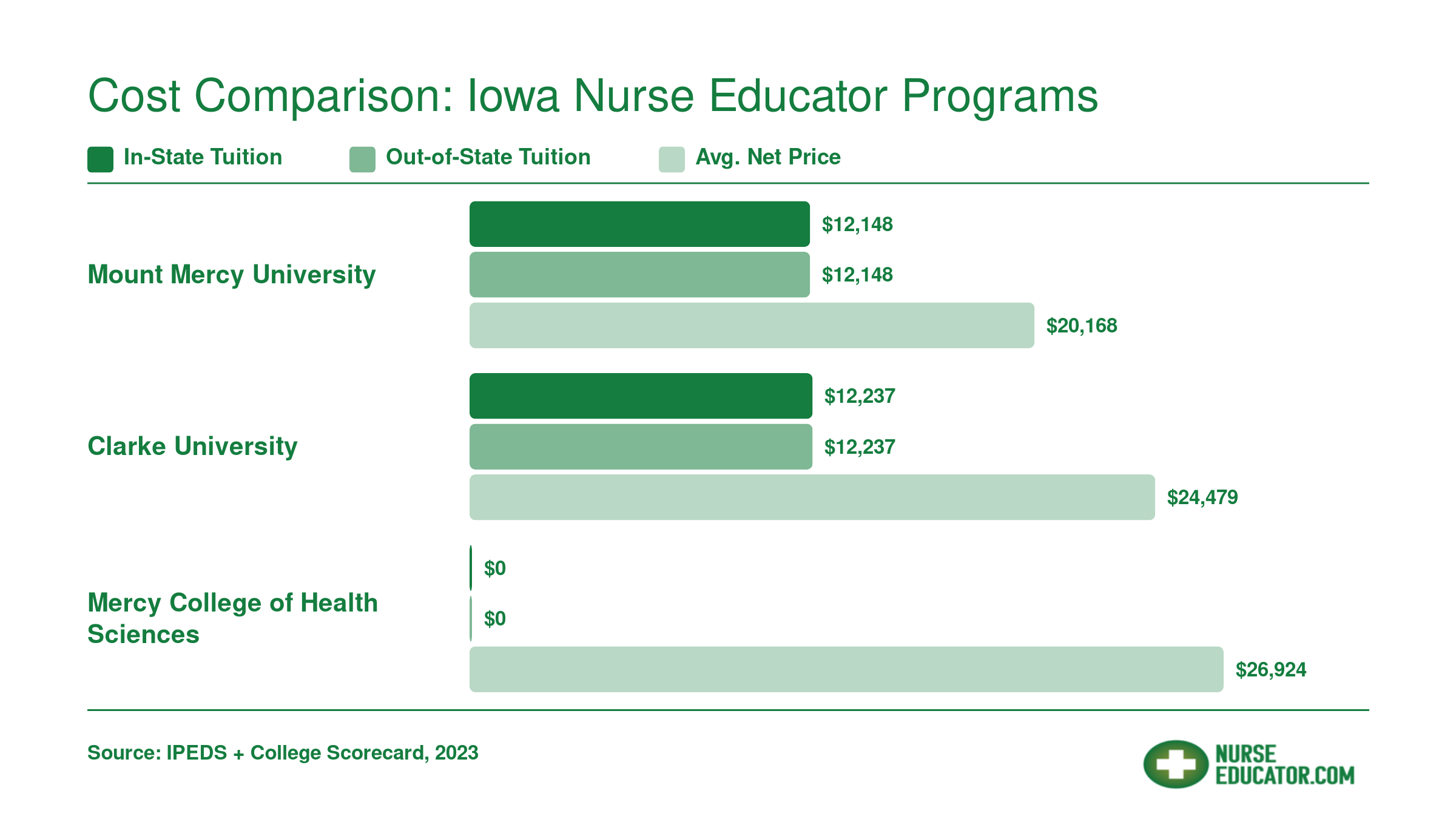
Tuition figures below reflect published per-year graduate tuition rates from IPEDS. The average net price shown is an institution-wide figure that includes all undergraduate and graduate students, so your actual out-of-pocket graduate costs may be higher or lower depending on financial aid. Program-level debt and repayment data are not yet available for these specific nursing education programs, but institution-wide median graduate debt ranges from $14,745 at Mercy College of Health Sciences to $26,717 at Clarke University, giving you a rough sense of what graduates borrow across all programs at each school.
Online Vs. On-Campus Nurse Educator Programs in Iowa
Most MSN Nursing Education programs in Iowa blend online coursework with required on-site practicum hours, so the choice is rarely a strict either/or. Among the three ranked Iowa programs, Allen College and Graceland University deliver their MSN Nursing Education tracks primarily online, while Clarke University offers its program in an on-campus format. Understanding the trade-offs helps you pick the structure that fits your clinical schedule and career goals.
Pros
- Online formats let working RNs complete asynchronous coursework around rotating shifts without relocating or reducing clinical hours.
- Studying online opens the door to competitive tuition from out-of-state programs, broadening your options beyond Iowa borders.
- Even online programs still require practicum hours, which you can often arrange at a local Iowa hospital or college nursing department.
- On-campus programs provide face-to-face mentorship with faculty who can observe and refine your classroom teaching skills in real time.
- In-person cohorts make it easier to network directly with Iowa healthcare employers, clinical partners, and fellow nurse educators.
- Campus-based teaching practicums give you hands-on experience in simulation labs, a growing priority for nursing program accreditors.
Cons
- Online learners may feel isolated from peers and faculty, which can make collaborative projects and mentorship harder to sustain.
- Asynchronous flexibility demands strong self-discipline; without a set class schedule, coursework can drift when shifts are demanding.
- On-campus programs require a predictable weekly schedule that is difficult to maintain alongside full-time bedside nursing.
- Commuting to a physical campus adds time and cost, especially for RNs in rural Iowa who may live hours from the nearest program.
- Some employers view fully online credentials with more scrutiny, so confirming your program holds CCNE or ACEN accreditation is essential.
Questions to Ask Yourself
How to Become a Nurse Educator in Iowa
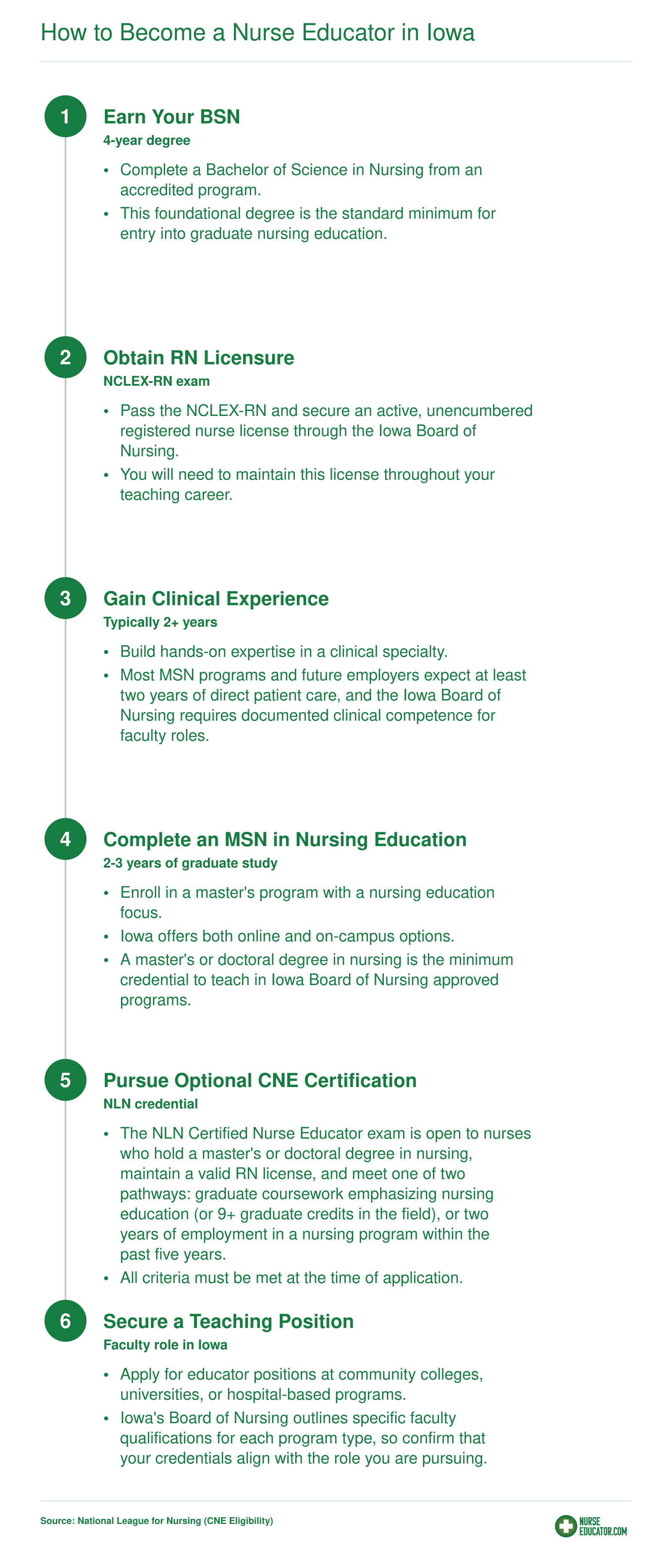
Transitioning from bedside nursing to the classroom follows a predictable path in Iowa. The Iowa Board of Nursing sets minimum faculty qualifications for approved nursing programs, and the National League for Nursing offers the Certified Nurse Educator (CNE) credential for those who want to formalize their teaching expertise. Here is the step-by-step progression most Iowa nurse educators follow.
Admission Requirements for Iowa Nurse Educator Programs
Admission requirements are the specific credentials, documents, and prerequisites a school uses to decide who gets a seat in its MSN Nursing Education program. In Iowa, these typically cluster around your BSN coursework, your RN license, your clinical track record, and a packet of supporting materials that demonstrate you are ready for graduate study. The exact thresholds vary by school, and they change often enough that you should always verify before you apply.
Where to Find Current Requirements
Start on the program pages themselves. Allen College in Waterloo and Morningside University in Sioux City (which absorbed the Briar Cliff nursing programs) both publish MSN Nursing Education admission criteria directly on their graduate nursing pages. Other Iowa institutions offering graduate nursing tracks post similar pages. These are the only places that reflect what the program is actually asking for this cycle.
If anything on the page is ambiguous, email or call the graduate admissions office. Ask specifically about minimum GPA, RN licensure (Iowa or compact state), required clinical hours or years of bedside experience, whether the GRE is waived, and what prerequisite courses (statistics, health assessment, research) they expect. For a broader look at how these requirements fit into the full career path, our guide on how to become a nurse educator walks you through each milestone.
Typical Components to Prepare
Most Iowa MSN Education applications ask for a similar packet. Build these in advance so you are not scrambling at the deadline:
- BSN from an accredited program: CCNE or ACEN accreditation is the standard. Verify your undergraduate school's status on the CCNE or ACEN site.
- Active, unencumbered RN license: Usually Iowa or a compact state.
- Minimum GPA: Commonly 3.0 on a 4.0 scale, sometimes higher for the nursing prefix coursework.
- Clinical experience: Often one to two years of RN practice, though some programs admit new graduates.
- Application materials: Personal statement or goal essay, two or three letters of recommendation, current resume or CV, and official transcripts.
Additional Guidance
The Iowa Nurses Association and the American Association of Colleges of Nursing (AACN) both publish resources on graduate application strategy and the nurse educator role. They are useful supplements when you are deciding which program fits your career plan and how to frame your application narrative. If you are also comparing options nationally, you may want to review the best online MSN nurse educator programs to see how Iowa schools stack up against programs in other states.
Nurse Educator Salary and Job Outlook in Iowa
If you are weighing a move from bedside care into the classroom, Iowa's salary data and workforce trends offer encouraging signals. As of May 2023, postsecondary nursing instructors and teachers in Iowa earned a mean annual wage of $79,550 (roughly $38.25 per hour), compared to a mean annual wage of $72,380 for registered nurses statewide.1 That roughly $7,000 premium reflects the advanced education and specialized skill set that nurse educators bring to the table.
To put Iowa's RN pay scale in fuller context, registered nurses at the 25th percentile earned about $63,780, while those at the 75th percentile brought home $82,320. Top earners at the 90th percentile reached $93,710.1 Nurse educator salaries sit comfortably in the upper half of that range, and many faculty members supplement their base pay with grants, consulting, or summer clinical work.
Iowa employed approximately 1,020 postsecondary nursing instructors as of May 2023, alongside 36,570 registered nurses.2 Although that ratio might seem small, a well-documented faculty shortage is keeping demand strong. Competitive clinical wages, an aging faculty cohort, and a limited pipeline into graduate education all constrain the supply of qualified educators.2 These pressures mean that RNs who earn an MSN or DNP with an education focus are stepping into a market where institutions genuinely need them.
Nationally, the picture is just as favorable. Across the country, nurse educator demand continues to outpace supply, and Iowa mirrors that trend. For nurses who want to explore the financial side of graduate school before committing, looking into affordable nurse educator DNP programs can help you plan a cost-effective path to the classroom. The bottom line: Iowa offers a competitive salary bump, steady employment, and a workforce landscape that rewards educators willing to step up and teach the next generation of nurses.
In 2024, U.S. nursing schools turned away more than 80,000 qualified applicants, primarily because there were not enough faculty members to teach them. This shortage creates strong demand for nursing educators in Iowa and nationwide, making it an opportune time to enter the field.
Frequently Asked Questions About Nurse Educator Programs in Iowa
Below are the questions nurses ask most often when exploring nurse educator programs in Iowa. Each answer is designed to give you a clear, concise starting point so you can make confident decisions about your education and career path.