
What you’ll learn in this article…
- Most online MSN nurse educator programs require 36 to 48 credits, while EdD programs typically add 54 to 66 credits beyond the MSN.
- Per-credit tuition ranges from under $400 at public universities to over $1,500 at private institutions, making program comparison essential.
- Over 80,000 qualified nursing applicants were turned away in 2024, and the national faculty vacancy rate reached 7.2% in 2025.
- CNE certification from the National League for Nursing strengthens hiring prospects and validates teaching expertise beyond a graduate degree alone.
Online Nursing Education Degrees: Your Path to Teaching the Next Generation of Nurses
If you're a registered nurse ready to move from the bedside to the classroom, you're in the right place. This guide walks you through every step of earning an online nurse educator degree, from choosing between an MSN and a doctorate to comparing costs, admission requirements, and certification options. You'll find side-by-side program breakdowns, salary data by state and setting, CNE exam prep guidance, and practical advice on financial aid. Whether you're just exploring the idea or narrowing down your final program list, the sections below give you the structured, evidence-based information you need to make a confident decision. With nurse educators in high demand nationwide, there has never been a better time to invest in this career path.
What Is a Nurse Educator Degree?
A master's with an education concentration versus a terminal doctorate: that's the first decision that shapes a nurse educator's career. Both paths prepare you to teach nursing, but they lead to different roles, institutions, and long-term opportunities. Understanding the degree landscape upfront helps you pick a route that matches your ambition, timeline, and the kind of classroom you want to stand in.
The Nurse Educator's Role
Nurse educators are not confined to one setting. Some teach in academic settings, leading lectures, running simulation labs, and mentoring students through clinical rotations. Others work as clinical nurse educators at the bedside, directly guiding hands-on skills in hospitals or clinics. A third branch focuses on staff development inside healthcare organizations, designing orientation programs and continuing education for practicing nurses. Each of these roles draws on advanced knowledge of teaching methods, curriculum design, and assessment, plus deep clinical experience.
Three Degree Levels for Nurse Educators
The credential ladder has three primary rungs, and they suit different starting points and end goals. An MSN in nursing education is the most common entry point. It is built for BSN-prepared RNs who want to move into teaching roles in associate or bachelor's degree programs or lead clinical education. A post-master's certificate in nursing education offers a shorter bridge for nurses who already hold a master's (say, an MSN in administration or an acute care specialty) and want to redirect their career toward education without repeating a full degree.
The doctoral tier splits into two main paths: the EdD in nursing education emphasizes practice and leadership, preparing graduates for high-level academic administration, curriculum innovation, and executive roles in education. The PhD in nursing education centers on research and theory, and is the typical route for those pursuing tenure-track faculty positions at research universities. Many universities now list a doctorate as the preferred or required credential for full-time faculty, making the terminal degree the ceiling for career advancement.
The CNE Certification Factor
While the Certified Nurse Educator (CNE) credential from the National League for Nursing is not a legal requirement to teach, it has become a widely recognized signal of competence. If you are weighing the standard CNE against the clinical version, a detailed CNE vs CNEcl certification comparison can help you decide. Many employers expect new faculty to obtain CNE certification within a few years of hire, and some MSN and doctoral programs align their coursework directly with the CNE exam blueprint. Choosing a program that builds in CNE preparation can save time and boost your resume before you ever step into the classroom.
So, What Degree Do You Actually Need?
The minimum credential to begin teaching nursing is typically an MSN with a nursing education focus or a post-master's certificate in nursing education. Community college programs and hospital education departments still hire MSN-prepared educators fairly often. However, if your sights are set on a university faculty position, particularly a tenure-track role, a doctorate is rapidly becoming the standard. Online MSN and doctoral programs make it realistic to earn the required degree while maintaining your clinical job, and many nurses start with the master's and pursue the doctorate later as their career goals evolve.
MSN Nurse Educator Programs: Curriculum, Credits, and What to Expect
An online MSN in Nursing Education gives you the advanced skills to design curricula, evaluate students, and lead the next generation of nurses, all while maintaining your current nursing role.
What You'll Study: Core Curriculum and Credit Range
Most MSN nurse educator programs require between 30 and 48 credits, depending on whether you enter with a BSN or through an RN-to-MSN bridge. For example, Thomas Edison State University's MSN requires 30 credits1, Western Governors University and Houston Christian University require 3623, and UNC Charlotte requires 39.4 Bridge programs like Spring Arbor University's RN-to-MSN may extend to 71 credits.5 The curriculum emphasizes four pillars:
- Curriculum Design and Evaluation: Building program structures and measuring student outcomes.
- Assessment Strategies: Developing valid and reliable exams, clinical evaluations, and rubrics.
- Instructional Technology: Integrating simulation, online platforms, and multimedia into teaching.
- Evidence-Based Teaching: Applying research to classroom and clinical instruction.
Practicum Hours: Bridging Theory and Practice
Every program includes a practicum component, typically ranging from 225 to 540 hours. UNC Charlotte splits its 360 hours into 180 clinical and 180 teaching hours4, while Houston Christian University requires 540 hours (200 clinical and the remainder focused on teaching).3 Spring Arbor University's RN-to-MSN incorporates 225 practicum hours.5 Students usually arrange these experiences at local hospitals, community colleges, or university nursing programs, making the online format viable regardless of geography. You'll shadow experienced nurse educators and gradually take on teaching responsibilities under supervision. If you're exploring the benefits of online nurse educator programs, this flexibility is one of the most significant advantages.
Program Length: Full-Time vs. Part-Time Paths
Most online MSN nurse educator programs are designed for working nurses and can be completed in two years full-time or three years part-time. Accelerated and competency-based options at schools like Western Governors University allow you to move faster if you can dedicate more time. Bridge programs, which also cover BSN content, may take up to four years part-time. For nurses comparing costs across programs, our guide to affordable online nurse educator MSN programs can help narrow the search.
Alignment with NLN Competencies and CNE Exam Preparation
Programs are built around the National League for Nursing (NLN) Nurse Educator Core Competencies, including facilitating learning, learner development, assessment, and curriculum design. While not all programs explicitly market CNE exam preparation, the coursework naturally aligns with the topics tested. You'll learn to foster critical thinking, manage diverse learning environments, and engage in scholarship, skills that directly support the Certified Nurse Educator credential. Keep in mind that the CNE exam also requires practice-based knowledge, so pairing your degree with a few years of teaching experience is the strongest path to certification. Curious about how candidates perform? Check out current CNE exam pass rate data to set realistic expectations.
Explore By State
- Alabama
- Alaska
- Arizona
- Arkansas
- California
- Colorado
- Connecticut
- Delaware
- Florida
- Georgia
- Hawaii
- Idaho
- Illinois
- Indiana
- Iowa
- Kansas
- Kentucky
- Louisiana
- Maine
- Maryland
- Massachusetts
- Michigan
- Minnesota
- Mississippi
- Missouri
- Montana
- Nebraska
- Nevada
- New Hampshire
- New Jersey
- New Mexico
- New York
- North Carolina
- North Dakota
- Ohio
- Oklahoma
- Oregon
- Pennsylvania
- Rhode Island
- South Carolina
- South Dakota
- Tennessee
- Texas
- Utah
- Vermont
- Virginia
- Washington
- Washington DC
- West Virginia
- Wisconsin
- Wyoming
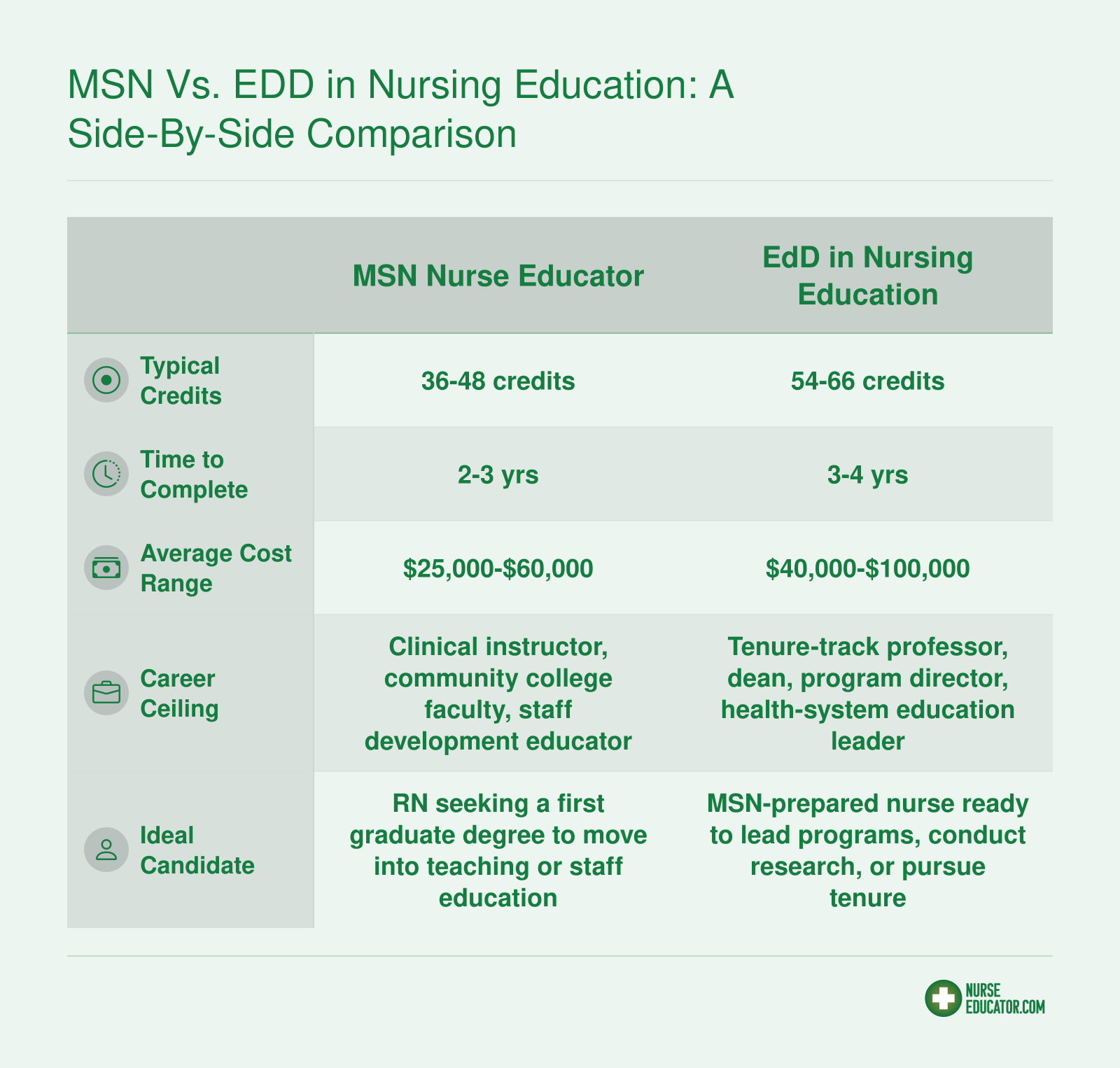
MSN Vs. EDD in Nursing Education: A Side-By-Side Comparison
Choosing between an MSN and an EdD in nursing education comes down to where you want your career to go. An MSN prepares you for clinical instruction and community college teaching, while an EdD positions you for tenure-track faculty appointments, program director roles, and system-level leadership. Here is how the two degrees stack up across the attributes that matter most.
EDD and Doctoral Programs in Nursing Education
Most EdD programs in nursing education require 54 to 66 credits beyond the MSN, making them a substantial but achievable commitment for working nurses.1 Understanding what that investment looks like, and what it returns, is essential before you apply.
EdD vs. PhD: Why the Distinction Matters for Educators
The EdD and the PhD both carry doctoral weight, but they serve different purposes. A PhD in nursing is research-focused, oriented toward generating new scientific knowledge and building an academic research career. If you're comparing options at the doctoral level, you may also want to explore affordable online nurse educator PhD programs alongside EdD offerings. An EdD, by contrast, is practice-focused: the degree is built around applying research to real-world teaching, curriculum design, and educational leadership. For nurses whose goal is to teach, lead academic programs, or shape how health systems train their staff, the EdD is the more practical and direct path. Most EdD programs culminate in a capstone project or applied dissertation rather than a traditional multi-study research thesis.
The Program Landscape
Online EdD programs in nursing education are widely available and vary considerably in structure and cost. A few representative options:
- American College of Education: A fully online Doctor of Education in Nursing Education, 64 credits, completable in 36 months at roughly $306 per credit. Total program cost comes to approximately $24,810, making it one of the most affordable doctoral options available.2
- University of St. Augustine for Health Sciences: An online EdD with a specialization in Nurse Educator, designed as a 48-month program. Format is online with details available directly from the institution.3
- Herzing University: Offers a Doctor of Nursing Education (DNE) delivered fully online, with an applied focus on nursing faculty development.4
Across the field, total program costs generally fall between $30,000 and $60,000, though selective private universities can push that higher.1 Nearly all programs require an MSN as the entry credential and a minimum undergraduate GPA of 3.0.
Career Payoff and ROI
The financial and professional case for doctoral preparation is real. Doctoral-credentialed nurse educators qualify for tenure-track faculty positions, program director and department chair roles, and health-system education leadership that MSN-prepared educators often cannot access. This is particularly important given the ongoing nursing faculty shortage, which has created strong demand for doctorally prepared educators. Salaries at the doctoral level are measurably higher across both academic and clinical settings, and you can review highest paid nurse educator roles to see how compensation scales with credentials.
Given the range between a $24,000 program and a $90,000+ one, the ROI analysis matters. A lower-cost, fully online EdD from an accredited institution can deliver the same credential doors as a more expensive program. Before committing, compare per-credit costs, residency requirements, and the specific capstone or dissertation format, since those details shape both your experience and the credential's reception in hiring.
Questions to Ask Yourself
Online Vs. On-Campus Nurse Educator Programs
Choosing between online and on-campus formats is one of the first decisions you will face when pursuing a nurse educator degree. Both paths lead to the same credential, and both can prepare you well for a teaching career. The right fit depends on your work schedule, location, learning style, and professional goals.
Pros
- Online programs let you keep working full-time in clinical practice while you earn your degree on your own schedule.
- Geography stops being a barrier: you can enroll in a top CCNE or ACEN accredited program in another state without relocating.
- Asynchronous coursework means you can log in after a 12 hour shift instead of commuting to a classroom on someone else's timetable.
- Total cost is often lower online because you avoid campus fees, parking, and relocation expenses, and many schools charge a flat tuition rate regardless of residency.
- CCNE and ACEN accredited online degrees carry the same professional weight as on-campus degrees, and transcripts do not distinguish the delivery format.
Cons
- On-campus students benefit from spontaneous, in-person mentorship with faculty who can guide teaching practice and career development in real time.
- Built-in networking through cohort experiences, campus events, and faculty introductions can open doors that are harder to replicate in a virtual setting.
- Structured practicum placements are typically arranged by the institution for on-campus students, while online learners must identify and coordinate their own local clinical or teaching sites.
- Research opportunities, lab access, and funded assistantships are more readily available to students who are physically present on campus.
- Even fully online programs require supervised practicum hours, so you will still need to secure a placement near your home, which can be challenging in rural or underserved areas.
Nurse Educator Program Costs and Financial Aid
Nurse educator program pricing varies more than almost any other graduate nursing pathway, with per-credit tuition swinging from under $400 at public in-state universities to over $1,500 at private institutions. Because totals depend on credit load, fees, clinical placement charges, and residency status, the only reliable cost figure is the one your target program's bursar confirms in writing.
What MSN and EdD Programs Typically Cost
MSN nurse educator programs generally run 36 to 48 credits. At public universities charging in-state residents, total tuition often lands in the $15,000 to $30,000 range. Out-of-state and private MSN programs frequently total $35,000 to $65,000. EdD and PhD programs in nursing education usually require 54 to 66 credits and run longer, pushing totals from roughly $40,000 at public institutions to well over $90,000 at private ones. For side-by-side comparisons, check our roundup of affordable nurse educator DNP programs.
Published sticker prices rarely tell the full story. Expect additional charges for technology fees, simulation lab access, clinical practicum coordination, textbooks, CNE exam prep materials, and graduation fees. Before you commit, request a line-item cost of attendance from each program's financial aid office and confirm whether the per-credit rate is locked for the duration of your enrollment or subject to annual increases.
Loan Forgiveness and Federal Aid
The HRSA Nurse Faculty Loan Program (NFLP) remains the most generous federal option for graduate students committed to teaching. Borrowers who complete the required full-time faculty service after graduation can have a substantial portion of their loan canceled. The ongoing nursing faculty shortage has kept programs like NFLP well funded, but terms, cancellation percentages, and participating schools change, so verify current guidance directly at hrsa.gov before counting on it. Public Service Loan Forgiveness (PSLF) is another route if you teach at a qualifying nonprofit or public institution.
Scholarships Worth Pursuing
Three professional organizations maintain robust scholarship pipelines specifically for aspiring and current nurse educators:
- National League for Nursing (NLN): Funds dissertation research, doctoral study, and faculty development through multiple named awards listed on its scholarships page.
- American Association of Colleges of Nursing (AACN): Partners with corporate sponsors to fund graduate study, with several awards targeted at future faculty.
- Sigma Theta Tau International: Offers research grants and education-focused scholarships open to members pursuing master's and doctoral work.
For broader cost benchmarking, BLS.gov and the National Center for Education Statistics publish trend data on graduate tuition and nursing faculty earnings, but treat those numbers as context, not quotes. Always confirm the actual figure with the school you plan to attend.
Admission Requirements and Bridge Pathways
Standard MSN Admission Requirements
Most MSN nurse educator programs look for a BSN from an accredited program, a current unencumbered RN license, and a minimum undergraduate GPA, often 3.0 on a 4.0 scale, though some programs accept lower GPAs with conditional admission or a strong professional background. Clinical experience expectations are common: many schools require one to two years of full-time RN practice, with preference for recent bedside or teaching-adjacent roles. Other typical requirements include official transcripts, a personal statement describing your interest in nursing education, and two or three professional references. Programs may also ask for a current CPR certification and evidence of immunizations. Some schools have waived standardized test requirements, but if GRE or MAT scores are needed, they must meet school-specific thresholds. Always verify specifics directly on the program website, as requirements vary.
ADN-to-MSN Bridge Pathways
If you hold an Associate Degree in Nursing (ADN), an RN-to-MSN bridge track can shorten your path into nursing education. These programs combine BSN-level bridge courses with graduate MSN coursework, allowing you to earn both degrees efficiently. Search for "RN-to-MSN" on university nursing school pages to find options with a nurse educator concentration. Some programs admit ADN-prepared nurses directly, while others require completion of general education prerequisites or a certain number of bridge credits before graduate work begins. Bridge structures vary widely; for example, you might take 12 to 18 credits of upper-division BSN courses (often delivered online) before moving into the MSN core. Contact the admissions office for detailed information on credit requirements, course sequencing, and how many credits will apply toward the MSN. This direct communication can also clarify financial aid eligibility and any state-specific licensure nuances.
Post-Master's Certificate in Nursing Education
For nurses who already hold an MSN in another specialty, a certificate in nursing education is a focused route into faculty roles. These certificates typically require 12 to 18 credits and can be completed in one to two years of part-time study, often fully online. Programs focus on curriculum design, assessment methods, and teaching practica without repeating core MSN content. However, program availability and structure change, so verify current details and accreditation status before applying.
Confirming Program Accreditation
Accreditation matters for financial aid, certification, and hiring. Use the CCNE (Commission on Collegiate Nursing Education) or NLN (National League for Nursing) searchable directories to verify that any program you consider is accredited for nursing education. If you are weighing where to study, our overview of the best states for nurse educator programs can help you compare options. This verification step is especially important for post-master's certificates and online programs, where state authorization may also influence eligibility.
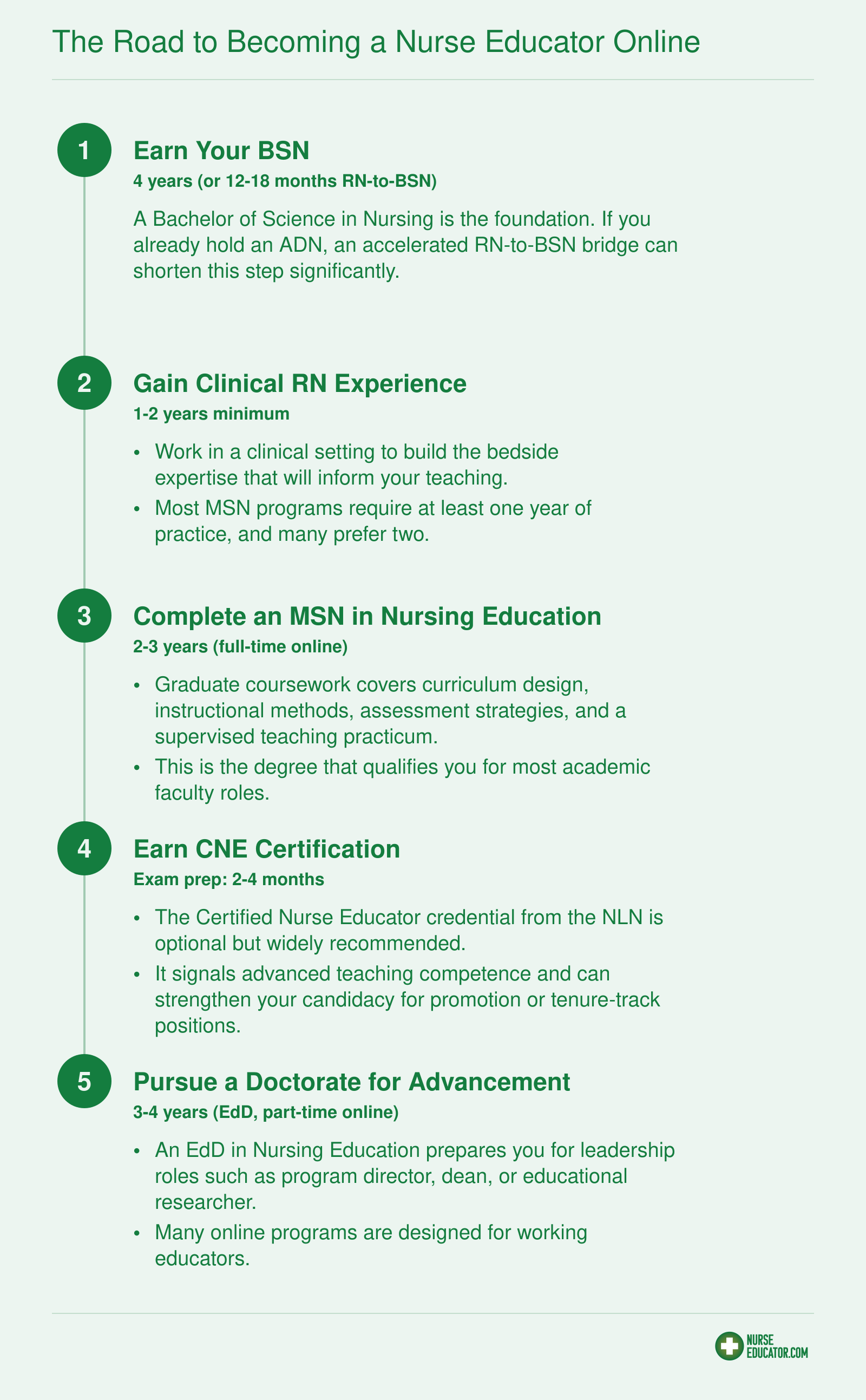
The Road to Becoming a Nurse Educator Online
Most nurse educators follow a clear credentialing ladder. Whether you complete every step online or blend formats, the progression below outlines what to expect and roughly how long each stage takes.
According to AACN, in 2024, over 80,000 qualified nursing school applicants were turned away, while the national faculty vacancy rate stood at 7.2% in 2025. Without enough nurse educators, programs can't expand to meet growing healthcare demands.
Nurse Educator Salary by State, Setting, and Degree Level
Salary varies significantly depending on whether you teach in academia or work as a clinical educator inside a hospital system, and understanding that gap is essential before you commit to a degree path.
National Salary Baseline for Academic Nurse Educators
According to 2023 Bureau of Labor Statistics data for Nursing Instructors and Teachers, Postsecondary (SOC 25-1072), the national median annual wage sits at $80,780.1 The national mean is slightly higher at $86,530, pulled upward by well-compensated faculty positions at research universities and medical centers. The spread across the full distribution is wide: the bottom tenth percentile earns around $49,120, while the top tenth percentile reaches $130,320. That upper range is typically occupied by full professors, department chairs, and educators who carry doctoral preparation into research-intensive roles.
For context, the national median for registered nurses overall was $86,070 in 2023, meaning the typical academic nurse educator earns modestly less than the typical bedside RN.3 That gap is even more pronounced compared to nurse practitioners, whose earnings often exceed six figures. The salary trade-off is a documented barrier to faculty recruitment, and nursing schools across the country feel the nurse educator demand.
Top-Paying States for Nursing Instructors
Geography matters a great deal. Among the highest-paying states based on 2023 BLS data:2
- District of Columbia: median wages in the $103,780 to $111,130 range
- Oregon: median wages in the $99,000 to $109,110 range
- New York: median annual wage of $102,980
- Hawaii: median annual wage of $102,180
- California: median annual wage of $99,010
- Alaska: median annual wage of $92,050
- Maryland: median wages in the $80,990 to $92,980 range
- Connecticut: median wages in the $81,490 to $101,760 range
These figures reflect state-level data from BLS and should not be treated as guarantees for any individual employer or institution.
Academic vs. Clinical Nurse Educator Roles
Not every nurse educator works in a classroom. Hospital-based clinical educators, sometimes called staff development specialists or clinical education coordinators, typically earn salaries closer to experienced staff RN pay scales. Industry salary surveys suggest hospital-based educators often land in a range comparable to or slightly above the national RN median, though individual institution, region, and years of experience all shift the number considerably. You can explore the distinctions in more detail in our comparison of the academic vs clinical nurse educator career paths.
Academic faculty salaries, by contrast, are strongly influenced by rank (lecturer, assistant professor, associate professor, full professor) and by whether the institution is a community college, regional university, or research-intensive school. Doctoral preparation tends to open the door to tenure-track positions, which carry higher base pay, more advancement potential, and in some cases research stipends.
The Real ROI: Beyond the Paycheck
The salary gap compared to clinical practice is real, but framing the decision purely around wage misses several concrete benefits. Full-time academic positions at public colleges and universities frequently qualify for Public Service Loan Forgiveness, which can be worth tens of thousands of dollars for nurses carrying graduate school debt. Academic calendars offer schedule predictability that shift work rarely provides. And national surveys consistently show nursing faculty reporting high levels of professional satisfaction tied to mentorship, intellectual engagement, and the impact of shaping future nurses.
For many RNs, the move into education is not a lateral pay shift but a deliberate life-stage decision, and the financial picture looks different once loan forgiveness timelines and retirement benefits enter the calculation.
CNE Certification: Exam Prep, Pass Rates, and Program Alignment
Earning a nurse educator position and excelling in one are two different achievements. The Certified Nurse Educator (CNE) credential, offered through the National League for Nursing, bridges that gap by formally validating your teaching expertise in a way that a degree alone cannot. Job postings increasingly list CNE as preferred or outright required, making it a meaningful credential to plan for from the moment you choose a graduate program.
What the CNE Credential Involves
The CNE is a voluntary, competency-based certification grounded in the NLN's framework for academic nurse educator practice.1 The exam covers domains such as facilitating learning, designing curriculum, evaluating learning outcomes, pursuing scholarship, and functioning within the broader educational environment. Each domain carries a weighted portion of the exam, and the NLN publishes a detailed test plan that maps directly to those competencies. Understanding the qualities of a good nurse educator the NLN emphasizes can help you anticipate what the exam expects.
Eligibility requires one of two pathways: an MSN with a focus in nursing education plus documented teaching experience, or a doctoral degree in nursing. If you are mid-way through an MSN program, this means certification typically comes after graduation and after accumulating some classroom hours, not immediately upon degree completion.
Pass Rates and the Transparency Gap
According to NLN certification statistics, the aggregate CNE pass rate in 2025 was approximately 74 percent, with around 1,376 exam registrations recorded that year and roughly 7,227 nurses currently holding the credential nationwide.2 Those are national, aggregate figures. What the NLN does not publish, and what most programs do not voluntarily release, is how graduates of any specific MSN program perform on the CNE exam. That is a real transparency gap.
Before enrolling, ask programs directly: Does your curriculum map to the NLN CNE test blueprint? Do you offer a CNE prep course or review resources for graduates? Some programs build test-plan alignment into their nursing education courses explicitly; others do not address it at all.
Choosing a Program With CNE in Mind
If CNE certification is part of your career plan, look for programs that frame their nursing education coursework around the NLN competency domains rather than treating them as incidental. Ask whether faculty hold CNE credentials themselves, which often signals that the program culture takes the certification seriously. A program that cannot answer basic questions about exam alignment is one to scrutinize more carefully before committing tuition dollars.
How to Choose the Right Nurse Educator Program
Choosing a nurse educator program means picking the specific MSN, post-master's certificate, or doctoral track that will prepare you to teach nursing in academic or clinical settings. The right fit depends on five concrete criteria you can evaluate before you ever fill out an application.
Five Criteria That Actually Matter
- Accreditation: The program must hold CCNE (Commission on Collegiate Nursing Education) or ACEN (Accreditation Commission for Education in Nursing) accreditation. This is non-negotiable. Graduates of unaccredited programs may be ineligible to sit for the CNE exam and are often screened out of tenure-track and community college faculty searches.
- CNE exam alignment: Ask whether the curriculum maps to the NLN's Certified Nurse Educator test blueprint, covering the eight core competencies. Programs built around these competencies set you up to certify within a year of graduation.
- Practicum flexibility and placement support: Find out whether the school helps you secure teaching practicum sites in your area, or whether you are on your own. Working RNs in rural areas especially need a program that supports remote placements.
- Total cost and aid: Compare sticker price, per-credit tuition, fees, and the availability of HRSA Nurse Faculty Loan Program funds, employer tuition reimbursement, and institutional scholarships.
- Format and scheduling: Decide whether you need fully asynchronous coursework, a cohort model with set deadlines, or a part-time pace that stretches the degree across three or four years.
Ask for the Data
Before committing, request program-specific numbers from each admissions office: graduation rates, average time to degree, CNE first-attempt pass rates among recent alumni, and a list of employer partners or hiring outcomes. Reputable programs share these readily. Vague answers are a warning sign.
Compare Three to Four Programs Side by Side
Build a simple spreadsheet with the five criteria as rows and three or four shortlisted programs as columns. Score each one honestly. This forces trade-offs into the open: a cheaper program with weaker placement support may cost more in the long run than a pricier option with a strong practicum network and proven CNE pass rates. Once you have narrowed down your options, understanding the nurse educator competencies NLN expects can help you weight that CNE-alignment column with confidence.
Frequently Asked Questions About Nurse Educator Programs
Choosing a nurse educator program raises a lot of practical questions, from degree requirements to cost and career outlook. Below are clear, concise answers to the questions prospective nursing faculty ask most often.