

What you’ll learn in this article…
- Arizona State University offers the state's primary dedicated nurse educator credential, delivered fully online.
- Arizona nursing instructor salaries trail the national median, though Phoenix and Tucson metros pay higher.
- The CNE credential is voluntary in Arizona but increasingly expected by hiring institutions.
- U.S. nursing schools reported 1,588 faculty vacancies for the 2025 to 2026 academic year, fueling strong demand.
Nurse Educator Programs in Arizona: What You Need to Know
Arizona's nursing schools are actively seeking qualified faculty, and earning a nurse educator credential is one of the most direct ways to answer that call. This guide covers the programs available to Arizona residents, from in-state options at Arizona State University to online degrees offered by institutions across the country. You will find practical advice on choosing the right program, understanding costs and financial aid, navigating CNE certification, and evaluating salary expectations in the Arizona market. Whether you are a bedside RN exploring reasons to become a nurse educator or a seasoned clinician ready to compare program details, the sections below walk you through every step of the transition from clinical practice to the classroom.
Best Nurse Educator Programs in Arizona
Arizona's nurse educator landscape is small but purposeful. Arizona State University stands out as the state's primary institution offering a dedicated, online nurse education credential designed specifically for experienced nurses ready to step into teaching roles. The ranking below reflects institutional outcomes, program affordability, and format flexibility, so you can evaluate fit at a glance.
- Net price and graduate debt
- Institution graduation and retention rates
- Program format and flexibility
- Graduate earnings outcomes
- Relevance to nurse educator careers
- Independent program research
- NCES-IPEDS federal institutional data — nces.ed.gov
- College Scorecard graduate earnings — collegescorecard.ed.gov
- Internal program database
- #1
Arizona State University
Tempe, AZ · $15,000/yr
Best for: Working RNs transitioning into teaching roles
Arizona State University pairs a large research university's resources with a focused, fully online nurse education credential that lets working nurses build teaching competencies without relocating. A $5.4 million U.S. Department of Labor grant is funding 140 full-tuition scholarships specifically for the MSN nursing education pathway, making ASU an unusually affordable option for Arizona nurses pursuing educator roles. The institution's 87% retention rate and median graduate debt of $19,500 signal strong student support, and the next cohort is set to begin in August 2026.
View program
- Fully online, 15-credit graduate certificate with 5 courses
- Course lengths range from 7.5 to 15 weeks each
- Covers curriculum creation, course design, and program evaluation
- Includes a dedicated teaching practicum component
- No thesis, capstone, or application fee required
- 3.0 GPA and a completed master's degree required for entry
- No RN licensure required at admission; CCNE-accredited curriculum
- Financial aid available; 140 DOL-funded scholarships for MSN track
How to Choose the Right Nurse Educator Program in Arizona
How do you identify the nurse educator program in Arizona that aligns with your career goals, learning style, and budget? The decision involves more than just picking a school name. You need to evaluate accreditation, clinical requirements, delivery format, and hidden logistics like state authorization before you enroll.
Start with Accreditation
Accreditation signals that a program meets rigorous educational standards and prepares you for the Certified Nurse Educator (CNE) exam later. For graduate nursing programs, look for the Commission on Collegiate Nursing Education (CCNE) or the Accreditation Commission for Education in Nursing (ACEN).1 CCNE accreditation is prevalent among MSN nurse educator tracks and is often preferred if you plan to pursue a doctoral degree. ACEN-accredited programs also maintain quality, but confirm that the specific nurse educator concentration meets your state's eligibility requirements for academic positions. Avoid unaccredited programs, as they may limit your employment options and disqualify you from federal financial aid.
Credit Hour and Practicum Breakdown
Most MSN nurse educator degrees require between 30 and 45 credits, with variance depending on whether capstone projects or thesis options are included.2 For example, an online program like the one from West Coast University packs the core curriculum into just 30 credits and can be finished in as few as 8 months,3 while William Paterson University's online MSN in nursing education spans 35 credits and incorporates 170 practicum hours.4 To put those hours in perspective, Duke University's MSN tracks generally allocate 56 practicum hours per credit hour.5 You can compare more options in our guide to the best online MSN nurse educator programs.
Across the board, expect anywhere from 100 to 400 total clinical teaching hours embedded in your coursework.2 These requirements apply whether you choose an online, hybrid, or on-campus format: practicum is non-negotiable. Ask each school about clinical placement support. Some institutions arrange your preceptor and site, while others expect you to secure your own mentor in an academic or staff development setting. If you work full-time, confirm early that you can complete the hours within your existing schedule.
Delivery Format Trade-offs
Online MSN nurse educator programs, like those from SUNY Delhi (36 credits, completed in 12 to 18 months) or Arkansas State University (32 credits), offer the flexibility to keep working while you study.67 However, even fully online degrees require you to log your teaching practicum in person, often at a facility near your home. Verify that the online program's practicum coordinator can help you find a site in Arizona; otherwise, you might face delays. Our article on benefits of online nurse educator program breaks down additional advantages and things to watch for.
Hybrid programs mix online coursework with occasional on-campus sessions for skills labs or intensive workshops. This model can provide in-person networking with faculty and peers, but the travel commitment may be a burden if you live far from the campus. Traditional on-campus programs offer the most direct faculty mentorship but demand a rigid class schedule. Weigh your need for flexibility against the value of face-to-face interaction.
Verify State Authorization
If you enroll in an out-of-state online program, you must confirm that the school holds proper authorization to offer distance education to Arizona residents. Without this authorization, your degree might not be recognized by Arizona employers or the Arizona State Board of Nursing when you apply for academic roles. Always ask the admissions office directly: "Is your program authorized to operate in Arizona, and will my diploma meet state requirements for nurse educator positions?"
Factor in Cost and Time
Program length varies widely. Accelerated tracks like West Coast's 8-month option can get you into the classroom quickly, while part-time pathways may stretch beyond two years and allow you to spread tuition payments over more semesters. Cost is obviously a major factor, and tuition differences between public and private schools can be substantial. Check our roundup of affordable online nurse educator MSN programs for side-by-side comparisons. For now, set a budget ceiling and confirm that the program's total credits and fees align with it.
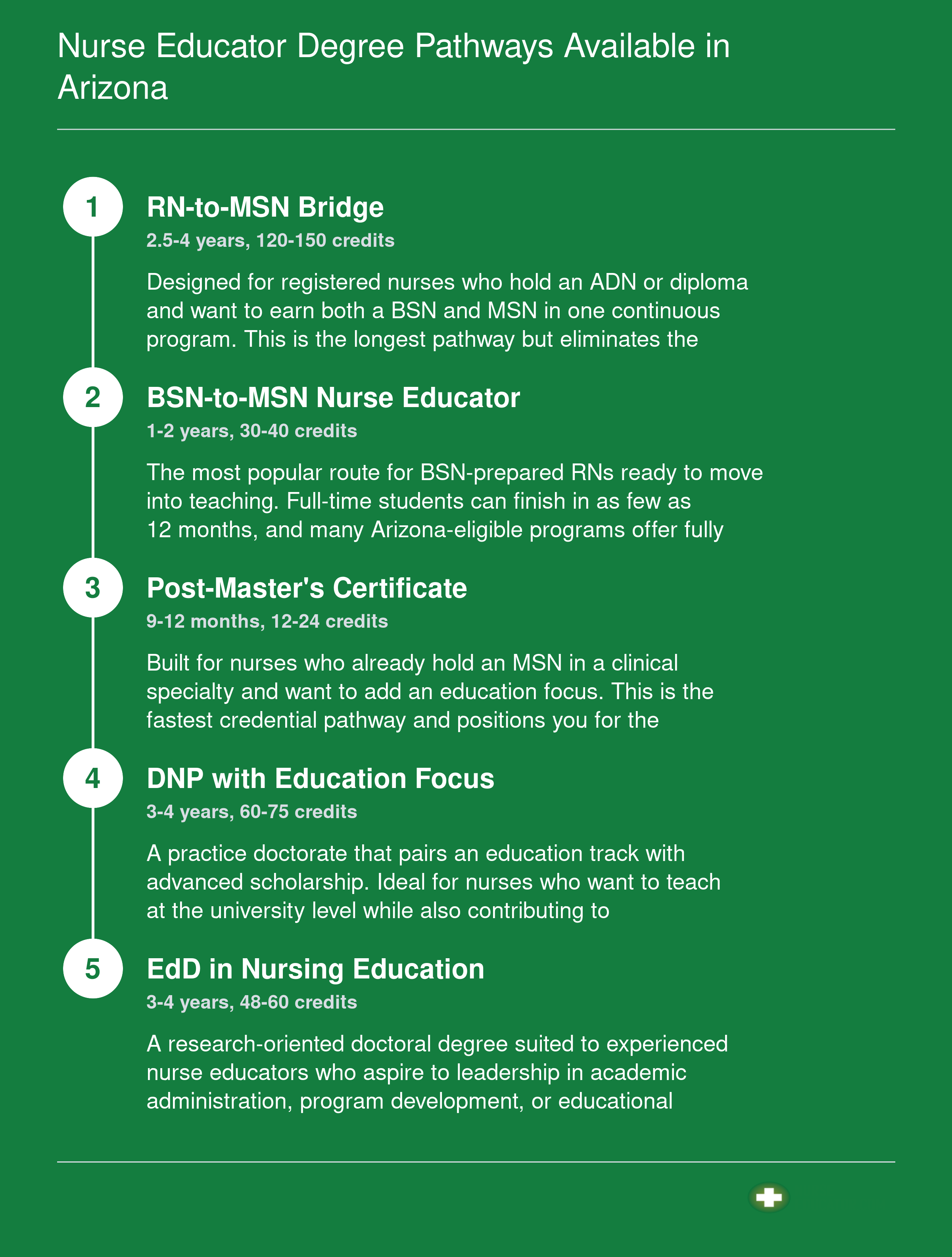
Nurse Educator Degree Pathways Available in Arizona
Not every aspiring nurse educator follows the same route. The right pathway depends on the degree you already hold, how quickly you want to start teaching, and whether you plan to pursue faculty roles at research universities or community colleges. Here is how the five most common pathways stack up.
Questions to Ask Yourself
How Much Do Nurse Educator Programs Cost in Arizona?
Public versus private, in-state versus out-of-state: these two distinctions drive the biggest swings in what you will actually pay for a nurse educator program in Arizona. Before you commit to any program, invest an hour comparing real numbers so you can layer scholarships and employer benefits on top of a tuition rate you already understand.
Start With Published Tuition at Arizona's Public Universities
Arizona State University, the University of Arizona, and Northern Arizona University each publish graduate tuition schedules on their websites, broken out by resident and non-resident status, credit-hour rates, and mandatory fees. Pull up the specific MSN or nurse educator degree page rather than relying on university-wide averages, because nursing programs often carry differential tuition or clinical-course surcharges. If you are eyeing an online format, check whether in-state pricing applies to distance learners; policies vary by institution.
Scholarships Through Arizona Nursing Organizations
The Arizona Nurses Association, through its foundation (AzFFN), offers several awards worth exploring:1
- AzFFN Academic Nursing Scholarship: $1,000 to $2,500 for students enrolled in an Arizona nursing career program. You must hold ANA/AzNA membership, and the application deadline is typically August 1.
- AzFFN Prelicensure BSN Scholarship: $2,500 for students in an Arizona prelicensure BSN program.2
- Central Arizona Chapter Scholarship: $500 for nurses advancing to a BSN, MSN, DNP, or PhD.3
Visit the Arizona Nurses Association website for current applications and any deadline extensions.
Employer Tuition Reimbursement
If you are currently working in clinical practice, reach out to your HR department before you enroll. Banner Health, HonorHealth, and Dignity Health each maintain tuition reimbursement or assistance programs for employees pursuing advanced nursing degrees. Program details, annual caps, and service commitments change from year to year, so contact each system directly for the latest terms.
State and Federal Aid Worth Investigating
Arizona has periodically funded nursing faculty loan repayment initiatives to address the nursing faculty shortage. Check the Arizona Board of Regents website and the state health department site for any active programs. On the federal side, the HRSA Nurse Corps Scholarship covers tuition, required fees, reasonable educational costs, and a monthly stipend in exchange for a service commitment at a Critical Shortage Facility after graduation.4 Public Service Loan Forgiveness is another option if you plan to teach at a public college or university; 120 qualifying payments while employed full-time can lead to remaining federal loan balances being forgiven.
Additional awards target specific populations. The NAHN Arizona College of Nursing Scholarship provides $10,000 for minority nursing students at Arizona College of Nursing campuses in Phoenix, Tempe, or Tucson.5 The NBNA offers scholarships for student nurses at every level, from LPN through doctoral study, with membership required.6
Putting It All Together
Stack these opportunities. A nurse working at Banner Health, for example, could combine employer reimbursement with an AzFFN scholarship and federal financial aid to significantly reduce out-of-pocket costs. The key is to research deadlines early, because most scholarship cycles close months before fall classes begin.
Nurse Educator Salary and Job Outlook in Arizona
Arizona nurse educators face a familiar tradeoff: salaries that trail the national average, set against a faculty shortage so persistent that experienced MSN-prepared nurses can often write their own ticket on hiring terms, schedule, and rank. Understanding both sides of that equation matters before you commit to a program.
What Arizona Nurse Educators Earn
According to the Bureau of Labor Statistics Occupational Employment and Wage Statistics (May 2023), nursing instructors and teachers, postsecondary (SOC 25-1072) in Arizona earned a median annual wage of $68,360.1 The 10th percentile sat at $40,260, and the 90th percentile reached $106,030. BLS did not publish complete 25th and 75th percentile figures for the Arizona state estimate at the level needed to report them confidently here, so treat the median and the 10th/90th bookends as the most reliable Arizona-specific anchors.
For national context, the BLS national median for the same occupation was $80,780, with a 10th percentile of $49,120, a 25th percentile of $63,050, a 75th percentile of $103,370, and a 90th percentile of $130,320.1 Arizona's median runs roughly $12,000 below the national figure, a gap that reflects both the state's overall wage structure and the heavy share of community college positions in the Arizona pipeline. You can explore a full state-by-state breakdown in our nurse educator salary by state data.
Metro-level data for Phoenix-Mesa-Chandler and Tucson is published by BLS within the same SOC 25-1072 series, but the values shift release to release and were not provided in the dataset behind this article. Check the current OEWS metro tables before quoting a specific Phoenix or Tucson number to a prospective employer.
Program Earnings vs. Occupational Wages
Occupational wage data and program-completer earnings measure different things. The BLS figures above describe what people currently working as nursing faculty earn. Program-level earnings from the federal College Scorecard, by contrast, capture median earnings of recent graduates across all jobs they take, not just teaching roles. For Arizona State University, the institution-wide median earnings figure for graduates ten years after entry is about $62,668, which blends every degree and career path on campus, not nurse educator outcomes specifically.
Demand and the Faculty Pipeline
The American Association of Colleges of Nursing has documented a national nurse faculty vacancy rate consistently in the high single digits, with the Southwest among the regions reporting unfilled positions and qualified applicants turned away from BSN programs each year. Our look at nurse educator demand covers the latest national data in detail. In Arizona, community colleges (Maricopa, Pima, and the rural districts) hire heavily at the MSN level, while ASU, University of Arizona, and Northern Arizona University recruit doctorally prepared faculty for tenure-track and clinical-track roles. If you hold an MSN with a nurse educator focus, the community college pipeline is the fastest entry point. A DNP in nursing education opens the university track and the higher end of that $106,030 ceiling.
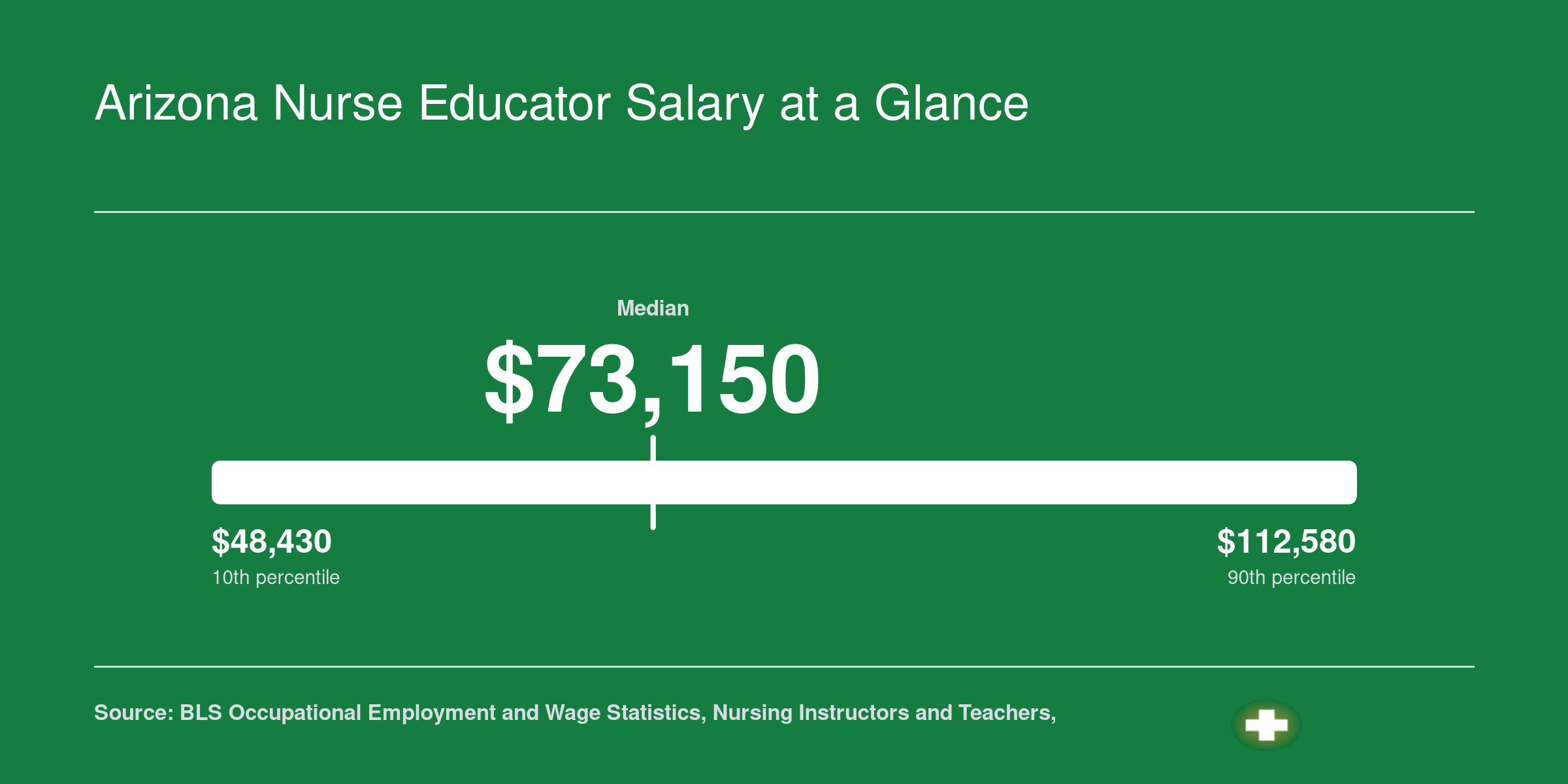
Arizona Nurse Educator Salary at a Glance
Arizona nursing instructors and teachers (postsecondary) earn salaries that span a wide range depending on experience, institution type, and metro area. The state median falls slightly below the national median, but educators in the Phoenix and Tucson metros can command competitive pay. Phoenix-area nursing instructors report a median annual wage of roughly $77,360, while Tucson-area instructors come in near $72,490.
Licensing, Certification, and the CNE Credential in Arizona
As nursing education evolves, Arizona institutions increasingly expect faculty to hold a credential that validates teaching expertise, not just clinical competence. While the state's licensing baseline is straightforward, voluntary certification has become a powerful signal of an educator's commitment to the craft.
Arizona RN License: The Non-Negotiable Foundation
Every nurse educator in Arizona must hold an active, unencumbered Registered Nurse license issued by the Arizona State Board of Nursing. This requirement applies whether you teach in a university, community college, or hospital-based program. Because the license must remain current throughout your teaching career, you will need to meet the Board's continuing competency standards and renew on time, typically every four years. Arizona does not issue a separate teaching license for nursing faculty; the RN license is the starting point.
The Certified Nurse Educator (CNE) Credential
The National League for Nursing (NLN) created the CNE credential to distinguish nursing faculty who have specialized knowledge in the science of teaching. It is not a legal requirement to teach in Arizona, but its influence on hiring and advancement is hard to overstate. Earning the CNE tells employers that you understand curriculum design, assessment, and learner development far beyond what a clinical orientation alone provides. Our full CNE certification requirements guide walks you through the process step by step.
Eligibility, Exam, and Renewal
To sit for the CNE exam in 2026, you need a graduate nursing degree that includes at least nine semester credits in education theory and a minimum of two years of full-time teaching experience in a nursing program.1 The exam itself is a 150-question, 150-minute computer-based test that yields a scaled score; a score of 400 or above is passing.2 The pass rate hovers around 85%, suggesting that candidates who prepare thoroughly tend to succeed.3 Once certified, you renew every five years by completing 100 continuing education hours, holding an active RN license, and affirming adherence to the NLN Code of Ethics.2 Renewal fees are $350 for NLN members and $450 for non-members.2
How Certification Shapes Hiring
Interest in the CNE is accelerating among university nursing programs. Most Arizona universities now list it as a preferred qualification for full-time faculty, and some build it in as a requirement for tenure-track positions. Community colleges, while often more flexible, still weigh CNE status heavily during hiring and promotion reviews. If you are applying to an ADN program, you may be able to secure a position without the CNE if you bring strong clinical experience and a willingness to earn the credential within a set timeframe. In short, holding the CNE opens doors that a license alone cannot.
The Clinical Nurse Educator (CNEcl) Alternative
For nurses who gravitate toward teaching in clinical settings, precepting students on a hospital floor rather than leading a classroom, the NLN offers a parallel credential: the Certified Clinical Nurse Educator (CNEcl). Eligibility mirrors the CNE, but the exam focuses on clinical teaching strategies and evaluation. You can explore the differences in our CNE vs. CNEcl certification comparison. An increasing number of Arizona hospitals and practice partners view the CNEcl as the gold standard for staff who precept students or orient new nurses, making it a valuable add-on if your role stays at the bedside.
Online Nurse Educator Programs That Accept Arizona Students
If you are weighing your options beyond the programs physically located in Arizona, online nurse educator degrees can open the door to nationally recognized curricula without requiring a move. Because Arizona is a SARA member state, most online programs based at SARA-participating institutions can legally enroll Arizona residents.1 However, "most" does not mean "all," so you should always verify state authorization before applying.
Here are some online programs and their current enrollment status for Arizona students:
- Arizona State University offers an online MSN with a concentration in Nursing Education. An active RN license is required for admission, and Arizona residents are fully eligible.1
- Western Governors University runs a CCNE-accredited BSN-to-MSN in Nursing Education that likely accepts Arizona residents, given WGU's broad state-authorization footprint.2
- Southern New Hampshire University offers an MSN Nurse Educator online and also likely enrolls Arizona students.3
- The University of Cincinnati offers an online MSN in Nursing Education, but Arizona is among its restricted states and residents are currently unable to enroll.4
The takeaway: do not assume every online program is available to you. Restrictions can change from year to year as schools update their state-authorization agreements, so check directly with the admissions office before investing time in an application.
When comparing programs, look beyond enrollment eligibility. Consider accreditation (CCNE or ACEN), clinical placement support in your area, tuition reciprocity, and whether the curriculum prepares you for the CNE exam. If you are still exploring which states have the highest demand for nurse educators, that context can help you target programs whose clinical networks align with your long-term career goals. Evaluating the benefits of online nursing programs can also clarify whether the format suits your schedule as a working RN.
U.S. nursing schools reported 1,588 faculty vacancies for the 2025-2026 academic year, according to the American Association of Colleges of Nursing. This shortage underscores the urgent demand for nurse educators in Arizona and beyond.
Frequently Asked Questions About Nurse Educator Programs in Arizona
Below are straightforward answers to the questions Arizona nurses ask most often when exploring a career in nursing education. If a topic here sparks deeper curiosity, the other sections of this guide fill in the details.