
What you’ll learn in this article…
- UNM and ENMU offer the only two accredited MSN nurse educator programs in New Mexico, both fully online.
- New Mexico does not require a separate nurse educator license, though national CNE certification strengthens your candidacy.
- Western region nursing schools reported a 10 percent faculty vacancy rate in the 2022 to 2023 academic year.
- Most nurse educators in New Mexico need five to seven years from BSN through clinical experience to a faculty role.
New Mexico's nursing schools sit in a Western region where one in ten budgeted faculty positions sits empty, according to 2023 AACN vacancy data. With only two ACEN-accredited MSN Nurse Educator programs in the state, the talent pipeline runs narrow, a reality that mirrors nurse educator demand trends nationally.
Both available options, University of New Mexico and Eastern New Mexico University, deliver the MSN entirely online, compressing coursework into flexible blocks that working RNs can manage. The bottleneck isn't a lack of interested nurses; it's a faculty capacity ceiling that makes choosing the right MSN an immediate priority for career changers.
Best Nurse Educator Programs in New Mexico: Rankings & Comparison
New Mexico currently has two accredited MSN Nurse Educator programs, both offered fully online to accommodate working RNs across the state. We ranked them by weighing tuition affordability, institution-wide graduation rates, and post-graduation earnings data to help you compare overall value. Program-level median earnings are not yet available for either school, so institution-wide figures are used as context.
How we ranked these
- Tuition and net price affordability
- Institution-wide graduation rate
- Post-graduation median earnings
- Program format and flexibility
- Accreditation and certification alignment
- NCES-IPEDS federal institutional data — nces.ed.gov
- College Scorecard graduate earnings — collegescorecard.ed.gov
- Independent program research
- Internal program database
- #1
University of New Mexico
Albuquerque, NM · $10,000/yr
Best for: RNs seeking a research university network
The University of New Mexico is the state's flagship research institution in Albuquerque, with a 54.7% institution-wide graduation rate and deep ties to New Mexico's healthcare infrastructure, including a university hospital system. UNM's College of Nursing participates in the New Mexico Nursing Education Consortium (NMNEC), embedding its nurse educator graduates in a statewide faculty development network. The university is also expanding capacity through a new College of Nursing and Public Health Excellence Building, signaling long-term investment in health-profession education across the state.
View program
- 100% online with flexible 8-week course blocks
- Two-year completion timeline for working nurses
- Prepares graduates to teach at ADN and BSN levels
- Emphasis on serving rural and underserved populations
- Scholarship funding available through the program
- Leadership-focused curriculum for education settings
- Interprofessional education strategies integrated throughout
- Connected to NMNEC statewide faculty pipeline
- #2
Eastern New Mexico University
Portales, NM · $6,000/yr
Best for: Budget-focused nurses prioritizing affordability
Eastern New Mexico University in Portales delivers one of the most affordable MSN options in the state, with in-state tuition of roughly $5,706 per year and a net price near $4,904 after aid. Its 36-credit Nurse Educator concentration is ACEN-accredited and explicitly designed to funnel graduates into New Mexico's teaching workforce, with the program reporting a 94% job placement rate. Full-time students can finish in as few as 16 to 20 months, and the program qualifies graduates to sit for the NLN Certified Nurse Educator (CNE) exam.
View program
- ACEN-accredited, 36 total credit hours
- Completable in 16 to 20 months full-time
- Asynchronous online classes, three start terms yearly
- Qualifies graduates to sit for the NLN CNE exam
- Eligible for the New Mexico Nurse Educator Scholarship
- Out-of-state students taking six or fewer hours pay in-state rate
- Capstone required, zero mandatory clinical hours
- 12 core credits plus 24 education-focused credits
MSN Nurse Educator Programs in New Mexico (Including RN-To-MSN)
For New Mexico RNs aiming to become nurse educators, the journey typically starts with one of two paths: a traditional MSN for those who already hold a BSN, or an accelerated RN-to-MSN bridge for ADN- or diploma-prepared nurses seeking to earn the master's credential without first completing a standalone bachelor's degree. Both routes lead to the same nursing education core, but the starting point and timeline differ significantly.
What to Expect in an MSN Nurse Educator Track
A Master of Science in Nursing with a focus on nursing education is widely considered the standard entry credential for teaching in academic or clinical staff development settings. New Mexico programs combine graduate-level nursing science with education theory to build confidence in curriculum design, assessment, and classroom or clinical instruction. Typical MSN nurse educator programs in the state require 34 to 36 credit hours and can be finished in roughly 24 months of full-time study.12
For example, Eastern New Mexico University’s online MSN includes 36 credits with 12 core credits and 24 nursing education credits3, while the University of New Mexico’s MSN in nursing education comprises 34 credits and a supervised teaching practicum of 192 hours.4 Across New Mexico, practicum experiences generally range from 150 to 500 clinical teaching hours5, giving candidates hands-on practice in academic or staff development roles before they graduate.
The curriculum covers areas such as advanced pathophysiology, pharmacology, health assessment, and evidence-based practice, alongside dedicated courses in instructional strategies, evaluation methods, and faculty role development. All these components build toward eligibility for the National League for Nursing’s Certified Nurse Educator (CNE) exam, which requires a graduate degree with an education emphasis.1 Completing an accredited MSN nurse educator program positions you to sit for that exam and pursue roles in New Mexico’s nursing schools or hospital-based education departments.
The RN-to-MSN Bridge Pathway
If you hold an associate degree or nursing diploma, an RN-to-MSN bridge lets you bypass the traditional BSN and move directly into master’s-level education courses. These programs first cover baccalaureate-equivalent content through bridge modules, then transition into the same MSN nurse educator core. Admission typically expects an active RN license, a minimum cumulative GPA of 3.0, and sometimes a year of clinical experience.6
The extended timeline for RN-to-MSN bridges in New Mexico generally falls between 36 and 48 months1, depending on part-time or full-time pacing. The bridge approach is especially attractive for working ADN nurses who want to reach educator roles faster than completing a BSN and then a separate MSN. Because many New Mexico programs are offered fully online, you can often continue working while completing coursework and scheduling practicum hours at a local clinical teaching site.
DNP & PHD Nurse Educator Programs in New Mexico
A doctorate in nursing is the terminal degree that opens the door to university tenure-track faculty roles, academic leadership positions, and formal research careers, but it sits above, not in place of, the standard nurse educator credential. In New Mexico, two doctoral routes exist, each serving distinct goals.
Practice-Focused: The DNP Route
The Doctor of Nursing Practice (DNP) is a practice doctorate built for RNs and APRNs who already hold an MSN and want to deepen their clinical and educational expertise without shifting into full-time research. New Mexico offers several DNP pathways with relevant concentrations, including Nursing Education, Population Health Leadership, NP specialties, and Nurse Anesthesiology. UNM's College of Nursing offers a Doctor of Nursing Practice (DNP) program and has introduced a modified post-baccalaureate DNP with a Psychiatric/Education track.4 NMSU's School of Nursing runs its own DNP, including an MSN-DNP in Population Health Leadership,5 and New Mexico Highlands University offers a fully online Doctor of Nursing Practice for nurses who need location flexibility. The DNP suits clinical faculty, simulation lab directors, and education program leaders who want advanced practice authority paired with teaching skill.
Research-Focused: The PhD Route
The PhD in Nursing is built for nurses drawn to generating new knowledge rather than applying existing evidence. This path fits future tenure-track faculty, nurse researchers, and principal investigators who want to design studies, secure grant funding, and publish original research. It demands a longer commitment and a dissertation, so it's best suited to nurses certain about an academic research career.
Do You Actually Need One?
Most nurse educator positions in New Mexico, including clinical instructor and community college faculty roles, require only an MSN.6 A doctorate becomes necessary mainly for university-level faculty appointments, academic leadership, or research-heavy roles. For a deeper comparison of coursework, timelines, and career outcomes, see the national DNP nursing education programs guide and the PhD in nursing education guide.
Post-Master's Certificate in Nursing Education in New Mexico
If you already hold an MSN in a clinical specialty, a post-master's certificate in nursing education lets you add the educator credential without repeating an entire degree. You complete about 12-18 credits, usually in one year of part-time study, covering curriculum design, instructional strategies, assessment, and evidence-based teaching.1 A supervised teaching practicum puts you in a classroom, simulation lab, or clinical setting, so you build experience before applying for faculty roles.1
In New Mexico, the University of New Mexico College of Nursing offers a post-master's certificate, designated Track C for MSN-holders whose prior concentration was outside nursing education, requiring 15 credits.2 Graduates are eligible to sit for the Certified Nurse Educator (CNE) exam administered by the National League for Nursing.2
Earning the CNE credential signals that you meet a national standard. Most certificate programs, including UNM's, satisfy the academic requirement for the CNE exam; you still need to check the NLN's experience prerequisites.
The certificate suits NPs, CNSs, nurse administrators, and other advanced practice nurses pivoting to academia. It's also a solid choice if you already precept students and want formal preparation and the credential for part-time or full-time faculty work.
For a comprehensive national overview, including what to look for in accreditation, curriculum, and clinical placement support, see the guide to post-master's certificates in nursing education.
How to Become a Nurse Educator in New Mexico
New Mexico does not require a separate nurse educator license, but most employers expect at least a master's degree. From your first BSN to a faculty appointment, the path typically spans about five to seven years, with two to three of those devoted to your MSN after you already hold a BSN and active RN license.

Online Vs. On-Campus Nurse Educator Programs in New Mexico
Both MSN nurse educator programs currently available in New Mexico, at the University of New Mexico (UNM) and Eastern New Mexico University (ENMU), are delivered primarily online, making them strong options for working RNs. Still, the two programs differ in meaningful ways across flexibility, practicum logistics, networking opportunities, and cost. The comparison below breaks down the key factors to help you decide which format and school fits your situation.
| Factor | UNM (Online MSN Nursing Education) | ENMU (Online MSN Nurse Educator) |
|---|---|---|
| Delivery Format | 100% online with an 8-week course format designed for working nurses | 100% online, asynchronous classes; three start dates per year (fall, spring, summer) |
| Program Length | Approximately 2 years | Approximately 2 years (may be completed in 16 to 20 months) |
| Total Credits | Varies by plan of study; contact the program for current requirements | 36 credits (12 core, 24 education emphasis) |
| Clinical or Practicum Hours | Teaching practicum component typically required; students generally arrange placements locally, though specifics should be confirmed with the program | No clinical hours listed; capstone project required instead |
| Practicum Location Flexibility | Online students may be able to arrange practicum at an approved site near their home; verify current policy with UNM's College of Nursing | No in-person clinical requirement reported, which can benefit out-of-state or rural students |
| Peer Networking | Larger university setting with a 15:1 student-to-faculty ratio; access to UNM Health Sciences Center events and interprofessional collaboration | Smaller cohort experience with an 18:1 student-to-faculty ratio; strong community focus and military-friendly campus culture |
| In-State Tuition (Institutional) | Approximately $9,860 per year | Approximately $5,706 per year |
| Out-of-State Tuition (Institutional) | Approximately $28,734 per year | Approximately $7,480 per year (discounted out-of-state rate available) |
| Accreditation | CCNE accredited nursing college | ACEN accredited program |
| CNE Exam Preparation | Curriculum supports educator competencies; CNE eligibility should be confirmed with the program | Explicitly designed to prepare graduates for the NLN Certified Nurse Educator (CNE) exam |
| Best Fit For | RNs seeking a research-university experience with a focus on underserved populations and interprofessional education | Budget-conscious RNs who want a fast, flexible path with no clinical hour requirement and built-in CNE exam prep |
Questions to Ask Yourself
Admissions Requirements for NM Nurse Educator Programs
What does it actually take to get into an MSN Nurse Educator program in New Mexico? The two most relevant in-state options, Eastern New Mexico University (ENMU) and the University of New Mexico (UNM), share several baseline expectations but differ in how strictly they gate applicants on GPA, clinical experience, and prerequisite coursework.
Licensure and Clinical Experience
Both programs require an active, unencumbered RN license. ENMU's online MSN with the Nurse Educator emphasis does not impose a minimum number of years of bedside RN experience, which makes it accessible to newer nurses who want to move into teaching earlier in their careers.1 Many accredited online MSN programs nationally expect one to two years of clinical practice before practicum placement, so applicants without recent direct-care experience should be prepared to explain how they will build content expertise alongside coursework.
GPA, Prerequisites, and Standardized Tests
ENMU does not publicly post a hard minimum undergraduate GPA for admission, though the program's affiliated scholarship requires students to maintain at least a 3.0 once enrolled.1 A 3.0 cumulative GPA is the working benchmark most applicants should target.
Common prerequisite coursework across NM nurse educator pathways includes:
- A BSN from a program accredited by ACEN or CCNE
- Undergraduate statistics
- Undergraduate health assessment
- Evidence of prior nursing research or theory coursework at the baccalaureate level
The GRE is not required for ENMU's MSN.1 This mirrors a broader national trend in which graduate nursing programs have waived standardized testing in favor of holistic review. If you are still mapping out the full path from clinician to classroom, our guide on how to become a nurse educator breaks down each milestone.
Cohort Structure and Deadlines
ENMU runs a cohort model with two courses per semester across spring, summer, and fall, completing in roughly 24 months.1 Confirm current application deadlines directly with each program's graduate nursing office, since cycles shift year to year.
One caution on outside data: institution-wide admissions or acceptance rates you may see on federal scorecards reflect the entire university, not the MSN Nurse Educator track specifically. Graduate nursing cohorts are typically smaller and more selective than those headline numbers suggest.
Tuition, Financial Aid & Return on Investment
Graduate tuition in New Mexico varies by institution and delivery format, but several financial aid programs can dramatically reduce your out-of-pocket costs. If you are comparing programs across the region, the WICHE Western Regional Graduate Program (WRGP) allows residents of participating western states to enroll at New Mexico universities at the in-state resident rate, which can save thousands of dollars per year.1
The HRSA Nurse Faculty Loan Program (NFLP) is one of the most valuable resources for aspiring nurse educators. Through this program, eligible students can borrow up to $35,500 per year to cover tuition, fees, books, and related expenses at a fixed 3% interest rate.2 To qualify, you must be a U.S. citizen, non-citizen national, or lawful permanent resident enrolled at a participating school of nursing with a minimum GPA of 3.0.2 The real payoff comes after graduation: if you take a full-time nurse faculty position at an accredited school of nursing, up to 85% of the loan can be canceled over four years (20% for each of the first three years and 25% after the fourth year).3 Any remaining balance enters a standard 10-year repayment period following a 9-month grace period.2
New Mexico also offers its own Nursing Education Loan-for-Service program, which provides year-for-year loan cancellation when graduates commit to teaching in the state.1 Additionally, the Nurse Corps Loan Repayment Program is open to nurse faculty and offers substantial repayment assistance in exchange for a two- to three-year service contract.4 Given the ongoing nursing faculty shortage, these incentives make an MSN in nursing education one of the stronger returns on investment among graduate nursing pathways.
When comparing affordable online nurse educator MSN programs, factor in not just sticker-price tuition but also clinical placement fees, technology charges, and whether the school participates in NFLP. A program that costs slightly more upfront may save you tens of thousands through loan cancellation if it holds NFLP funding.
Nursing schools in the Western region reported a 10 percent faculty vacancy rate in the 2022–2023 academic year, according to the AACN Special Survey on Vacant Faculty Positions. That means one in ten budgeted full-time nurse educator positions sat empty. For New Mexico, this gap reduces the number of qualified nursing students that programs can enroll and train.
Nurse Educator Licensing and Certification in New Mexico
No Separate Nurse Educator License
New Mexico does not issue a standalone "nurse educator" license. To teach in a nursing program, whether in a classroom, skills lab, or clinical setting, you must hold an active, unencumbered New Mexico RN license and meet the degree and experience requirements set by your employer and the state's nursing education regulations. Typically, academic institutions expect a graduate degree in nursing; many now require or strongly prefer the MSN with a nurse educator concentration. Your pathway begins with maintaining RN licensure and choosing the right graduate preparation.
National Certification Options: CNE and CNEcl
Employers often look beyond the state license to national board certification. The National League for Nursing (NLN) offers two credentials that signal specialized teaching competency. For a deeper comparison, see our guide on CNE vs. CNEcl certification comparison.
Certified Nurse Educator (CNE)
- Eligibility, Option A: An active RN license plus a graduate degree in nursing with an education focus, a post-master's certificate in nursing education, or at least nine graduate-level education credits.1
- Eligibility, Option B: An active RN license plus a graduate degree in nursing (any focus) and two years of full-time employment in a nursing program within the past five years.1
- Exam Format: 150 multiple-choice questions covering six content areas (facilitate learning, learner assessment, curriculum design, etc.). The test is computer-based and administered year-round at Pearson VUE centers.1
- Renewal: Every five years via continuing education, practice hours, or re-examination.
The NLN does not publish official pass rates, but some third-party sources suggest an approximate 85% success rate on the CNE exam; these figures should be treated with caution.2
Certified Clinical Nurse Educator (CNEcl)
For nurses who teach primarily in clinical settings, the CNEcl focuses on precepting and bedside instruction.
- Eligibility: Active RN license, a graduate degree in nursing, and two years of clinical teaching experience within the past five years.3
- Renewal: Same 5-year cycle as the CNE, with options for continuing education or retesting.
Unofficial estimates place the CNEcl pass rate near 100%.4 Both certifications require ongoing commitment to stay current. You can learn more about eligibility details in our full nurse educator certification guide.
New Mexico Programs and Exam Alignment
Eastern New Mexico University (ENMU) and the University of New Mexico (UNM) both offer MSN tracks with nurse educator emphases. While neither school publicly maps its curriculum directly to the CNE test blueprint, each program covers the core competencies, including curriculum development, assessment strategies, and teaching methods, that form the backbone of the NLN exam. Prospective students should ask program directors for a curriculum-to-certification crosswalk and inquire about optional CNE review courses. A program that integrates NLN competencies into its coursework can streamline your exam preparation.
Career Impact of Certification
No New Mexico state law requires CNE or CNEcl certification to teach, but many nursing schools list it as a preferred or required qualification. Holding the credential can strengthen your application and may allow you to negotiate a higher starting salary. Although statewide salary data for certified vs. non-certified educators is not published, anecdotal evidence from academic hiring panels suggests that certified candidates often have an edge. In a state facing a nursing faculty shortage, certification signals a commitment to teaching excellence that employers value.
For more granular salary numbers, refer to the salary breakdown earlier in this article.
Nurse Educator Salary and Job Outlook in New Mexico
Understanding how nurse educator pay compares to other nursing roles in New Mexico can help you plan your career transition with realistic expectations. The table below draws on BLS data specific to New Mexico, covering postsecondary nursing instructors alongside registered nurses and nurse practitioners for context. New Mexico currently employs approximately 360 postsecondary nursing instructors, a relatively small workforce that underscores the state's ongoing need for qualified faculty.
| Occupation | Total Employment in NM | 25th Percentile Salary | Median Salary | 75th Percentile Salary | Mean Salary |
|---|---|---|---|---|---|
| Nursing Instructors and Teachers, Postsecondary | 360 | $57,030 | $77,850 | $86,870 | $74,280 |
| Registered Nurses | 17,510 | $82,630 | $88,260 | $104,720 | $94,360 |
| Nurse Practitioners | 1,870 | $113,240 | $138,440 | $156,000 | $136,620 |
Frequently Asked Questions About Nurse Educator Schools in NM
Choosing a nurse educator program raises plenty of practical questions, from degree requirements to earning potential. Below are answers to the questions prospective nursing faculty in New Mexico ask most often.
How do I become a nursing educator in New Mexico?
Start with an active, unencumbered RN license in New Mexico. Next, earn a Master of Science in Nursing (MSN) with a nurse educator concentration, or pursue a Doctor of Nursing Practice or PhD in nursing. After completing your graduate degree, gain teaching experience through a clinical practicum and consider earning the Certified Nurse Educator (CNE) credential to strengthen your candidacy for faculty positions.
What degree do you need to be a nurse educator in New Mexico?
An MSN is the minimum degree most New Mexico colleges and universities require for nursing faculty roles. Some community college positions may accept an MSN with relevant clinical experience, while four-year universities often prefer or require a doctoral degree (DNP or PhD). Programs accredited by CCNE or ACEN are strongly recommended to ensure your credentials are widely recognized.
Are there online nurse educator programs in New Mexico?
Yes. The University of New Mexico offers an online MSN option that includes a nursing education pathway, allowing working RNs to study remotely. Several nationally accredited universities outside the state also enroll New Mexico residents in fully online MSN nurse educator programs. Online formats typically require a supervised teaching practicum arranged at a clinical site near you.
How long does it take to complete an MSN nurse educator program?
Most full-time MSN nurse educator programs take about two years to complete, while part-time tracks designed for working nurses generally run three years. Accelerated options at some institutions can shorten the timeline to 18 months. Program length also depends on whether you need prerequisite coursework or hold a BSN at admission.
What is the salary for a nurse educator in New Mexico?
According to the Bureau of Labor Statistics, postsecondary nursing instructors in New Mexico earned an annual mean wage of approximately $77,790 as of recent data. Salaries vary by institution type, academic rank, and whether you hold a doctoral degree. Faculty at research universities and those with administrative responsibilities tend to earn at the higher end of the range.
What certification do nurse educators need?
Certification is voluntary but highly valued. The National League for Nursing offers the Certified Nurse Educator (CNE) credential, which requires a master's or doctoral degree in nursing and documented experience in the educator role. Earning the CNE signals specialized competence in teaching, curriculum design, and student assessment, and can give you a competitive edge when applying for faculty positions.
Is there a demand for nurse educators in New Mexico?
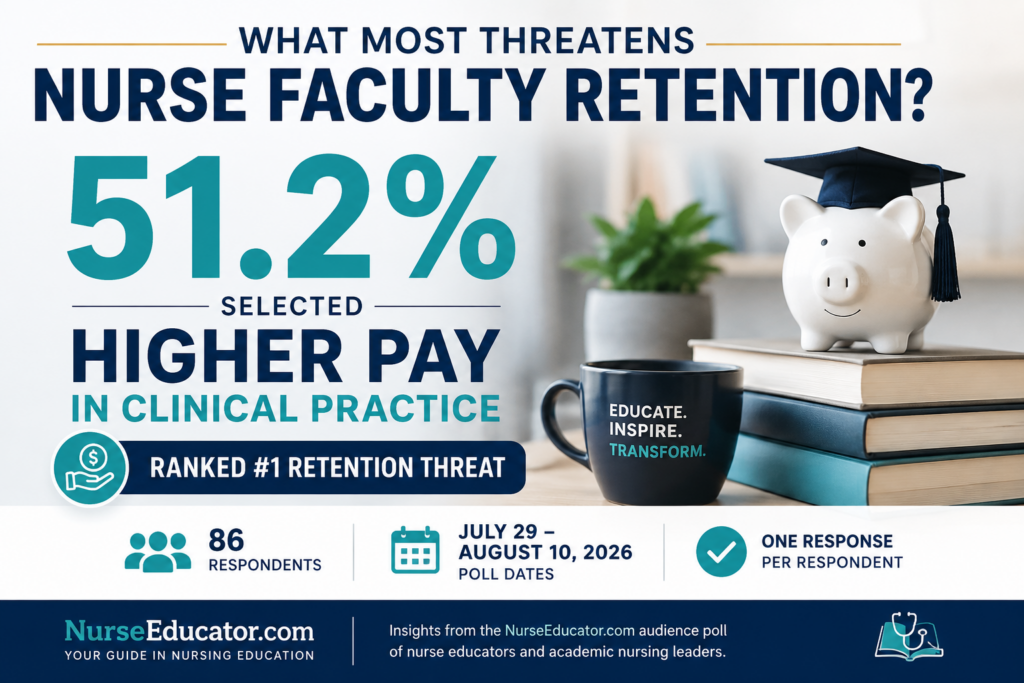
Demand is strong. New Mexico faces a well-documented nursing faculty shortage, contributing to enrollment caps at many nursing programs across the state. An aging faculty workforce, competitive clinical salaries that draw nurses away from teaching, and a growing population all intensify the need. The state has invested in loan repayment and scholarship programs specifically to attract qualified educators into academic roles.