
What you’ll learn in this article…
- The NLN identifies eight measurable competency areas that define what makes a great nurse educator.
- Programs whose faculty demonstrate strong educator qualities report NCLEX pass rates above the 2025 national average of 89.34%.
- Academic educators lean toward curriculum design and scholarship while clinical educators prioritize real-time assessment and mentoring.
- BLS projects 8% job growth for postsecondary nursing instructors through 2032, with over 1,500 faculty vacancies reported by AACN in 2025.
The United States nursing faculty shortage reached a documented crisis point in 2025, when AACN reported nearly 1,600 unfilled faculty positions and a vacancy rate above 7 percent. Nursing programs turned away more than 65,000 qualified applicants that year, not because of a lack of student interest, but because qualified educators were unavailable. That context matters: when faculty seats are scarce, the quality of each individual nurse educator carries outsized weight.
The 15 qualities covered here are drawn from the National League for Nursing's Nurse Educator Competencies framework and from peer-reviewed research on student outcomes, not from anecdotal experience or editorial preference. That distinction matters to working nurses who need a reliable foundation for their own development planning.
The nursing education workforce increasingly spans two distinct tracks, academic faculty and clinical nurse educators, and the qualities that matter most shift depending on which path a nurse pursues. That gap between tracks, along with salary variation, credentialing requirements, and evidence-based development strategies, shapes the real decisions nurses face when becoming a nurse educator.
What the Research Says About Effective Nurse Educators
Teaching in nursing is not simply a matter of knowing clinical content and standing in front of a classroom. Research consistently shows that what separates effective nurse educators from average ones comes down to a defined, measurable set of competencies, and the profession has spent decades building the evidence to prove it.
The NLN Framework: A Professional Gold Standard
The National League for Nursing (NLN) Core Competencies for Nurse Educators, updated in 2022, organizes the role into eight competency domains.1 Together, they describe the full scope of what excellent nurse educators actually do:
- Facilitate Learning: Creating environments that promote critical thinking and active engagement in both classroom and clinical settings.
- Facilitate Learner Development and Socialization: Supporting students as they develop professional identity and values.
- Use Assessment and Evaluation Strategies: Designing fair, valid methods to measure student learning and competence.
- Participate in Curriculum Design and Evaluation: Contributing to program-level planning that aligns with professional standards.
- Pursue Continuous Quality Improvement in the Nurse Educator Role: Reflecting on and improving one's own teaching practice.
- Engage in Scholarship: Generating and applying evidence to nursing education practice.
- Function as a Change Agent and Leader: Influencing institutional culture and advocating for students and the profession.
- Engage in the Academic Environment: Navigating the organizational and political landscape of higher education.
This framework matters because it moves the conversation away from vague personality traits toward concrete, learnable behaviors.
What Students and Research Actually Prioritize
Studies on nursing student perspectives add another layer to the NLN framework by capturing what learners themselves value most. Research examining nursing student and new graduate perspectives identifies five broad factors students associate with competent educators, with active learning facilitation ranking at the top.2 Students consistently prioritize educators who facilitate active learning, create psychologically safe environments for questions and mistakes, and demonstrate clinical credibility. That emphasis on psychological safety connects closely to teaching emotional intelligence to nursing students, a skill set that strengthens both the educator's practice and the student experience.
Clinical instructor research echoes these findings. Students in both academic vs clinical nurse educator settings rate approachability, clear communication, and genuine investment in student success as more important than technical expertise alone.
Why This Article Is Built Around Evidence
Many lists of nurse educator qualities read like character inventories: be compassionate, be organized, be enthusiastic. Those traits are real, but listing them without grounding them in a framework does not help a nurse who is actively trying to grow. The 15 qualities covered in this article map directly to the NLN competency domains and the findings from student-centered research. Each quality is traceable to something the profession has identified as measurable and teachable, not just admirable.
There is also a practical reason this matters. These qualities are not just philosophically sound. As the outcomes section later covers, they correlate with concrete results, including Next Generation NCLEX pass rates, student retention, and graduate practice readiness.
The 15 Essential Qualities of a Great Nurse Educator
The conversation about nurse educator competencies has shifted from a focus on years of clinical experience alone to a broader, evidence-based framework that balances pedagogical skill, relational capacity, and scholarly practice.1 The National League for Nursing's Nurse Educator Competencies provide the scaffold, but real-world excellence emerges when those competencies translate into observable behaviors and habits.
Below are 15 essential qualities of great nurse educators, organized into thematic clusters to help you identify strengths and pinpoint growth areas. Each quality includes a definition, a concrete example, and its alignment with NLN competencies. These nurse educator skills form the foundation for both academic and clinical teaching roles.
Knowledge and Expertise
Excellence in nursing education begins with a command of both clinical practice and the science of teaching. These qualities ensure that what you teach is accurate, current, and grounded in real-world application.
1. Clinical Expertise
Clinical expertise is the ability to draw on deep, current knowledge of patient care to inform classroom instruction and clinical supervision. A nurse educator with strong clinical expertise demonstrates a procedure at the bedside, then immediately connects the technique to pathophysiology, patient safety data, and common student pitfalls observed in practice. This quality maps directly to the NLN competency Facilitate Learning, where authentic clinical context strengthens student reasoning and confidence.
2. Evidence-Based Teaching
Evidence-based teaching means selecting instructional strategies grounded in educational research rather than tradition or convenience. When a simulation coordinator replaces a lecture-heavy orientation with spaced repetition and deliberate practice sessions, citing studies on retention and transfer, that is evidence-based teaching in action. The quality aligns with the NLN competency Use Assessment and Evaluation Strategies, as it requires evaluating which methods actually produce learning gains. For a deeper dive into classroom approaches, explore innovative teaching strategies in nursing education.
3. Curriculum Design Skills
Curriculum design skills involve structuring courses, units, and clinical experiences so that learning objectives build logically and meet accreditation standards. An educator redesigning a pharmacology course might sequence content from foundational pharmacokinetics through disease-specific protocols, embedding formative quizzes and case studies at each stage. This quality supports the NLN competency Facilitate Learner Development and Socialization, ensuring that students progress through a coherent, scaffolded path.
4. Assessment Literacy
Assessment literacy is the knowledge of how to design, administer, and interpret both formative and summative assessments to accurately measure student learning. A clinical instructor who uses a validated rubric to score skills check-offs and then reviews item analysis to identify weak test questions demonstrates assessment literacy. The competency Use Assessment and Evaluation Strategies depends on this quality, as fair and meaningful evaluation drives program improvement.
Teaching and Communication
The ability to explain, adapt, and engage defines the day-to-day work of nursing education. These qualities turn content knowledge into student understanding.
5. Clear Communication
Clear communication is the capacity to present complex concepts in language that is precise, organized, and accessible to diverse learners.1 When an educator introduces heart failure, she opens with a simple analogy, defines terms before using them, and summarizes key points at the close. This essential quality of a teacher in nursing education underpins the NLN competency Facilitate Learning, as clarity directly impacts comprehension and retention.
6. Adaptability
Adaptability means adjusting teaching methods, pacing, and expectations in response to student needs, technology changes, or clinical site constraints. During a pandemic-related clinical suspension, an adaptive educator pivots to virtual case rounds, telehealth observations, and asynchronous skills videos without sacrificing learning outcomes. The quality aligns with Facilitate Learning and supports resilience in dynamic healthcare environments.
7. Technology Fluency
Technology fluency is comfort and skill with learning management systems, simulation software, virtual reality, and other digital tools that enhance instruction. An educator who integrates interactive polling during lectures, records skills demonstrations for on-demand review, and troubleshoots student login issues exemplifies this quality. It supports the NLN competency Facilitate Learning by expanding access and engagement.
8. Scholarly Inquiry
Scholarly inquiry is a commitment to asking research questions about teaching effectiveness, student outcomes, and curriculum innovation, then disseminating findings. A faculty member who conducts a pilot study on flipped-classroom formats and presents results at a regional conference demonstrates scholarly inquiry. This quality aligns with the NLN competency Function as a Change Agent and Leader, as scholarship drives the profession forward.
Relationship and Mentorship
Nursing education is fundamentally relational. These qualities build trust, foster growth, and create psychologically safe learning environments.
9. Mentorship Orientation
Mentorship orientation is the intentional effort to guide students through academic challenges, career decisions, and professional identity formation. A mentor who schedules one-on-one check-ins with a struggling student, helps her map out a study plan, and connects her with campus tutoring resources embodies this quality. It maps to Facilitate Learner Development and Socialization, as mentorship accelerates both competence and confidence.
10. Emotional Intelligence
Emotional intelligence is the awareness of your own emotions and the ability to read, respond to, and regulate the emotions of others. When a clinical instructor notices a student's anxiety before a first IV start, validates the feeling, and offers calm reassurance and coaching, she demonstrates emotional intelligence. This quality supports Facilitate Learning by creating conditions where students can take risks and grow.
11. Cultural Competence
Cultural competence is the knowledge, awareness, and skill to teach and mentor students from diverse backgrounds and to prepare them for culturally responsive patient care. An educator who invites students to share cultural health practices in class discussions and revises case studies to reflect the demographics of the local community demonstrates this quality. It aligns with Facilitate Learner Development and Socialization, as inclusive teaching prepares students for diverse practice settings. You can read more about the role nurse educators play in healthcare disparities and equity-focused strategies.
12. Patience and Approachability
Patience and approachability mean remaining calm, open, and non-judgmental even when students ask basic questions, repeat mistakes, or struggle with confidence. A faculty member who holds weekly office hours, answers every email warmly, and never makes a student feel foolish for not knowing exemplifies this quality. It underpins all NLN nurse educator competencies, as students learn best when they feel safe to admit gaps in understanding.
Professional Growth and Leadership
Great educators do not stand still. These qualities reflect a commitment to continuous improvement and to shaping the future of nursing education.
13. Lifelong Learning Commitment
Lifelong learning commitment is the habit of pursuing continuing education, certifications, advanced degrees, and new teaching methods throughout one's career. An educator who completes a certificate in online pedagogy, attends a simulation workshop, and subscribes to nursing education journals demonstrates this quality. It aligns with Function as a Change Agent and Leader, as personal growth fuels institutional innovation. If you are weighing your certification options, comparing CNE vs. CNEcl certification is a practical first step.
14. Leadership
Leadership is the ability to guide teams, influence policy, and advocate for students and the profession. A department chair who spearheads a revision of clinical placement agreements, mentors junior faculty through the promotion process, and represents the school on a state nursing workforce council demonstrates leadership. This quality directly maps to the NLN competency Function as a Change Agent and Leader.
15. Collaboration
Collaboration is the skill of working productively with colleagues, clinical partners, interprofessional teams, and students to achieve shared goals. When a nurse educator co-teaches a module with a pharmacist, coordinates clinical schedules with hospital education departments, and solicits student feedback to refine assignments, she demonstrates collaboration. The quality supports Engage in Scholarship, as most impactful projects require partnerships across disciplines and institutions.
Together, these 15 qualities form a comprehensive profile of nursing education excellence. No educator masters all 15 immediately, but awareness of the full spectrum helps you chart a deliberate path from novice to expert teacher.
Questions to Ask Yourself
Academic Vs. Clinical Nurse Educator: Which Qualities Matter Most?
Both academic and clinical nurse educators draw from the same core skill set, but the weight each role places on specific qualities differs in meaningful ways. Understanding where these emphases shift can help you target the right professional development as you move into teaching, whether your path leads to a university classroom or a hospital unit.
The National League for Nursing's Core Competencies for Academic Nurse Educators outlines expectations that lean heavily toward curriculum architecture, scholarly inquiry, and program-level assessment.1 Research reviewing those competencies confirms that clinical teaching roles, by contrast, demand deeper bedside expertise and real-time formative evaluation.2 The comparison below maps six key quality dimensions across both settings. For a deeper look at each career track, see our guide on the clinical nurse educator role compared to the academic path.
Quality Comparison by Setting
- Curriculum Design: Critical for academic educators, who architect entire program outcomes and course sequences. Important for clinical educators, who translate that curriculum into hands-on patient-care experiences, but they rarely build it from scratch.1
- Scholarship and Research: Critical in academic roles, where tenure and promotion often require peer-reviewed publications and funded projects. A nice-to-have in clinical roles, where the focus shifts to evidence-based practice translation and quality improvement at the unit level.2
- Clinical Expertise: Important for academic educators so they can ground lectures in real-world relevance, but critical for clinical educators, whose teaching credibility depends on current bedside competence.1
- Assessment and Evaluation: Critical in both settings, though the tools differ. Academic educators design exams, rubrics, and program-level data analysis. Clinical educators rely on direct observation, skills checklists, and formative bedside feedback.2
- Leadership and Collaboration: Critical across the board, yet the arena changes. Academic leadership centers on faculty governance, committee work, and interdepartmental coordination. Clinical leadership revolves around inter-organizational partnerships and operational workflows.1
- Professional Socialization: Critical in both roles with a different lens. Academic educators shape scholarly and professional identity through mentorship in research and publication. Clinical educators socialize students into unit culture, interdisciplinary teamwork, and practice-role expectations.2
What This Means for Your Career Path
If you thrive on research design and long-range program planning, an academic appointment will let those strengths shine. If you are energized by real-time teaching moments at the bedside and translating evidence into immediate patient care decisions, a clinical educator position is a natural fit. Many nurse educators move between settings over the course of a career, so developing competence across all six dimensions keeps your options open. If you are weighing which nurse educator certification to pursue first, let the setting you are targeting guide that decision. The key is knowing which qualities to sharpen first based on the role you are pursuing right now.
Related Articles
How These Qualities Connect to Student Outcomes
The qualities a nurse educator brings to the classroom and clinical setting are not abstract virtues: they show up directly in measurable student performance data.
NCLEX Pass Rates as a Benchmark
National first-time NCLEX-RN pass rates for prelicensure programs sit in the 86 to 87 percent range as of 2025, according to NCSBN data.1 That figure represents programs across widely different resource levels, faculty preparation, and teaching approaches. When you drill into state-level data, the variation becomes striking. California nursing programs, for instance, have reported first-time pass rates ranging anywhere from 70 to 100 percent across recent years.2 That 30-point spread within a single state is not explained by student aptitude alone. Faculty quality, mentorship practices, and how well educators translate clinical reasoning into the classroom all play a role.
What the Research Points Toward
Peer-reviewed studies published in journals such as the Journal of Nursing Education and Nurse Educator consistently examine the link between teaching effectiveness and student outcomes. Searching those sources using terms like "clinical competence" and "NCLEX success" surfaces studies that report effect sizes and correlations between specific educator behaviors (timely feedback, structured remediation, and active learning strategies) and downstream pass rates or clinical performance scores. Many of these studies require database access through CINAHL or PubMed, but abstracts are often freely available and give you enough to understand the direction of the evidence.
Where to Find Program-Level Data
If you want to compare programs directly, several sources are worth bookmarking:
- NCSBN annual reports: Publish national and jurisdiction-level NCLEX pass rate trends over time.
- State boards of nursing: Most post school-specific first-time pass rates publicly, making it possible to compare programs within a state.
- NLN Biennial Survey of Schools of Nursing: Covers program completion rates, enrollment trends, and faculty data across nursing school types.
- AACN reports: Focus on baccalaureate and graduate programs, including retention and graduation rate data broken down by school type.
Translating Data Into Hiring and Program Decisions
For nurses considering a teaching role, understanding these connections matters practically. Programs with strong educator pipelines, experienced mentors, and faculty who hold certifications like the NLN Certified Nurse Educator credential tend to post better outcomes. The ongoing nursing faculty shortage makes it even more important for programs to recruit educators who embody these qualities. That does not mean every data point traces back to a single educator, but it does mean that the qualities discussed throughout this article are not just soft attributes. They accumulate into program-wide cultures that either support students toward licensure or leave them underprepared for it. If you are exploring where to earn your graduate degree, reviewing best states for nurse educator programs can help you identify schools with strong outcome records.
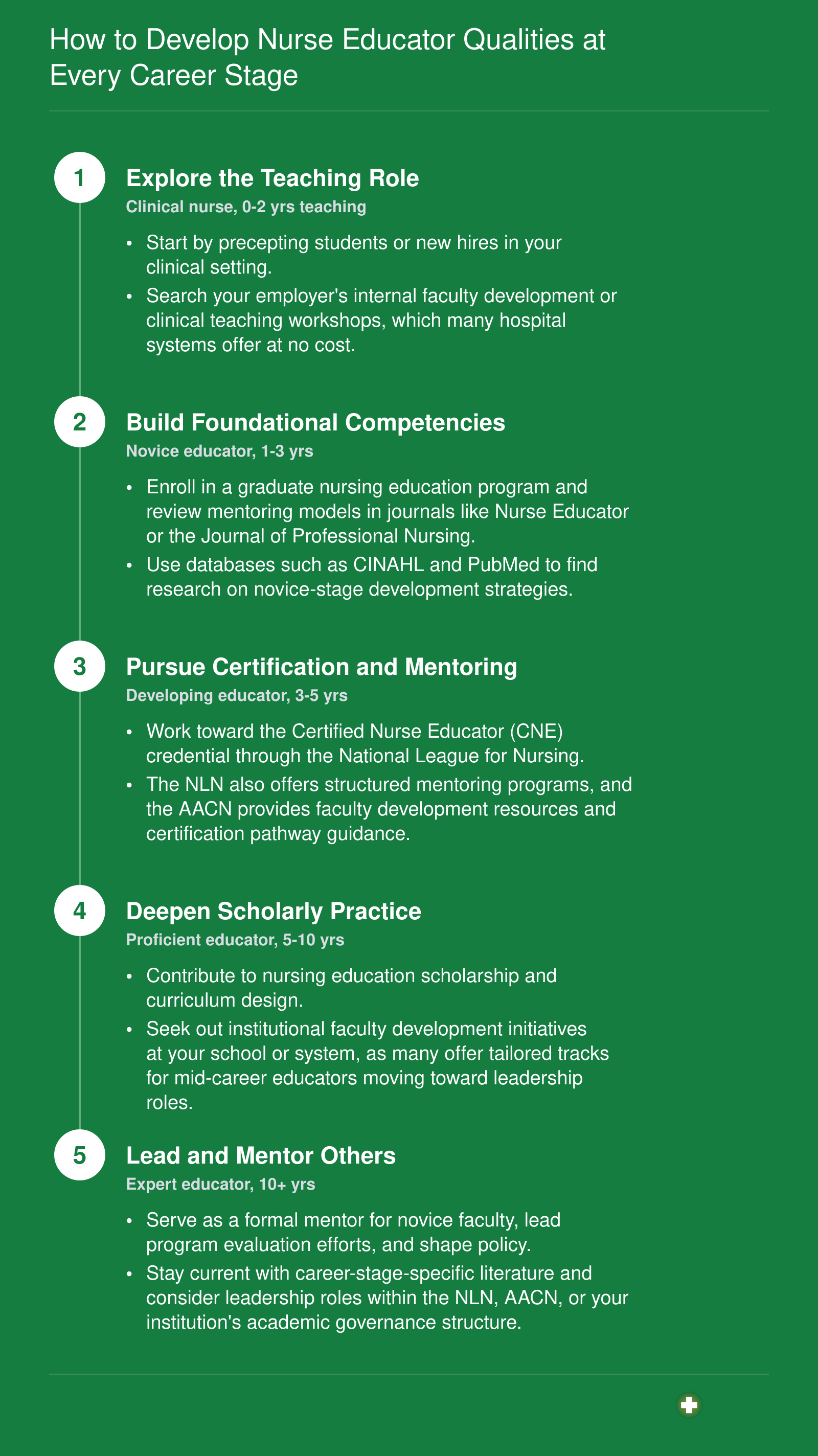
How to Develop Nurse Educator Qualities at Every Career Stage
Building educator qualities is not a one-time event. It is a deliberate, career-long process that looks different depending on where you are in your journey. The resources below can help you target the right growth activities at each stage. For salary benchmarks and job outlook data, consult BLS.gov directly, keeping in mind that figures vary by institution, region, and career stage.
Demonstrating Your Qualities to Employers and Programs
Hiring committees and MSN admissions panels are increasingly specific about what they want to see from candidates, which means pointing to your qualities in general terms is rarely enough anymore. The nurses who stand out are those who can show their competencies in concrete, documented form.
Build a Teaching Portfolio
A teaching portfolio is the most direct way to translate your educator identity into something reviewers can evaluate. At minimum, yours should include:
- Teaching philosophy statement: A concise narrative, typically one to two pages, explaining how you approach learning, what you believe students need, and how your clinical background shapes your educational values.
- Sample lesson plans or curricula: Even informal ones you developed for staff orientation or patient education count. Format them so the learning objectives and assessment methods are visible.
- Peer evaluations: If a colleague or manager observed you teaching, ask for written feedback you can include.
- Student or learner feedback: Preceptee comments, post-training surveys, or evaluations from continuing education sessions all work. Anonymize as needed.
A portfolio does not need to be elaborate. A well-organized PDF or simple website that walks a reviewer through your approach and evidence is more effective than a lengthy document with no clear thread.
Translating Clinical Experience Into Educator Language
Your CV and application essays carry the most weight in MSN admissions and academic hiring. Clinical titles and responsibilities do not automatically read as teaching competencies, so you need to make the translation explicit. Our Nurse Educator Resume Guide walks through this process in detail.
When describing past roles, frame contributions around education-adjacent actions: developed training protocols, mentored new staff through skills acquisition, identified knowledge gaps during quality improvement reviews. This language maps your experience onto the NLN Nurse Educator Core Competencies framework, which hiring committees and program faculty recognize immediately.
The CNE Credential as a Signal of Readiness
The National League for Nursing's Certified Nurse Educator (CNE) credential formalizes the competencies that employers look for. Holding the CNE, or even being actively enrolled in preparation for it, signals to hiring committees that you understand the academic role as a discipline in its own right, not just an extension of clinical practice.
Concrete Tips for MSN Applicants
If you are applying to an MSN nursing education program, three moves will strengthen your application noticeably:
- Reference specific qualities from the NLN competency framework in your personal statement rather than speaking in general terms about enjoying teaching.
- Align the experiences you describe to competency domains such as facilitating learning, using assessment and evaluation strategies, or pursuing continuous quality improvement.
- Request recommendation letters from supervisors or colleagues who have directly observed you in a teaching or mentoring role, and brief them on what you want emphasized. A letter that speaks to your ability to explain complex clinical concepts is far more useful than a general character reference.
Preparing for the interview stage is just as important. Familiarize yourself with common nurse educator interview questions so you can articulate your teaching philosophy and competencies under pressure.
Nurse Educator Salary and Career Outlook
Understanding salary data helps you benchmark your earning potential and negotiate from a position of strength, especially given the current nursing faculty shortage. In 2025, AACN reported 1,588 faculty vacancies across nursing programs nationwide, with a 7.2% vacancy rate and over 80,000 qualified applicants turned away from baccalaureate and graduate nursing programs in 2024 alone. The Bureau of Labor Statistics projects 18 to 19% job growth for postsecondary nursing instructors between 2024 and 2034, far outpacing the 5% growth rate for registered nurses overall. Developing the qualities outlined throughout this article positions you competitively in a market where demand for skilled educators continues to surge, and institutions are actively competing for talent.
| State | Median Annual Salary | 25th Percentile | 75th Percentile | Total Employment |
|---|---|---|---|---|
| California | $99,010 | $65,510 | $124,290 | 6,120 |
| Texas | $97,610 | $73,670 | $123,360 | 5,940 |
| New York | $93,640 | $63,540 | $128,930 | 5,380 |
| Alaska | $92,050 | $82,800 | $105,590 | 190 |
| Montana | $84,550 | $66,280 | $105,390 | 230 |
Great nurse educators are made, not born. The 15 qualities covered here are learnable, measurable, and grounded in established competency frameworks like those from the NLN. Developing them through deliberate practice and formal education is one of the most reliable ways to improve student outcomes and build a lasting, impactful career in nursing education.
FAQ: Common Questions About Nurse Educator Qualities
These are some of the most frequently asked questions about the qualities of a good nurse educator, from competency frameworks to practical skill-building strategies. If you are considering a move from clinical practice into teaching, these answers can help you plan your next steps.