
What you’ll learn in this article…
- Carthage College's 15-month MSN for nurse educators starts February 2027.
- Faculty shortage caused Wisconsin nursing schools to reject 1,500+ qualified applicants in 2024.
- Nurse educators in the Chicago metro earn a median $88,090 annually.
Carthage College in Kenosha, Wisconsin, will welcome its first cohort of students into a new 15-month Master of Science in Nursing (MSN) Nurse Educator program in February 2027.1
The program arrives as nursing schools nationwide turn away thousands of qualified applicants each year, largely because there are too few faculty to teach them. Wisconsin is not immune: baccalaureate and graduate nursing programs in the state consistently report unfilled faculty lines and capped admissions. The nurse faculty vacancy rate nationally stood at 7.2% in 2024, a figure that underscores just how acute the hiring gap has become.
An accelerated, educator-specific track like Carthage's could funnel experienced nurses into classrooms in 15 months, compared with the two-to-three-year timelines typical of other Wisconsin offerings, a short runway that might directly address the shortage at its source.
Why Carthage College Launched an MSN Nurse Educator Program Now
The nursing faculty shortage has reached a critical tipping point, with consequences that ripple from classrooms to hospital bedsides.
The National Faculty Shortage by the Numbers
In 2024, the American Association of Colleges of Nursing reported 1,588 full-time faculty vacancies across 863 nursing schools, a 7.2% vacancy rate.1 This gap forced programs to turn away 80,162 qualified applicants, deepening the clinician pipeline crisis.1
Wisconsin Nursing Programs Under Pressure
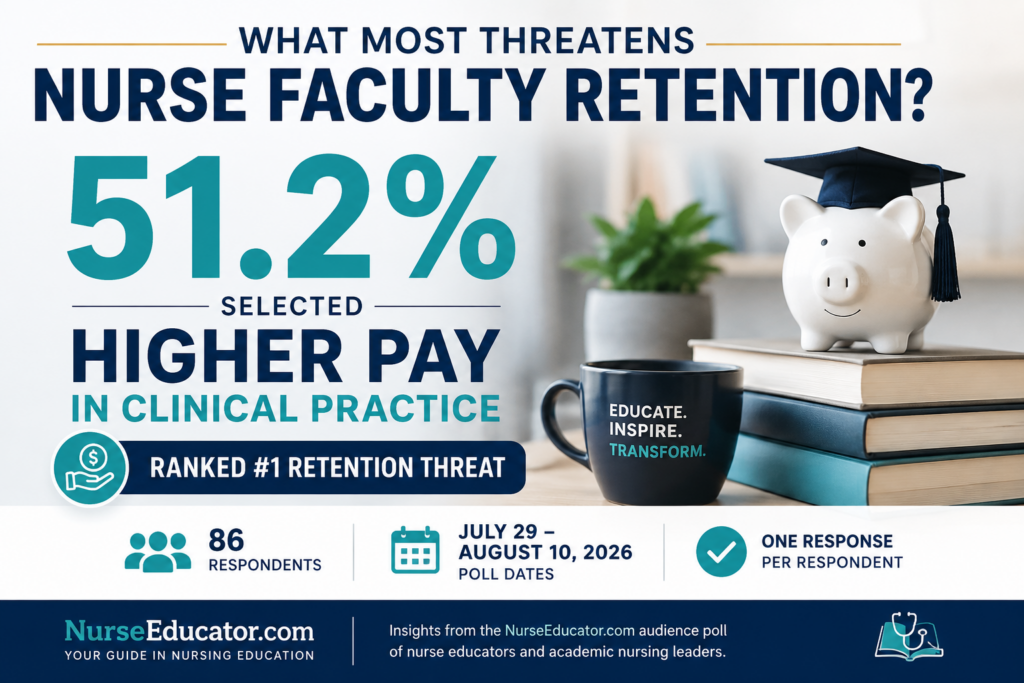
While state-level data on unfilled slots is not uniformly reported, Wisconsin nursing programs face the same headwinds. Faculty retirements, competition from higher-paying clinical positions, and enrollment growth all constrain how many new nurses schools can admit.
Breaking the Cycle with Educator-Focused MSN Programs
The shortage creates a vicious cycle: fewer faculty leads to fewer graduates, worsening bedside shortages, driving burnout, and discouraging experienced nurses from pursuing teaching. nursing faculty shortage data makes clear just how entrenched this pattern has become. Carthage College's new MSN Nurse Educator program, announced on June 9, 2026, is a direct countermeasure. It is designed specifically to prepare experienced nurses to teach, mentor, and lead in both academic and clinical settings, equipping them to fill the faculty gap and reverse the cycle.
Program Structure: Curriculum, Format, and Timeline
The Carthage College Master of Science in Nursing (MSN) with a Nurse Educator focus is an accelerated 15-month graduate program built for working RNs who want to move into teaching roles without pausing their careers.1 The program blends online coursework with essential on-campus experiences, guiding experienced nurses through a 41-credit curriculum that culminates in two hands-on teaching practicums and a capstone project.
Delivery Format and Schedule
Courses are delivered primarily online, offering flexibility for working professionals, but the program also requires periodic on-campus sessions at Carthage's Kenosha, Wisconsin campus.2 This hybrid structure lets you maintain employment while engaging in face-to-face workshops, simulations, and peer collaboration. The program spans four consecutive semesters, with the first cohort starting in Spring 2027 (February). Because the format is mostly asynchronous, you can generally plan your study time around a full-time work schedule, though specific weekly time commitments will vary by course load and semester. If you want to compare how this format stacks up against similar options, our guide to online nurse educator program advantages breaks down what to look for.
Curriculum and Credit Hours
The 41-credit plan of study integrates graduate nursing core content with specialized nurse educator preparation.3 Foundational courses include Theoretical Foundations of Nursing Practice (NSG 500, 3 credits) and Advanced Pharmacology (NSG 502, 3 credits), ensuring you deepen your clinical expertise while you learn to teach. Educator-focused coursework covers curriculum design, assessment strategies, and instructional methods for both academic and clinical settings. The entire sequence is mapped to the National League for Nursing's nurse educator competencies, intentionally preparing you for the Certified Nurse Educator (CNE) exam upon graduation.
Clinical Practicums and Capstone
Two dedicated practicums form the backbone of your hands-on training:3 - Practicum in Academic Nursing Education (NSG 514, 3 credits): You'll teach in a classroom or lab setting under the mentorship of an experienced faculty member. - Practicum in Clinical Nursing Education (NSG 515, 3 credits): You'll guide nursing students in a clinical or simulation environment, applying your own bedside experience to precept the next generation.
A final Capstone course (NSG 516, 4 credits) allows you to develop an evidence-based educational project that addresses a real-world teaching challenge. Exact clock-hour requirements for the practicums are not yet publicly available; interested students should contact the program coordinator for those details.
Accreditation and Certification Eligibility
Because the MSN Nurse Educator program is new, Carthage College has not yet disclosed its accreditation status with the Commission on Collegiate Nursing Education (CCNE) or the Accreditation Commission for Education in Nursing (ACEN).3 Generally, graduates of an appropriately accredited master's program with a nurse educator focus are eligible to sit for the CNE exam. Prospective students are encouraged to verify the program's accreditation and certification outcomes directly with Carthage's admissions office before applying.
Tuition, Financial Aid, and ROI for Nurse Educators
A private university tuition bill can look like a steep cliff, but targeted loan-forgiveness programs can build a sturdy financial bridge. For nurses eyeing the new MSN Nurse Educator track at Carthage College, understanding the cost is only half the picture. The real story is in the funding tools that can slash out-of-pocket expenses and boost long-term return.
Understanding the Cost of a Private MSN Program
Because Carthage's MSN Nurse Educator track is brand new, exact per-credit rates and total program fees haven't been widely published yet. Private programs often carry a higher sticker price than in-state public options, but they also commonly bundle intensive student support, accelerated timelines, and close faculty mentorship into that cost. To get the most current numbers, reach out directly to the Carthage financial aid office or monitor the program's official webpage. When you do, ask for a breakdown that includes tuition, fees, books, and any technology or clinical placement costs so you can compare apples to apples. If cost is a deciding factor, it's also worth comparing affordable online nurse educator MSN programs to understand the full range of what's available.
The Nurse Faculty Loan Program: A Game-Changer for Educators
The Health Resources and Services Administration (HRSA) runs the Nurse Faculty Loan Program (NFLP), which can make a private MSN dramatically more affordable. If Carthage participates, and many Wisconsin schools do, MSN nurse educator students may borrow up to the full cost of attendance and then have up to 85% of the loan forgiven over four years of post-graduation teaching in an accredited nursing school. Check the HRSA website for current eligibility rules and forgiveness terms, and ask Carthage's financial aid counselors whether NFLP funds are available for this cohort. Pairing NFLP with other aid like employer tuition reimbursement or scholarships can bring your net cost down to a fraction of the headline price.
Weighing Your Return on Investment
A quick ROI calculation starts with salary data. Nurse educators in Wisconsin and the Chicago metro area earn median wages well above the state's registered nursing average, and the Bureau of Labor Statistics publishes updated regional figures. Compare your projected total program cost (after NFLP and any other aid) to the expected salary bump or new earning potential as a full-time faculty member. Professional organizations like the National League for Nursing (NLN) and the American Association of Colleges of Nursing (AACN) occasionally release alumni outcome surveys that can give you a sense of job placement rates and early-career earnings. Because Carthage's program is cohort-based and designed for working nurses, many students may continue earning a clinical salary while studying, further improving the math. The broader nursing faculty shortage context also matters here: strong demand for qualified educators translates into genuine job security once you graduate. Always cross-reference multiple sources, including school financial aid counselors, HRSA fact sheets, and nursing workforce surveys, to make a fully informed decision.
Admission Requirements and How to Apply
Carthage College has not released the complete admission requirements for the new MSN Nurse Educator program. The following reflects typical expectations for such programs and Carthage’s general graduate admissions framework. Check the official program page for final details.
- Expected prerequisitesAn active, unencumbered RN license, a BSN from an accredited institution, and a minimum 3.0 GPA are common. Some programs require a year or more of clinical experience and undergraduate statistics.
- Application materialsBe ready to submit official transcripts, a professional résumé, a goal statement, and 2–3 professional references. The program may request a copy of your RN license and a completed prerequisite form.
- Strengthening your applicationEmphasize any teaching, precepting, or charge nurse experience. A clear goal statement explaining why you want to transition into academia and your long-term commitment to nursing education can set you apart.
- Timeline for the February 2027 cohortApplications are now open for the inaugural spring 2027 start. Submit materials early; exact deadlines will be posted on Carthage’s MSN Nurse Educator website.
Nurse Educator Salaries in Wisconsin and the Chicago Metro Area
Based on 2024 data from the U.S. Bureau of Labor Statistics, the table below compares recent salary figures for nursing instructors and teachers with those of registered nurses and nurse practitioners in two key regions. Since Kenosha is part of the Chicago-Naperville-Elgin metro statistical area, the Chicago median of $81,430 is a locally relevant benchmark for nurse educators completing Carthage's program. Percentiles provide additional context; for example, the middle 50% of nurse educators in Chicago earn between $61,190 and $102,170 annually.
| Metro Area | Occupation | Annual Median Wage | Annual Mean Wage |
|---|---|---|---|
| Chicago-Naperville-Elgin, IL-IN | Nursing Instructors and Teachers, Postsecondary | $81,430 | $86,310 |
| Chicago-Naperville-Elgin, IL-IN | Registered Nurses | $96,480 | $94,580 |
| Chicago-Naperville-Elgin, IL-IN | Nurse Practitioners | $131,690 | $131,580 |
| Milwaukee-Waukesha, WI | Nursing Instructors and Teachers, Postsecondary | $79,810 | $77,730 |
| Milwaukee-Waukesha, WI | Registered Nurses | $83,990 | $91,040 |
| Milwaukee-Waukesha, WI | Nurse Practitioners | $129,760 | $130,020 |
Related Articles
How Carthage Compares to Other Wisconsin MSN Nurse Educator Programs
Choosing an MSN nurse educator program means balancing time, cost, and learning format. Carthage College's new 15-month program enters a landscape where most Wisconsin options take two years or more. Below, we compare Carthage with two established nurse educator tracks in the state: UW-Oshkosh and Carroll University.
Program Length and Delivery Format
Carthage compresses the educator MSN into a 15-month accelerated schedule, a sharp contrast to the 24-month timelines at UW-Oshkosh1 and Carroll.3 That means working nurses can transition to faculty roles nearly nine months faster. While Carthage's delivery format is still being finalized, the accelerated pace suggests a streamlined, cohort-based model that minimizes time away from clinical practice.
UW-Oshkosh offers its 37-credit nurse educator MSN entirely online, ideal for nurses who need location flexibility.2 Carroll University's 40-credit program uses a hybrid model, blending online coursework with periodic on-campus intensives.3 Both are well-suited to distance learners, but neither matches Carthage's speed to completion.
Curriculum and Credit Requirements
- UW-Oshkosh: 37 credits, online, CCNE-accredited.1
- Carroll University: 40 credits, hybrid, CCNE-accredited.3
- Carthage College: Credit totals are not yet published, but the 15-month duration points to a concentrated, high-intensity curriculum designed for quick mastery.
Because Carthage's program is built specifically to address the nurse educator shortage, expect a curriculum heavy on teaching practicums, curriculum design, and assessment strategies, all embedded within a tight timeframe. UW-Oshkosh and Carroll spread similar content over two years, giving students more breathing room but slower entry into faculty roles.
Location and Cohort Experience
Carthage sits in Kenosha, squarely between Milwaukee and Chicago. This metro-region placement opens doors to clinical teaching sites in large health systems and community colleges across southeastern Wisconsin and northeastern Illinois. As a new program, Carthage is likely to launch with intentionally small cohorts, offering more personalized faculty mentorship and closer ties to local hiring networks. In contrast, UW-Oshkosh's fully online model draws students statewide, and Carroll's hybrid format serves a mix of regional and commuting students. For a broader look at nurse educator programs in Wisconsin, the state has several accredited options at varying paces and price points.
Accreditation and Program Maturity
Both UW-Oshkosh and Carroll hold CCNE accreditation, a stamp of quality that students and employers recognize. Carthage's MSN is new, but the college's existing BSN and graduate programs hold regional accreditation, and nursing accreditation is typically sought once a program has enrolled its first cohort. Prospective students can verify accreditation status and expected CCNE candidacy with the nursing department.
Carthage's key differentiators remain its 15-month pace, its strategic Kenosha-Chicago corridor location, and the tight-knit, updated curriculum that only a newly launched program can offer. For nurses eager to enter the classroom quickly, it is a compelling alternative to longer, more established options.
Career Paths and CNE Certification After Your MSN
Earning your MSN in nursing education from Carthage College opens doors to diverse roles in academic and clinical settings, along with eligibility for the Certified Nurse Educator (CNE) credential, a nationally recognized mark of teaching excellence.
Career Paths You Can Pursue with Your MSN
The program prepares you for positions that directly shape the next generation of nurses. Common roles include:
- Academic faculty: Teach in ASN, BSN, or MSN programs as an adjunct or full-time instructor, often with opportunities for course coordination.
- Clinical educator: Bridge classroom knowledge and patient care by supervising students or training staff in a hospital or health system.
- Staff development coordinator: Design and deliver orientation, continuing education, and competency programs for nursing teams.
- Simulation lab director: Manage high-fidelity simulation experiences, integrating technology to enhance clinical reasoning skills.
These roles let you leverage your clinical expertise while building educational leadership. If you are weighing your options, a closer look at the academic vs clinical nurse educator distinction can help you choose the setting that fits your goals.
Why the CNE Certification Matters
Offered by the National League for Nursing (NLN), the CNE credential validates your mastery of the nurse educator role.1 Carthage's MSN, with its 41-credit focus on nursing education, satisfies the academic requirement because it provides a major emphasis in education.1 To sit for the exam, you also need an active RN license and two years of employment in an academic nursing program within the last five years.1 New educators with less experience can pursue the CNE Novice designation, designed for those in their first three years of academic practice.2
Becoming CNE-certified signals to employers that you have evidence-based teaching skills, which can lead to broader career opportunities, higher nurse educator salaries, and eligibility for leadership roles like program director or dean.
Projected Job Growth for Nurse Educators
The U.S. Bureau of Labor Statistics projects a 7% growth rate for postsecondary nursing instructors through 2029, faster than the average for all occupations.3 This demand is fueled by the ongoing nurse faculty shortage, as thousands of qualified applicants are turned away from nursing schools each year due to insufficient educators. Your MSN positions you squarely in this high-need field.
A Stepping Stone to Doctoral Study
This MSN also builds a strong foundation for future doctoral work. Graduates commonly continue to a Doctor of Nursing Practice (DNP) or a PhD in nursing, which opens doors to tenure-track faculty positions, academic administration, and advanced research. Carthage's curriculum aligns with the competencies needed for doctoral-level nursing education, making the transition smooth.
Steps to Become a Nurse Educator in Wisconsin
Transitioning from clinical practice to nursing education requires a clear pathway. Carthage College's new MSN Nurse Educator program accelerates the credentialing step, but your journey begins long before. Follow this roadmap to advance into a faculty role.

Frequently Asked Questions About the Carthage MSN Nurse Educator Program
Here are answers to common questions about Carthage College's new MSN Nurse Educator program. If you have additional queries, reach out to the admissions team directly.
What are the admission requirements for Carthage College's MSN Nurse Educator program?
Specific admission criteria were not detailed in the program launch announcement. Typically, MSN programs require an active, unencumbered RN license and a Bachelor of Science in Nursing from an accredited institution. For the most current requirements, contact Carthage College directly.
How long is the Carthage College MSN Nurse Educator program?
The program is designed to be completed in 15 months of full-time study. The first cohort begins in February 2027, preparing experienced nurses for faculty roles in a streamlined timeframe.
How much does the Carthage MSN Nurse Educator program cost?
Tuition and fee details have not yet been publicly released for this new program. Prospective students should inquire with Carthage College's admissions or financial aid office for the most accurate and up-to-date cost information.
Is the Carthage MSN Nurse Educator program online or in-person?
The delivery format was not specified in the initial announcement. Carthage College may offer on-campus, hybrid, or online options. Contact the program directly to learn about course delivery methods and any required on-site components.
What salary can nurse educators expect in Wisconsin?
Nurse educator salaries in Wisconsin vary by institution, experience, and geographic location, but they generally align with advanced practice nursing roles. For detailed local data, refer to the Bureau of Labor Statistics or state-specific workforce reports.
Does the Carthage MSN qualify graduates to sit for the CNE exam?
The program is designed to align with the core competencies for the Certified Nurse Educator exam. Graduates typically meet educational eligibility, but always verify current requirements with the National League for Nursing.