
What you’ll learn in this article…
- Lewandowski's power-outage simulation cut evacuation times by 90 seconds in three months.
- Simulation replaced up to 50% of clinical hours in NCSBN's 2014 study.
- Chamberlain's MSN educator practicum requires 144 hours, 96 of them education-focused.
Strong bedside nurses and strong instructors are not the same people, and a program that hires the first while hoping for the second usually pays for it in turnover. Eleven years in a medical ICU builds deep clinical judgment, but it does not teach someone the nurse educator responsibilities of writing a course objective, running a debrief, or grading a care plan fairly.
Adriane Lewandowski, a former ICU nurse now at the University of Hawaiʻi at Hilo, won the 2026 Chancellor's Award for Excellence in Teaching only two years after arriving. Her path runs through the sections that follow as a working example.
Most nursing faculty still get little structured support after the offer letter, and that is where mentoring either closes the gap or fails to.
Why Mentoring Expert Clinicians Into Educators Matters
Mentoring an expert clinician into an educator means pairing a nurse who already knows patient care deeply with an experienced faculty member who helps them learn a second, very different craft: teaching. A veteran ICU nurse can manage a crashing patient with calm precision, but that skill does not tell her how to write a course objective, grade a care plan fairly, or coach a struggling student through a first clinical rotation.
Clinical Expertise Is Not Teaching Expertise
New nurse faculty arrive as experts and, almost overnight, become novices again. The transition literature describes what they lose: the immediate feedback of a patient improving, the autonomy of bedside judgment, and the comfort of a mastered role. In its place comes a stack of unfamiliar responsibilities, often all at once:
- Course design: building syllabi, objectives, and assessments aligned to program outcomes.
- Grading and evaluation: making and defending decisions about student performance.
- Clinical supervision: keeping a group of students safe on a unit you no longer staff.
- Scholarship and service: expectations that may stay vague until review time.
That cognitive load peaks in the first year, when a new instructor has the fewest supports.
The Retention Stakes
The numbers explain why schools cannot afford to lose these hires. AACN's special survey on vacant faculty positions for the 2025-2026 academic year, released in October 2025, counted 1,588 full-time nursing faculty vacancies, a national vacancy rate of 7.2%. Schools also reported needing about 150 additional positions beyond those vacancies to meet student demand. AACN points to noncompetitive salaries and a limited pool of doctoral-prepared educators as contributors to the nursing faculty shortage. Retirements add longer-term pressure: an AACN-cited projection from 2015 estimated that roughly one-third of that year's faculty would retire by 2025. Current national turnover figures from the NLN were not available, so treat the retirement estimate as a signal of direction rather than a precise count.
What Happens Without a Mentor
Unmentored new faculty tend to follow one of two paths. Some leave, returning to clinical roles where the work feels familiar and the pay is often better than a nurse educator salary. Others stay but teach the way they were taught, leaning on lecture and memorization because no one showed them alternatives like structured debriefing or simulation design.
Neither outcome serves students. What mentors can actually do comes next: choose a mentorship model, set clear expectations, protect time, build scholarship skills, and recognize excellent teaching publicly, including through award nominations.
Case Example: What One Award-Winning Instructor's Path Teaches Mentors
Nursing education now rewards evidence of measurable teaching impact as much as clinical experience. For mentors, that raises a practical question: how do you verify the signal behind a colleague's award or simulation-based nursing education result before using it in a nomination or development plan? Start with the UH Hilo Chancellor's profile of Adriane Lewandowski and read it as a source-checking exercise, not a summary. Use the steps below to turn one public story into a defensible evidence base for faculty development.
What to Look For in the Primary Source
As you open the profile, look for four types of evidence: nursing roles, award citation language, simulation details, and scholarship. The profile may include a 2026 Chancellor's Award for Excellence in Teaching entry with language about teaching effectiveness, personal values, academic advising, and subject mastery. Search for the power-outage evacuation simulation and any reported change in evacuation time. Also note the presentations and publications listed, but treat any missing items as open questions rather than conclusions.
A Short Source-Verification Checklist
- Check the UH Hilo Chancellor's office and School of Nursing pages for the instructor profile and award announcement.
- Open the UH system faculty-award page to read the current criteria for the Chancellor's Award for Excellence in Teaching.
- Use BLS.gov for broad nursing career-path and outlook context, not program-specific claims.
- Consult AACN, NLN, or Sigma for discipline-specific expectations around faculty scholarship and simulation.
For each source, note what it confirms and what it leaves open. A nursing program page may reproduce the award language but omit simulation outcomes; a federal data page will not tell you how the instructor performs in a classroom.
When the Public Record Is Incomplete
If presentation or publication lists are absent, do not assume the work does not exist. Compare the public award record against any program outcomes or simulation reports you can locate. Contact the nursing department or public information office for a fuller list. Record what you requested and the date; unavailable items are still useful evidence gaps to document.
Turn Source-Checking Into an Evidence File
Build a simple evidence file for nurse educator awards nominations, mentee guidance, or program comparisons. For each claim, record the exact URL, access date, and what was missing. That way your mentoring advice rests on verifiable public information rather than unverifiable summaries.
Mentorship Models for New Nurse Educators, Compared
No single model fits every program. Small schools with a handful of full-time faculty usually get the most from a one-to-one dyad paired with structured onboarding, while larger programs can support team mentoring and a mentor-preparation academy. If you rely heavily on adjunct or remote clinical instructors, pair peer mentoring with an online, competency-based onboarding curriculum so no one is left to figure out the role alone.
| Model | How it works | Goals it serves | Evidence and evaluation reported | Adjunct or remote fit |
|---|---|---|---|---|
| One-to-one (traditional dyad) | New faculty member paired with one experienced mentor for individualized guidance and role socialization | Recruitment, retention, fitting into academic culture, building teaching expertise | Widely described in the literature; limited time and weak faculty support are the most common barriers | Workable by video meetings if protected time is scheduled |
| Team mentoring | Mentee supported by a team: dyad partner, department chair, senior faculty, and someone outside the department | Access to multiple experts, leadership support, broader perspectives | Model is described but not shown to outperform other approaches | Harder to coordinate across schedules; assign clear roles |
| Peer mentoring | Faculty of similar rank or experience share information and solve problems as equals | Mutual support, shared problem-solving, reduced isolation | NLN presents it as one option, not a replacement for senior mentoring | Strong fit for adjunct cohorts who meet virtually |
| Speed mentoring | Mentee interviews each potential mentor for 5 minutes using prepared questions, then rates each encounter | Fast exploration of mentor fit before committing | Encounter ratings guide selection; no evidence it alone improves retention or teaching competence | Useful as a kickoff event for dispersed faculty |
| Pre-teaching attachment | Prospective or novice educator attached to an experienced educator before or while preparing to teach | Early socialization, clinician-to-educator transition, role orientation | Needs a formal orientation and mentorship process to cover the full role | Best for clinicians moving into part-time teaching |
| Structured onboarding mentorship | 8-week onboarding with weekly mentor meetings and an online curriculum built on NLN Nurse Educator Core Competencies | Competency-based transition into academia | Reported from a quality-improvement project, not a controlled trial | Online curriculum suits remote and adjunct faculty |
| Mentorship Academy plus Mentor-the-Mentors | Seasoned faculty trained to mentor; new faculty attend an academy covering promotion and tenure, active learning, and LMS navigation | New-faculty success, satisfaction, retention, and mentor readiness | Literature stresses ongoing mentor training, evaluation, and follow-up | LMS navigation content helps faculty teaching online |
Who Qualifies as a Nurse Educator Mentor: Qualifications, Training, and Workload
Eligibility: Skill Beats Seniority
No source we reviewed sets a universal rule for mentors, such as a required rank, tenure status, or number of teaching years. Programs do commonly look for a graduate degree, a track record of sound teaching, and credentials such as the CNE. The recurring features in the literature, though, are competence, institutional knowledge, and a willingness to do the work. Being senior faculty is not the same as being a good mentor. Someone who has taught for twenty years but never gives feedback will help a new instructor less than a third-year colleague who observes, listens, and knows where the syllabus templates live.
Selecting, Training, and Matching
Hanover Research's review of faculty mentoring stresses careful selection, clear expectations, voluntary participation, orientation, and letting participants have a say in pairings.1 The NLN's mentoring tool kit, written for early-, mid-, and late-career educators, points the same way. It suggests that training come through the nursing department, college, or university.2 Matching matters because a clinician becoming a nurse educator needs different things from a mentor than a seasoned adjunct navigating the nursing faculty tenure process. Consider pairing by teaching context (simulation, clinical, or didactic) before you pair by rank.
Workload Credit, Release Time, and Stipends
Nursing-faculty literature names time as the main barrier to mentoring and recommends workload credit, release time, or stipends. The NLN likewise recommends workload credit and stipends. A few institutional examples show what this looks like:
- Columbus State Community College: All new full-time faculty take part in mentoring, which runs up to two semesters. Mentors receive release time or professional-development funds. Listed release time is 1 to 4 load hours in the first semester and 1 to 2 in the second. Listed funds are $650 and $350 respectively. Awards depend on the semester.3
- University of Memphis Loewenberg College of Nursing: The workload policy grants 1 TC of credit per student mentored, with additional credit when the mentor is also faculty of record. That policy appears to concern student mentoring, so treat it as a model for counting mentoring work, not as a faculty-mentor formula.4
No single policy we found combines eligibility, required training, credit, stipend, and separation from evaluation, so plan to assemble your own.
Keep Mentoring Apart From Evaluation
The sources do not state a firm rule here, but we recommend it as practice. Where possible, a mentor should not be the person who writes the mentee's reappointment or performance review. New instructors admit struggles with grading, faculty incivility, or simulation debriefs only when candor carries no risk to their file. If your school is small and overlap is unavoidable, put confidentiality in the written mentoring agreement.
Recognition That Keeps Mentors Engaged
The NLN urges administrators to reward mentors, not merely thank them.5 Options to consider include:
- Counting mentoring as documented service in annual reviews.
- Naming mentoring explicitly in promotion and tenure criteria.
- Nominating mentors for internal or NLN recognition.
Mentoring in MSN Nurse Educator Programs and Early Teaching Roles
Chamberlain University requires 144 practicum hours for students in MSN nurse educator programs, split into 48 direct-care hours and 96 education-focused hours under an MSN-or-higher mentor. Practicum requirements vary widely across programs, however, and reported figures are not directly comparable because definitions of practicum, clinical, and teaching hours differ. For example, Worcester State lists 60 teaching-practicum hours, Arkansas State lists 180, and Ohio University reports 500 total hours including direct patient care and teaching.
How Mentored Teaching Practicums Are Structured
Mentor qualifications are set at the program level. Some programs require an MSN or higher, while others accept a BSN plus a master's in another discipline. Experience requirements also vary, from one year to three years in a current role, depending on the school. Chamberlain's model pairs students with faculty guidance and an MSN-or-higher mentor; Sura College uses selection criteria for preceptors with at least one year of experience.
Program-Assigned vs. Student-Selected Mentors
Placement models differ. Worcester State assigns a mentor as part of the practicum. Ottawa University asks students to identify a preceptor with an MSN or higher and two years of current role experience, subject to instructor or designee approval before the practicum starts. Many online nurse educator programs allow students to arrange a local preceptor or site, but this is not universal. Online delivery typically covers coursework and supervision, while in-person teaching and clinical practice occur at an approved local site.
Accreditation and Early Faculty Development
CCNE, ACEN, and NLN do not mandate a specific number of mentored teaching-practice hours or a universal mentor degree. Instead, accredited programs commonly operationalize supervised role preparation through approved educational and direct-care practice experiences. Mentors can help new graduates prepare for doctoral study by co-developing a scholarly agenda in nurse-led research in education, including topics such as burnout across the student-to-practice transition. Evidence linking specific mentoring designs to that outcome remains limited, so early faculty should treat these directions as exploratory rather than proven.
Building a Faculty Development Program That Retains Educators
A faculty development program keeps educators when it runs on a schedule, collects data, and never leaves a new hire guessing about support. Good intentions and an occasional coffee chat do not count.
Set a Cadence and a Feedback Loop
Match meeting frequency to how much a new instructor needs. Meet weekly through the first semester, move to biweekly in the second, then settle into monthly check-ins. Each cycle should follow the same loop:
- Observe: The mentor sits in on a lecture, lab, simulation, or clinical day, using a shared rubric to spot evidence-based teaching strategies for nursing educators.
- Debrief: Meet within a few days, while the session is fresh, and start with the mentee's own read of it.
- Reset goals: Write one or two specific goals for the next cycle and record them.
The 12-month calendar graphic is the operating plan. It lays out when each step happens so no one has to improvise.
Track What Matters
Choose a small set of measures and review them on a fixed schedule:
- New-faculty retention at one, two, and three years
- Mentee satisfaction with the mentoring relationship
- Classroom and clinical observation ratings over time
- Student evaluations for mentees' courses
- Scholarship output, such as presentations, posters, and manuscripts
Pair the numbers with exit and stay interviews. They often explain what a percentage cannot.
What the Evidence Shows, and Where It Stops
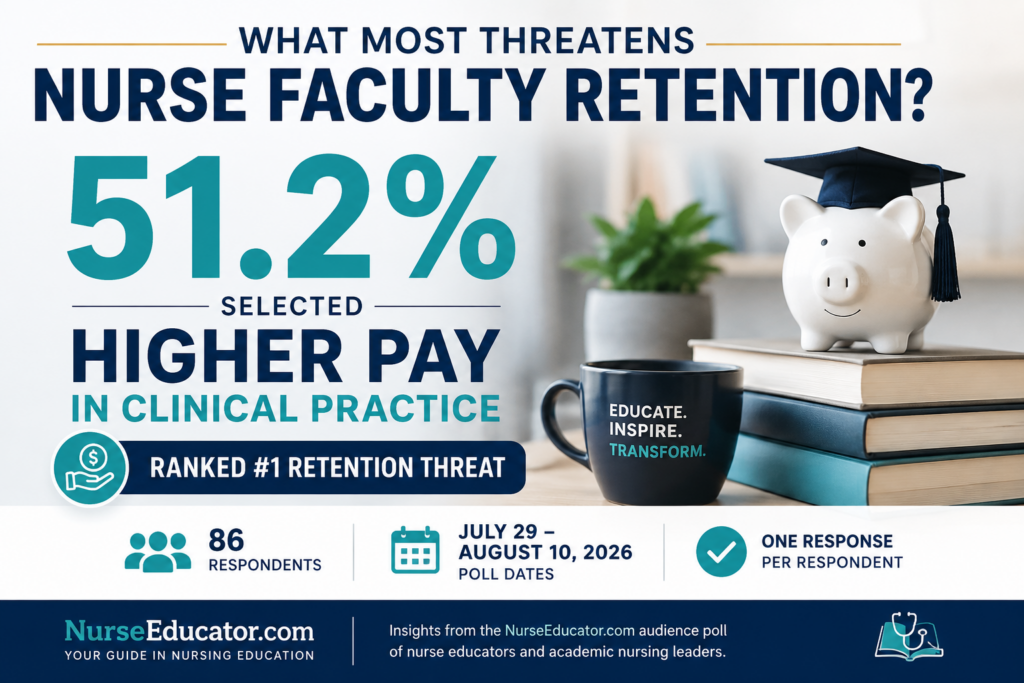
The strongest recent signal is an association, not proof. A 2024 study in Nurse Educator surveyed 496 nursing faculty (221 current, 275 former). Among current faculty, 77.1% of those wishing to remain reported adequate mentorship, compared with 63.3% of those considering departure. Current faculty overall reported adequate mentorship more often than former faculty, 71.5% versus 56%. Departing faculty also named low compensation, unrealistic workload, retirement, and lack of appreciation as reasons for leaving.
Read that carefully. The study does not show that a mentoring program caused anyone to stay. One implementation report described 100% retention two years after a novice-faculty mentoring project, but it does not establish how many participants were involved, whether a comparison group existed, or whether the figure covered everyone. A 2023 analysis of associate-level faculty found that job satisfaction was linked to intent to remain, while satisfaction with mentoring did not predict it. The NLN recommends structured mentoring for all new faculty hires, but its guidance offers recommendations rather than measured retention effects.
The practical takeaway: mentoring is one part of nursing faculty retention strategies, sensible and low-cost, but not a substitute for fair pay and workable workloads. Track your own numbers so your program builds its own evidence.
What Should a New Nursing Faculty Member's First Year of Mentoring Look Like?
Structure beats good intentions. Use this four-phase calendar to pace meetings and anchor each stage to one concrete deliverable, so your mentee moves from orientation to scholarship and recognition within a single academic year.

Related Articles
How to Nominate and Support Nursing Faculty for Teaching Awards
What does it actually take to get a nursing instructor nominated for a teaching award, and when should you start? The honest answer: the file that wins is assembled across semesters, not the week before a deadline.
The five-step nomination process
- Identify candidates early. Keep a running list of faculty whose course redesigns, simulation work, or advising load stand out. Novice educators are often overlooked because nobody is tracking their wins.
- Read the criteria before you write anything. Award language varies enormously, and a nomination statement that ignores the published criteria rarely advances.
- Gather evidence. Course evaluations, peer observations, syllabi, a current CV, and a teaching philosophy statement are the common backbone of a university dossier.
- Secure letters of support. Ask writers to address one specific criterion each rather than repeating general praise. Give them four weeks and a short brief.
- Submit ahead of the deadline. For the National League for Nursing's 2026 cycle, nominations closed April 20, 2026, with winners announced August 26, 2026. A lag of that length means you are documenting a nominee's work well over a year before recognition arrives.
Use the four-criterion structure as a mentoring roadmap
The University of Hawaiʻi at Hilo's Chancellor's Award for Excellence in Teaching, an annual award for a lecturer or instructor, evaluates four areas: teaching effectiveness, personal values beneficial to students, effectiveness as an academic advisor, and subject mastery and creativity. Those four headings work just as well as a development plan. Ask a first-year educator which of the four they have the thinnest evidence for, then build the next semester around closing that gap. Advising records, for instance, are almost never captured unless someone decides in August to capture them.
National versus institutional awards
NLN awards operate on a national cycle with distinct categories, including the Mary Adelaide Nutting Award for outstanding teaching and leadership in nursing education, the Isabel Hampton Robb Award for clinical practice leadership, and the Lillian Wald Humanitarian Award. Nominees are expected to show excellence in nursing education, humanitarian service, and meaningful impact on others. Institutional awards like UH Hilo's are tied to the academic calendar, with recognition at Spring Commencement and the campus Awards and Recognition Celebration. Always confirm current-year forms and attachment rules directly with the issuing body, since requirements shift between cycles.
Build the evidence file from a new educator's first semester. It doubles as a promotion dossier.
The landmark 2014 NCSBN National Simulation Study found that prelicensure programs could replace up to 50% of traditional clinical hours with high-quality simulation without harming students' outcomes. That makes simulation expertise one of the most valuable skills a mentor can help new nursing faculty build.
Mentoring Simulation Innovation, Scholarship, and Student Outcomes
Mentoring simulation innovation means guiding an instructor from a good teaching idea to a method that has been tested, measured, and shared with others. The power-outage evacuation simulation created by Adriane Lewandowski at UH Hilo shows what that looks like. Within three months of practice, evacuation times fell by a minute and thirty seconds. That result is easy to explain and easy to defend because someone chose a measurable outcome first.
Define, Pilot, Track, Iterate
A mentor's most useful early question is "What will be different if this works?" From there, the cycle is straightforward:
- Define: Pick one behavior and one metric, such as time to complete a task, a checklist score, or a debriefing rubric.
- Pilot: Run the scenario with one cohort before rolling it out widely.
- Track: Record a baseline and repeat measurements after each practice round.
- Iterate: Change one element at a time so you know what moved the number.
Early on, help the instructor decide whether the simulation is formative, summative, or high-stakes. INACSL's current (fourth edition) standards treat these as distinct evaluation types, and the choice shapes what you can fairly conclude.
From Classroom Improvement to Poster to Manuscript
Check with your institutional review board before collecting data you hope to publish. Then move in stages: a local presentation, an abstract for a poster at a meeting such as INACSL or the International Meeting on Simulation in Healthcare, and finally a manuscript built on audience feedback. Lewandowski presented at both of those meetings. A mentor can add value by co-developing the abstract, setting writing deadlines, suggesting target journals, and reading drafts. Many new faculty stall between the poster and the manuscript, so that is where accountability helps most.
What the Evidence Does and Does Not Show
The case for simulation as a learning method is reasonably solid. A 2026 systematic review of 30 studies found that simulation-based education generally improved prelicensure students' knowledge, clinical performance, and OSCE scores compared with traditional teaching, with some gains lasting one to three months. Even so, satisfaction and confidence results were inconsistent, grade point average showed no benefit, and most studies were quasi-experimental. A 2026 home-visit simulation study found a correlation of 0.43 between simulation quality and clinical judgment in nursing, with realism and structured debriefing tied to better judgment and self-efficacy.
The link from faculty development or mentoring to student outcomes is much weaker. A 2026 Nurse Educator article reported first-time NCLEX pass rates rising from 90% to 96.1% after faculty coaching and Next Generation NCLEX-aligned training. It did not describe its design or sample clearly, so treat it as suggestive rather than proof. Current evidence does not show that mentoring independently raises NCLEX pass rates. Most of what we have is associational.
That candor is useful in practice. Tell your mentees to report their own local numbers, name the limits of their design, and avoid claiming that a simulation, or a mentor, caused an improvement the data cannot support.
A mentoring relationship that is not written down is just a series of hallway conversations. Put the agreement, the observation notes, and the honest feedback on paper, and the development becomes real, reviewable, and defensible at promotion time.
Mentoring Tools and Templates You Can Adapt Today
You don't need a large budget to run a structured mentoring program. You need a small set of documents that make expectations visible and progress measurable. The tools below follow a new educator from the first meeting through scholarship and award nomination, so adapt them to your program's policies and use them consistently.
| Tool | Purpose | Key Components | When to Use |
|---|---|---|---|
| Mentoring Agreement | Sets shared expectations between mentor and mentee so the relationship has structure from day one | Meeting frequency, communication preferences, confidentiality terms, 3 to 5 written goals, review dates, and a no-fault exit clause | First two weeks of the relationship, revisited at the midpoint and end of year one |
| Individual Development Plan | Translates the new educator's clinical expertise into teaching, advising, and scholarship goals | Current strengths, target competencies, specific actions, resources needed, and target dates | Within the first month, updated each semester |
| Peer Teaching Observation Form | Gives structured, nonevaluative feedback on classroom, lab, or clinical teaching | Learning objectives observed, student engagement, clarity of explanations, use of active learning, one strength and one growth area | Once per semester per course type, followed by a debrief within one week |
| Reflective Teaching Journal | Helps new faculty process the shift from clinician to educator and track their own growth | Weekly prompts on what worked, what didn't, student questions that surprised them, and next steps | Weekly during the first year, then monthly |
| Simulation Design and Outcomes Template | Turns a simulation idea into a project with measurable results that can be evaluated and shared | Clinical problem, learning objectives, scenario script, debriefing plan, baseline and follow-up performance measure (for example, time to complete a patient evacuation) | Before building any new simulation and again after repeated practice cycles |
| Scholarship Pipeline Tracker | Moves teaching innovations toward conference presentations and publication | Project title, data collected, target conference or journal, submission deadlines, coauthors, and status | Reviewed at monthly mentoring meetings |
| Teaching Award Nomination Portfolio | Collects evidence over time so nominations are strong and timely | Student feedback, observation summaries, advising examples, evidence of subject mastery and creativity, and a narrative mapped to the award criteria | Started in year one and updated each semester, finalized when the nomination window opens |