What you’ll learn in this article…
- Nurse educator resumes must satisfy both academic administrators and clinical department heads on a single document.
- Lead with teaching identity and quantified achievements, not years of bedside experience alone.
- Include ATS keywords such as curriculum development, NCLEX pass rates, and simulation-based learning to clear initial screening.
- The CNE credential from NLN is the most widely recognized certification for nursing faculty roles in 2026.
The Bureau of Labor Statistics projects nursing instructor and teacher employment to grow faster than average through 2033, yet faculty vacancy rates at U.S. nursing schools sit above 7% according to AACN's most recent survey. Open positions and qualified applicants exist in roughly equal numbers, which makes resume quality the deciding factor.
The complication: nurse educator search committees evaluate two competencies at once, clinical depth and pedagogical capacity, and a standard bedside resume signals only the first. Tenure-track faculty postings often require a doctorate or active enrollment; hospital-based clinical educator roles weigh CNE or CNEcl certification, preceptor hours, and competency-based curriculum work. If you are still weighing whether nurse educators are in high demand enough to justify the transition, the data says yes.
That dual evaluation, combined with rising applicant pools at MSN and DNP programs, means generic nursing resumes get filtered out before a human reads them.
What Makes a Nurse Educator Resume Different
Most nursing faculty search committees include both academic administrators and clinical department heads, which means your resume must satisfy two distinct sets of expectations simultaneously. That hybrid scrutiny is exactly what makes nurse educator resumes unlike any other document in healthcare hiring.
Clinical Competence and Teaching Effectiveness: You Need Both
A hospital recruiter scanning a staff nurse resume cares about licensure, certifications, and patient care outcomes. A university provost reviewing a faculty application wants to see publications, course development, and accreditation contributions. A nurse educator hiring committee wants all of it, and they want it organized so neither side has to hunt for what matters to them.
Your resume must speak two languages fluently:
- Academic credentialing: peer-reviewed publications, grants awarded, curriculum design, accreditation self-study participation, student outcome data, and conference presentations.
- Clinical credibility: specialty certifications (CNE, CCRN, CPN, and others), patient populations served, years of bedside or advanced practice experience, and any evidence-based practice projects you led or supported.
Stripping out either dimension weakens the document. A resume heavy on scholarship but thin on clinical detail may signal someone out of touch with current practice. One loaded with clinical experience but missing teaching metrics can look like a bedside nurse who has not yet made the transition. If you are weighing that shift right now, our guide on becoming a nurse educator can help you gauge your readiness.
CV or Resume: Which One Do You Actually Need?
This is one of the most common questions nurse educators ask, and the answer depends on the role. Tenure-track and full-time academic faculty positions at colleges and universities almost always require a curriculum vitae, which has no page limit and catalogs your entire scholarly and professional record. Clinical educators, staff development specialists, and simulation coordinators working in hospitals or health systems typically submit a focused, two-page resume. Understanding the distinction between the academic vs clinical nurse educator track helps you decide which document to prepare. Adjunct faculty postings can go either way, so read the job announcement carefully. When in doubt, prepare both and submit whichever the posting requests.
The Three F's: Format, Function, Fit
A practical framework for building your nurse educator resume is what some career advisors call the three F's:
- Format: Choose a layout that separates teaching experience from clinical experience with clear section headers. Reverse-chronological order works best for most nurse educators because hiring committees want to trace your career trajectory.
- Function: Every bullet point should serve a purpose. If a line item does not demonstrate either teaching effectiveness or clinical expertise, cut it or rewrite it so the relevance is obvious.
- Fit: Tailor your resume to each posting. A community college seeking a pediatric nursing instructor and a research university hiring an assistant professor of nursing science are looking for very different strengths, even though both roles fall under the nurse educator umbrella.
Different careers in nurse education call for different emphases, so applying the three F's keeps your document tight and purposeful whether you are submitting a two-page resume or a multi-page CV. The step-by-step walkthrough in the next section will show you how to put this framework into action, line by line.
How to Write a Nurse Educator Resume Step by Step
The tension most clinical nurses face when building an educator resume: lead with twenty years of bedside expertise (which feels safest), or lead with the teaching-adjacent work that actually maps to the job description (which feels riskier because it is unfamiliar territory). The right answer usually depends on whether you have formal teaching experience or are transitioning from clinical practice.
Step 1: Choose the Right Format
Reverse-chronological is the standard format and the safest choice if you already have classroom or clinical instructor roles to list. Hiring committees can scan your trajectory in seconds. For clinical nurses transitioning into education, a combination (hybrid) format works better: open with a skills-and-qualifications block that surfaces curriculum development, simulation, precepting, and competency assessment, then follow with reverse-chronological work history. Avoid pure functional resumes. Search committees distrust them.
Step 2: Order Your Sections Deliberately
For faculty roles, lead with academic credentials. For staff development or clinical nurse educator roles in hospitals, lead with experience. A reliable sequence:
- Header and contact information (name, credentials after name, city/state, phone, email, LinkedIn)
- Professional summary (3 to 4 lines tailored to the posting)
- Education (degrees, institutions, graduation years, dissertation or capstone title if relevant)
- Licensure and certifications (RN license with state and number, CNE, CHSE, specialty certs)
- Teaching experience (academic appointments, adjunct work, guest lectures)
- Clinical experience (condensed once you have teaching history)
- Publications, presentations, and grants
- Professional affiliations and service
Step 3: Reframe Clinical Work as Teaching Experience
If you have never held a faculty title, you still have teaching evidence. Precepting new graduates is one-on-one clinical instruction. Patient and family education is curriculum delivery to a non-expert audience. Staff in-services are continuing education. Charge nurse orientation is competency-based training. These are exactly the qualities of a good nurse educator that search committees want to see. Write these accomplishments using instructional verbs: designed, facilitated, evaluated, debriefed, assessed. Quantify when you can: "Precepted 14 new graduate RNs over 3 years; 12 passed unit competency on first attempt." That single line tells a search committee you can teach, mentor, and assess outcomes.
Step 4: Pass the ATS Screen
Most academic medical centers and university systems route resumes through applicant tracking software before a human sees them. Keep formatting clean: no tables, no text boxes, no graphics, no headers or footers containing critical information. Use standard section labels the parser recognizes. Submit as .docx unless the posting specifies PDF. Mirror the exact phrasing from the job posting (if it says "didactic instruction," use that phrase rather than "classroom teaching") so keyword matching credits you correctly.
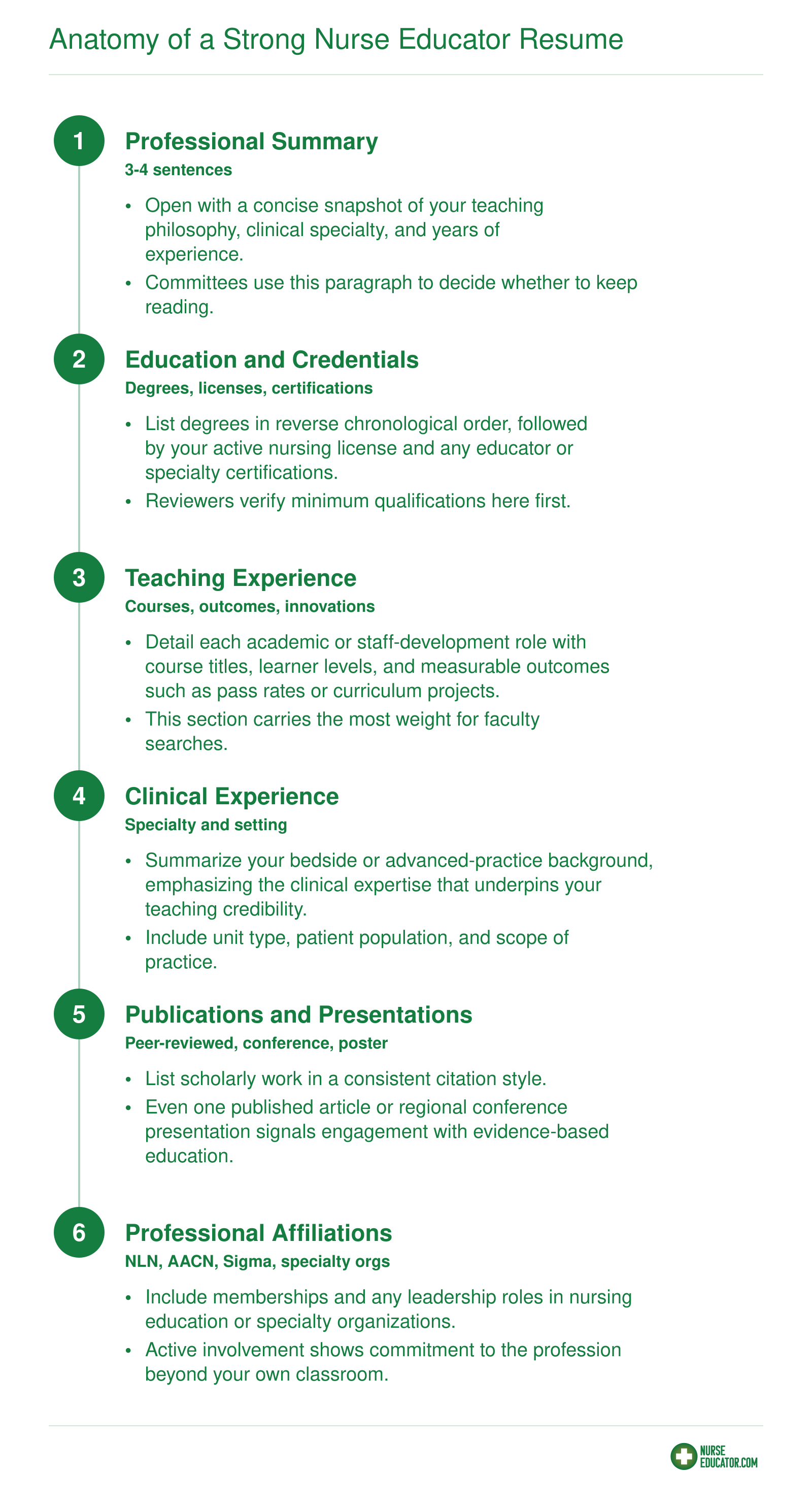
Anatomy of a Strong Nurse Educator Resume
Hiring committees at nursing schools and healthcare organizations scan resumes in a predictable order. Arrange yours in these six sections so reviewers find exactly what they need, right where they expect it.
Nurse Educator Resume Summary Examples
A traditional nursing resume might lead with years of bedside experience; a nurse educator resume opens with a summary that weaves clinical mastery into a clear teaching identity. That 3- to 4-sentence block at the top of your resume is your first chance to show a hiring committee you understand education, not just patient care.
What a Summary Does
A nurse educator professional summary blends your teaching philosophy, clinical expertise, and a measurable outcome into a tight paragraph. It answers the question: why are you the right person to shape future nurses? Instead of listing duties, it signals the lens you bring to curriculum, assessment, or student support. When written well, it previews the evidence that follows in your resume body.
Examples by Career Stage
Clinician Transitioning to Education
Registered nurse with 8+ years of critical care experience transitioning to academic education. Skilled in bedside precepting and unit-based education, with a 95% new hire competency rate. Pursuing MSN in Nursing Education; BLS and ACLS instructor certified. Committed to fostering clinical reasoning through simulation-based learning.
Mid-Career Nurse Educator
Dedicated nursing instructor with 5 years of classroom and clinical teaching in ADN programs. Improved NCLEX first-time pass rates from 87% to 94% through curriculum redesign and targeted remediation. Specializes in medical-surgical and fundamentals of nursing. Expert in active learning strategies and test-item writing.
Senior Faculty or Program Director
Visionary nurse educator and program director with 12+ years leading BSN and MSN programs. Achieved 100% ACEN accreditation, raised enrollment by 30%, and secured $1.2M in grants for simulation lab upgrades. Published in peer-reviewed journals on competency-based education. National presenter on curriculum innovation.
Online or Remote Nursing Educator
Remote nursing educator with 6 years developing and delivering asynchronous courses for RN-to-BSN programs. Increased student engagement scores by 22% using interactive video and discussion boards. Proficient in Canvas, Blackboard, and Articulate 360. PhD in Nursing Education; certified online instructor (COI).
Why These Summaries Work
- Keywords: Each example uses terms hiring systems and humans scan for: "simulation-based learning," "NCLEX pass rates," "ACEN accreditation," "asynchronous courses," specific LMS platforms, and certifications.
- Metrics: Tangible numbers (95% competency rate, 94% NCLEX pass, 30% enrollment lift) ground the claims in results.
- Credentials: Industry-recognized certifications (BLS/ACLS instructor, CNE, COI) and degrees (MSN, PhD) build credibility quickly. If you are weighing certification options, our CNE vs CNEcl certification comparison can help you decide which credential to highlight.
- Tailoring: The language shifts from preceptorship and unit education (transitioning) to curriculum design, accreditation, and faculty leadership (senior roles), matching the level of responsibility.
Build Your Own: A Simple Formula
Adapt this template: [Years of experience] + [clinical specialty] + [teaching focus or methodology] + [measurable outcome or credential]. For example: "10 years of pediatric nursing experience plus simulation-based teaching methods, resulting in a 20% increase in student competency scores." Start with the role you want, not the one you have, and choose one standout result that proves you can move the needle on student outcomes. If you are still exploring masters in nursing education, weave your in-progress degree into the summary to show forward momentum. Once your resume lands the interview, prepare with common nurse educator interview questions so your talking points align with everything on the page.
Questions to Ask Yourself
ATS Keywords Every Nurse Educator Resume Needs
Most universities and hospitals now route applications through an Applicant Tracking System (ATS) before a human ever reads them. If your resume does not contain the right keywords, it may never reach the hiring committee. The list below, drawn from current faculty job postings, covers the terms you should weave into your resume sections and bullet points.1
Teaching Roles and Pedagogy
Start with foundational role descriptors: nurse educator, nursing faculty, clinical instructor, didactic teaching, classroom instruction, clinical teaching, lab instruction, and simulation-based education. Then layer in pedagogical frameworks such as adult learning principles, learner-centered teaching, active learning strategies, evidence-based teaching, competency-based education, and culturally responsive teaching. Assessment language matters too: include formative and summative assessment, objective structured clinical examination (OSCE), rubrics, course evaluation, and continuous quality improvement in teaching.
Curriculum and Accreditation
Hiring committees want to see that you understand accreditation standards. Work in terms like curriculum development, curriculum design and evaluation, course development, syllabus development, and program accreditation preparation. Reference specific frameworks: AACN Essentials, ACEN standards, CCNE standards, and alignment with State Board of Nursing requirements. If you have experience with curriculum mapping for NGN, mention mapping to the NCLEX-RN test plan and NCLEX-RN success strategies along with student learning outcomes (SLOs).
Clinical Practice Skills
Your clinical background is a selling point. Use keywords like current clinical practice experience, clinical competence, evidence-based nursing practice, clinical judgment, clinical reasoning, and patient safety. Name your specialty area directly, whether that is medical-surgical nursing, maternal-child nursing, psychiatric-mental health nursing, critical care, community/public health nursing, or another discipline. For hospital-based roles, add orientation and onboarding, staff education, competency validation, and continuing education.
Technology and Simulation Tools
List every platform you have used: Canvas, Blackboard, D2L Brightspace, Moodle, or Sakai for learning management; Zoom, MS Teams, or Webex for synchronous delivery; and Shadow Health, vSim for Nursing, or iHuman for virtual simulation. Simulation lab experience should include terms like high-fidelity simulation, Laerdal SimMan, scenario design, and debriefing techniques. Also note electronic health record (EHR) training and online testing platforms.
NLN Core Competencies
Aligning your language with the NLN Core Competencies for Nurse Educators signals that you understand the professional standards expected of nursing faculty. Incorporate phrases such as facilitate student learning, professional role socialization, scholarship of teaching and learning, systematic program evaluation, and nurse educator competencies NLN. These competencies map directly to what search committees evaluate, so matching their vocabulary gives your resume a significant advantage.
Certifications to Highlight
Finally, list every relevant credential: CNE (Certified Nurse Educator), CNEcl (Certified Academic Clinical Nurse Educator), CNEn (Certified Nurse Educator Novice), or CHSE (Certified Healthcare Simulation Educator). Include your RN license, highest degree earned (MSN, DNP, PhD, or EdD), and any clinical certifications such as CCRN, CMSRN, PMH-BC, or RNC-OB.
Where to Place These Keywords
Include them in a dedicated "Nursing Education Skills & Keywords" section near the top of your resume and within experience bullet points throughout.1 The goal is natural integration, not keyword stuffing. Each term should connect to a real accomplishment or responsibility you can discuss confidently during your nurse educator interview.
Nurse Educator Resume Examples by Career Stage
The hardest part of writing a nurse educator resume isn't formatting. It's calibrating the level: a bedside RN moving into teaching needs to argue that her experience counts as teaching at all, while a senior faculty member needs to compress decades of scholarship without bloating past two pages. Below are three skeleton outlines pulled from real job posting language for adjunct clinical instructor, assistant professor, and program director roles.
Example 1: New-to-Education Clinician (8+ Years Bedside, No Faculty Title)
Target role: adjunct clinical instructor. Postings at schools like Baylor's Louise Herrington School of Nursing and University of Tennessee typically require an MSN, an active RN license, and three years of recent clinical experience (within the last five).12 Your job is to translate clinical work into teaching evidence. If you're weighing whether this path is right for you, our guide on why nurses become nurse educators walks through the trade-offs.
- Professional summary: MSN-prepared RN with 8 years in medical-surgical and critical care, seeking a clinical instructor role supervising student groups of up to 10 in acute care rotations.3
- Teaching and precepting experience (list this BEFORE clinical employment): preceptor for 14 new-graduate RNs over four years, unit-based educator for sepsis bundle rollout, BLS instructor, patient and family education for post-CABG discharge.
- Clinical experience: condensed to role, dates, unit type, patient population.
- Certifications: RN license, CCRN, BLS/ACLS instructor.
- Technology: EHR (Epic), CastleBranch for compliance tracking.1
Reframing is the move here. "Precepted new graduates" becomes "facilitated clinical onboarding for 14 RNs, including objective-based skill validation and weekly performance feedback." That is teaching language.
Example 2: Mid-Career Educator (3 to 7 Years, CNE Certified)
Target role: assistant professor or full-time clinical track faculty. Assistant professor postings increasingly list doctoral preparation (PhD, DNP, or EdD) as required, but MSN-with-doctorate-in-progress is often acceptable for clinical track.24
- Summary: CNE-certified nurse educator with 5 years teaching in a BSN program, course coordinator for Adult Health II.
- Teaching: courses taught with enrollment numbers, course redesign work, NCLEX pass rate trends (e.g., "led item analysis revision that contributed to first-time pass rate improvement from 84% to 91% over three cohorts").
- Curriculum and scholarship: concept-based curriculum mapping, simulation scenario authorship, one peer-reviewed publication or podium presentation.
- Service: admissions committee, curriculum committee, student remediation lead.
- Technology: Canvas or D2L/Brightspace, high-fidelity simulation, virtual EHR training systems.4
At this stage, showcasing innovative teaching strategies in nursing education on your resume can set you apart from other applicants.
Example 3: Senior Faculty or Program Director (10+ Years)
Target role: program director or department chair. Postings require a graduate nursing degree with doctorate strongly preferred, three to five years of leadership, and accreditation experience with CCNE or ACEN.4
- Summary: two lines, doctoral credential, scope of programs led, accreditation outcomes.
- Administrative leadership: budget authority, faculty FTE supervised, program enrollment, accreditation cycles led (self-study authorship, site visit outcomes).
- Scholarship: select 5 to 7 most relevant publications, not a complete CV dump. Move full publication list to a separate addendum.
- Grants: funded projects with role, agency, and dollar amount.
- Teaching: condensed to courses currently taught and doctoral committee chair counts.
The discipline at this level is subtraction. A two-page cap forces you to choose your strongest five publications rather than list twenty.
A Note on Online and Remote Nurse Educator Roles
Assistant professor postings now routinely list online instruction as preferred and name specific platforms: Canvas, Blackboard, D2L/Brightspace, video conferencing, and EHR training systems.4 If you are targeting remote or hybrid faculty positions, add a distinct "Online Teaching" subsection covering synchronous facilitation experience (Zoom breakout structures, virtual clinical post-conferences), LMS course build work (not just "used Canvas" but "designed Canvas modules with embedded H5P assessments"), and virtual simulation coordination with platforms like vSim or Shadow Health. Understanding what subjects nurse educators teach can help you tailor this subsection to the courses you're most qualified for. Quantify it: number of online sections taught, average enrollment, course evaluation scores.
Academic Faculty Vs. Clinical Educator: Tailoring Your Resume
One of the most important decisions you will make when crafting your nurse educator resume is understanding which type of role you are targeting. Academic nursing faculty and clinical nurse educators operate in very different settings, and your application materials should reflect that distinction clearly.
If you are pursuing an academic faculty position at a college or university, hiring committees typically expect a curriculum vitae (CV) rather than a traditional resume.1 Common titles include Assistant Professor, Associate Professor, Lecturer, and Clinical Faculty. Academic employers prioritize advanced credentials: an MSN is generally the minimum, with a PhD or DNP preferred.1 Your document should foreground formal teaching experience, curriculum design, scholarly publications, grants, and committee service. Think of it as a comprehensive record of your academic contributions rather than a concise marketing document.
Clinical nurse educators, on the other hand, usually work in hospitals, health systems, or staff development departments.1 Titles such as Clinical Nurse Educator, Clinical Education Coordinator, and Professional Development Specialist are common. For these roles, a targeted resume (typically one to two pages) works best. A BSN or MSN is often sufficient, though specialty certifications like the CNE or CMSRN carry significant weight.1 Emphasize hands-on competencies: orientation programs you have built, competency validation workflows, simulation facilitation, in-service education, and precepting experience.
Here is a quick comparison to guide your approach:
- Academic Faculty: submit a CV; highlight teaching philosophy, course development, research, and publications.
- Clinical Educator: submit a resume; highlight competency programs, simulation outcomes, quality metrics, and staff training impact.
Understanding these differences matters because hiring managers can tell immediately when a candidate has submitted a generic document. If you are still exploring which path fits best, our overview of nurse educator job titles can help you compare the landscape before you start writing. Tailoring your format and content to the specific role signals professionalism and shows you understand the expectations of the position.
If you're applying to a university tenure-track role, lead with education, scholarship, and accreditation work (and consider whether a CV is more appropriate). If you're targeting a hospital-based clinical educator position, lead with clinical certifications, competency program development, and measurable staff training outcomes. Same profession, very different documents.
How to Quantify Achievements on a Nurse Educator Resume
Hiring committees at ACEN- and CCNE-accredited programs are increasingly data-literate, which means vague bullets like "taught nursing students" or "assisted with curriculum" carry almost no weight.1 Concrete numbers, by contrast, give search committees something to anchor to and compare across candidates.
Why Metrics Matter in Nursing Education
Accreditors require programs to track student outcomes, and nursing schools are expected to demonstrate continuous improvement.1 When you walk in with data already on your resume, you signal that you understand that culture. Committees want to see that your students passed licensure exams, completed courses, and progressed on time. Showing a 94% NCLEX first-time pass rate, an 89% retention rate, or a student evaluation score of 4.6 out of 5 tells a far more compelling story than any adjective you could choose.
A Framework for Finding Your Numbers
Not sure where to look? Work through four categories:
- Student outcomes: NCLEX first-time pass rates, course completion rates, clinical competency evaluation scores, and on-time progression rates. Example: a cohort that improved dosage calculation exam scores from a 23% failure rate down to 9% is a headline achievement.
- Program scale: Students enrolled per semester, clinical sections coordinated, credit hours delivered, and advising load. Coordinating 12 clinical sections or advising 35 to 40 students per term communicates scope.
- Curriculum impact: Courses developed or substantially revised, simulation scenarios created, percentage of curriculum converted to online or hybrid delivery. Developing 10 simulation scenarios or achieving a 90% course-outcome attainment rate across 80 to 100 enrolled students are both strong data points.
- Professional development: Conference presentations, peer-reviewed publications, and grant awards with specific dollar figures.2 Three publications, six presentations, and a $50,000 curriculum grant, for example, speak directly to scholarly productivity.3
Before-and-After Bullet Rewrites
Seeing the transformation in practice is the fastest way to apply this approach:
- Weak: Taught pharmacology to nursing students. Strong: Taught pharmacology to 80 to 100 pre-licensure students per semester; cohort NCLEX pass rate reached 94% over two consecutive years.
- Weak: Helped improve student retention. Strong: Implemented targeted advising interventions that raised program retention by 7 percentage points over two years.
- Weak: Developed simulation labs. Strong: Authored 10 high-fidelity simulation scenarios used across four clinical sections, contributing to a 95% on-time progression rate.
- Weak: Supervised clinical rotations. Strong: Coordinated 12 clinical sections per semester with a 24-hour monthly direct-supervision commitment, mentoring students through 10 years of combined practice expertise.4
- Weak: Advised doctoral students. Strong: Chaired or served on committees for 7 doctoral projects, with all students completing milestones on schedule.
- Weak: Presented at conferences. Strong: Delivered 6 peer-reviewed presentations at regional and national nursing education conferences; secured $50,000 in grant funding to support simulation curriculum development.
Metrics for Online and Remote Educators
If your teaching experience is primarily online, you have a distinct set of numbers to surface. Course completion rates, student satisfaction scores from end-of-term surveys, and LMS engagement data (log-in frequency, discussion-board participation rates) all count. Virtual simulation hours coordinated and the percentage of legacy content you migrated to an online format are equally valuable. Programs expanding their distance-education footprint will find these figures especially persuasive, so consider highlighting the benefits of online nurse educator program offerings you supported. A bullet noting that student top-box evaluation scores ran between 85% and 92% across multiple online cohorts is concrete and directly relevant. Frame these figures the same way you would face-to-face data; the category is different, the logic is identical.
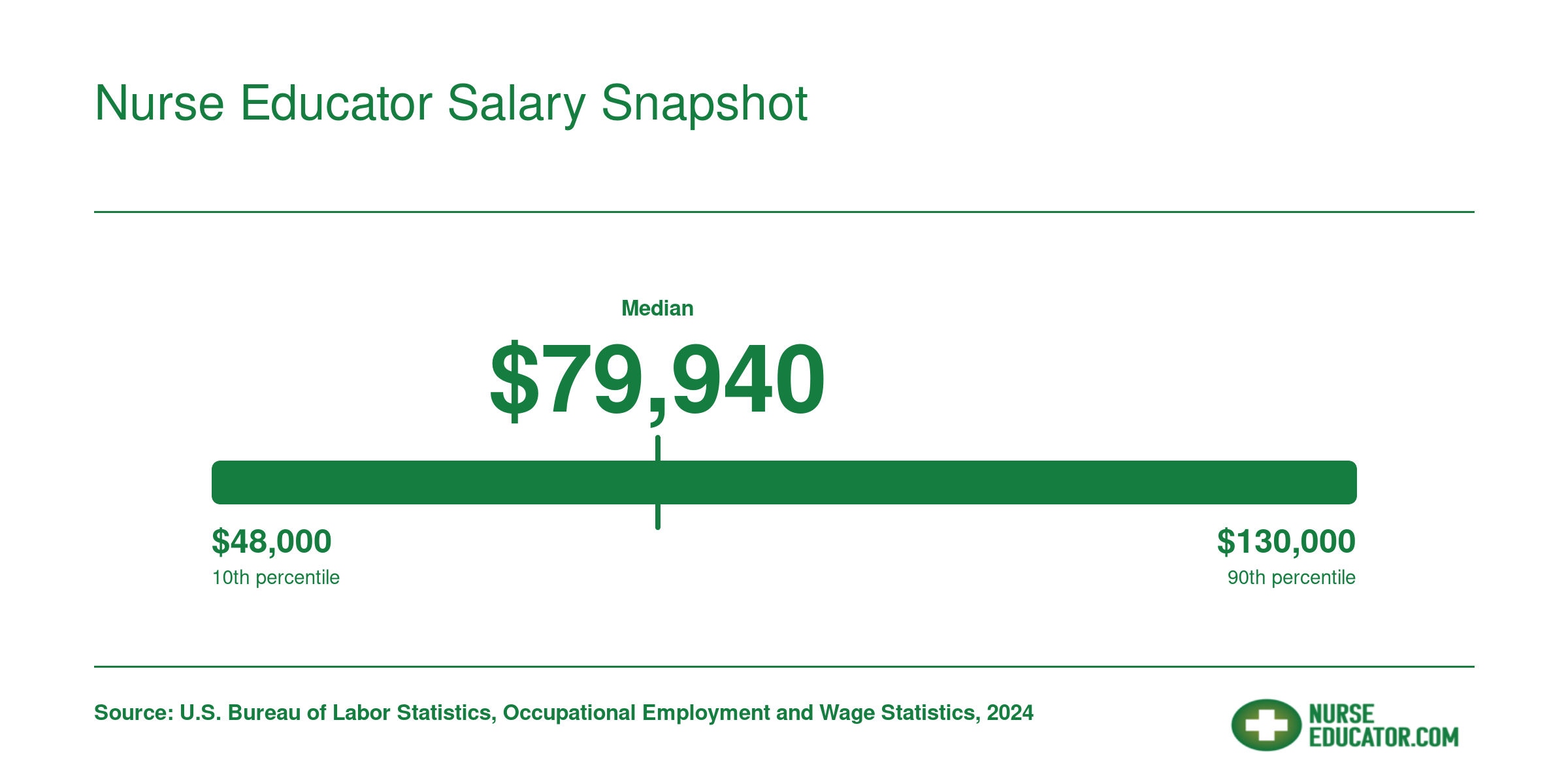
Nurse Educator Salary Snapshot
Where you land on the pay scale depends partly on experience and institution type, but a polished, targeted resume helps you compete for roles at the higher end. Here is the national wage distribution for nursing instructors and teachers at postsecondary institutions, based on BLS data. With roughly 74,250 professionals employed nationwide, demand remains strong.
Which Certifications Should Be on a Nurse Educator Resume?
Certifications tell hiring committees that you have validated expertise, not just years on the job. The single most recognized credential is the Certified Nurse Educator (CNE), issued by the National League for Nursing.1 To qualify, you need a master's or doctoral degree in nursing, an active RN license, and either a graduate focus in nursing education or at least two years of teaching experience.2 There are currently 7,227 active CNE certificants nationwide, so holding this credential places you in a relatively small, distinguished group.3
If you are unsure whether the CNE is the right fit, or whether the CNEcl (Certified Academic Clinical Nurse Educator) better matches your background, a detailed CNE vs CNEcl certification comparison can help you decide. The CNEcl is a newer NLN credential with 935 active holders, while the Academic Novice Nurse Educator (CNEn) designation, designed for those just entering the teaching role, has 326 certificants.3
Beyond NLN credentials, consider the Certified Healthcare Simulation Educator (CHSE) from the Society for Simulation in Healthcare if you design or facilitate simulation labs. The CHSE requires two years of simulation experience and renews every three years.4 Because it is interprofessional, it signals that you can collaborate across disciplines, a quality that resonates with programs seeking versatile faculty.
When listing certifications on your resume, include the credential abbreviation, the issuing body, and the year earned or renewed. Place active certifications in a dedicated section near the top of your document, right after your education. Expired or in-progress credentials should be noted with their expected completion date so reviewers can see your trajectory at a glance.
Nurse Educator Cover Letter Tips
A cover letter for a nurse educator position is a targeted argument for why your specific clinical and teaching background fits a specific program's needs. It is not a personality essay, and it is not a summary of your resume. Hiring committees read dozens of letters that open with some version of "I have always been passionate about nursing education," and those letters go to the bottom of the pile immediately.
The Structure That Works
Think of the letter as four working parts, each doing a distinct job.
- Opening paragraph: Name the exact position and institution. Show you know something specific about the program: a clinical focus, an accreditation milestone, a student population they serve.
- Clinical-to-teaching paragraph: Connect your practice background to the courses or competencies the program needs covered. A perioperative nurse applying to a surgical technology partnership program should make that link explicit. If you need to articulate the breadth of roles you could fill, review the nursing education curriculum a typical program covers.
- Achievement paragraph: Offer one measurable teaching result. Pass rates, simulation lab outcomes, preceptor evaluation scores, a curriculum project you led. Concrete numbers do more work here than any adjective.
- Closing paragraph: Tie your goals to the program's mission or an accreditation priority (ACEN, CCNE, or NLN). Committees respond to candidates who have clearly read the self-study or strategic plan language.
Opening Lines That Actually Work
Skip the clichés. Here are three alternatives that get into substance immediately.
- 'Your ADN program's focus on rural clinical placement matches the community health experience I bring from seven years at a critical-access hospital in eastern Oregon.'
- 'The simulation coordinator role at [Institution] aligns with the high-fidelity lab curriculum I built and validated across three semesters at my current program.'
- 'After a decade in pediatric critical care, I shifted into prelicensure instruction specifically to address the clinical reasoning gaps I kept seeing in new graduate hires.'
Each of these opens a conversation rather than stating an intention.
A Note on Academic Faculty Letters
For tenure-track or full-time faculty positions, the cover letter often functions as a brief teaching philosophy statement as well. Keep the letter itself under one page. If the posting asks for a teaching philosophy separately, attach it as its own document rather than folding it into the letter. Blending the two dilutes both. The cover letter makes the case for fit; the teaching philosophy makes the case for your pedagogical approach. They serve different readers at different stages of the review process. Once you secure an interview, prepare thoroughly by reviewing common clinical nurse educator interview questions so your letter's claims hold up under scrutiny.
Frequently Asked Questions About Nurse Educator Resumes
These are the questions nurses ask most often when building or updating a resume for educator roles. Each answer gives you a quick overview, and you can dig deeper in the corresponding section of this article.