What you’ll learn in this article…
- The CDCES credential requires 1,000 hours of diabetes education experience and a current clinical license, not necessarily a bachelor's degree.
- An MSN with a Nurse Educator concentration prepares you for both academic teaching roles and BC-ADM certification eligibility.
- National median pay for nursing instructors was $80,780 in 2024, while registered nurses earned $93,600, according to the BLS.
- From nursing school entry to certification, the full path typically takes 4 to 7 years depending on your starting degree.
What does it actually take for a registered nurse to become a certified diabetes educator?
More than 37 million Americans are living with diabetes, and the CDC expects that number to keep rising. That patient volume has created real demand for clinicians who specialize not just in treating the disease, but in teaching people how to manage it daily. The diabetes nurse educator fills that gap, functioning as the primary connector between clinical care and long-term self-management support. If you have ever felt drawn to the teaching side of patient care, the nurse educator demand in this specialty is especially strong.
For working RNs, the path involves two distinct credentialing tracks: the Certified Diabetes Care and Education Specialist (CDCES) and the Board Certified-Advanced Diabetes Management (BC-ADM). Each carries different eligibility rules, scope of practice, and professional positioning. Understanding which credential fits your current license, degree level, and career goals is the practical decision most nurses underestimate before starting the process.
What Does a Diabetes Nurse Educator Do?
While many nursing roles involve managing diabetes on a shift-by-shift basis, the diabetes nurse educator occupies a distinctly different space: one built around teaching, coaching, and empowering patients to take control of a condition they will live with every single day. If you are drawn to the idea of long-term patient relationships and measurable behavior change rather than acute clinical interventions, this specialty deserves a close look.
Core Purpose of the Role
A diabetes nurse educator helps people with Type 1, Type 2, gestational, and prediabetes develop the practical skills and confidence they need for daily self-management. The professional framework guiding this work is the ADCES7 Self-Care Behaviors model, developed by the Association of Diabetes Care and Education Specialists. Those seven behaviors are:
- Healthy coping: Addressing the emotional burden of living with a chronic condition.
- Healthy eating: Translating nutrition science into meal-level decisions.
- Being active: Building sustainable physical activity into daily routines.
- Monitoring: Teaching blood glucose self-monitoring, continuous glucose monitor (CGM) interpretation, and pattern recognition.
- Taking medication: Guiding insulin administration techniques, oral medication adherence, and dosage adjustment basics.
- Problem solving: Helping patients respond to hypo- and hyperglycemic episodes, sick days, and travel.
- Reducing risks: Educating on foot care, cardiovascular risk, eye exams, and other complication-prevention strategies.
Every patient interaction ties back to at least one of these behaviors, giving the role a structured, evidence-based foundation.
Day-to-Day Responsibilities
On a typical workday, a diabetes nurse educator might:
- Conduct one-on-one education sessions with newly diagnosed patients, walking them through glucometer use or insulin pen technique.
- Facilitate group classes covering carbohydrate counting, label reading, or exercise planning.
- Develop individualized care plans that align with each patient's health literacy level, cultural background, and personal goals.
- Interpret lab results, particularly A1C trends and lipid panels, and translate those numbers into actionable next steps the patient can understand.
- Coordinate care with endocrinologists, registered dietitians, pharmacists, and primary care providers to ensure consistent messaging across the care team.
- Document patient progress within a Diabetes Self-Management Education and Support (DSMES) program, the nationally recognized structure that defines how diabetes education is delivered, reimbursed, and evaluated.
DSMES programs must meet standards set by the Centers for Medicare and Medicaid Services, and the diabetes nurse educator often serves as the program coordinator or lead instructor within that framework.
How This Differs From General Diabetes Nursing
A staff nurse on a medical-surgical floor may administer insulin, check blood glucose, and manage a diabetic ketoacidosis episode. That work is essential, but it is episode-driven. The diabetes nurse educator, by contrast, focuses on the months and years between those acute moments. The goal is sustained behavior change: helping a patient move from confusion and frustration to competent self-care. If you have ever wondered about the broader difference between a nurse and a nurse educator, this specialty illustrates the contrast clearly.
This means the educator role demands strong skills in motivational interviewing, health literacy assessment, and culturally responsive communication. You are not simply delivering a treatment; you are teaching someone to manage their own health for life. Success requires many of the same qualities of a good nurse educator found in academic settings, including patience, adaptability, and clear communication. That shift from doing to teaching is what makes the specialty both challenging and deeply rewarding for nurses who thrive on patient connection and measurable outcomes. For a deeper look at how educators interact directly with patients across different settings, see our guide on whether nurse educators work with patients.
The DCES Credential Explained: Understanding the Diabetes Care and Education Specialist Title
In 2020, the Association of Diabetes Care & Education Specialists (ADCES) introduced Diabetes Care and Education Specialist as the new professional title for clinicians who provide diabetes education and management support.1 This change replaced the familiar Certified Diabetes Educator designation that nurses had used for decades. Understanding how DCES relates to professional certification helps you navigate job postings, credential requirements, and career planning in a nurse educator career path.
Why the Title Changed
The shift from CDE to DCES reflects an expanded vision for the role. Previously, the title emphasized "education" as the primary function. The updated designation signals that specialists deliver collaborative, comprehensive, person-centered care alongside patient education. This broader scope acknowledges that diabetes care professionals increasingly address cardiometabolic conditions, coordinate with multidisciplinary teams, and integrate clinical management into their practice rather than focusing solely on teaching.
The organization behind this change, formerly known as the American Association of Diabetes Educators, also rebranded as the Association of Diabetes Care & Education Specialists to align with this philosophy.1
How DCES and CDCES Connect
DCES describes a professional title and scope of practice, while CDCES represents the national certification credential. The Certification Board for Diabetes Care and Education issues the CDCES credential, which replaced the CDE certification.2 If you previously held the CDE, you transitioned to CDCES without retesting.2
Here is the key distinction: any qualified professional can use the DCES job title to describe their role, even without certification.1 However, earning the CDCES credential through the certification board demonstrates validated expertise and meets the requirements many employers specify in job postings.
What This Means for Your Career
When searching for positions, you will encounter both terms in nurse educator job descriptions. Some postings advertise for a Diabetes Care and Education Specialist, while others require CDCES certification specifically. Recognizing that DCES is the professional title and CDCES is the earned credential helps you interpret requirements accurately. For nurses building careers in diabetes education, pursuing CDCES certification provides the clearest signal of competence to employers and patients alike.
Diabetes Nurse Educator Vs. Other Diabetes Nursing Roles
Not every nursing role in diabetes care looks the same, and understanding the distinctions can help you choose the path that best matches your goals. Here is a quick comparison of three common diabetes-focused nursing roles.
Diabetes Nurse Educator (RN with CDCES) - Primary focus: patient and community education on self-management, nutrition, medication adherence, and lifestyle modification - Prescriptive authority: no independent prescribing1 - Typical settings: outpatient diabetes clinics, community health centers, hospital-based education programs, telehealth platforms
Diabetes Care and Management Nurse (BC-ADM) - Primary focus: direct clinical management of complex diabetes cases, including medication titration and ongoing care coordination - Prescriptive authority: yes, within licensure1 - Typical settings: endocrinology practices, inpatient units, specialty clinics
Nurse Practitioner, Endocrinology - Primary focus: diagnosing, treating, and managing endocrine disorders (including diabetes) across the lifespan - Prescriptive authority: yes1 - Typical settings: endocrinology offices, academic medical centers, hospital systems
The diabetes nurse educator role stands apart because it centers on teaching rather than prescribing. If you thrive when helping patients understand their condition and build sustainable habits, the educator track is a natural fit. For a broader look at how teaching roles compare to clinical ones, see this nurse educator vs other medical roles guide. Nurses who want both direct patient management and education often pursue the BC-ADM credential first and layer on the CDCES later, giving them flexibility across clinical and educational settings.
Step-By-Step Path to Becoming a Diabetes Nurse Educator
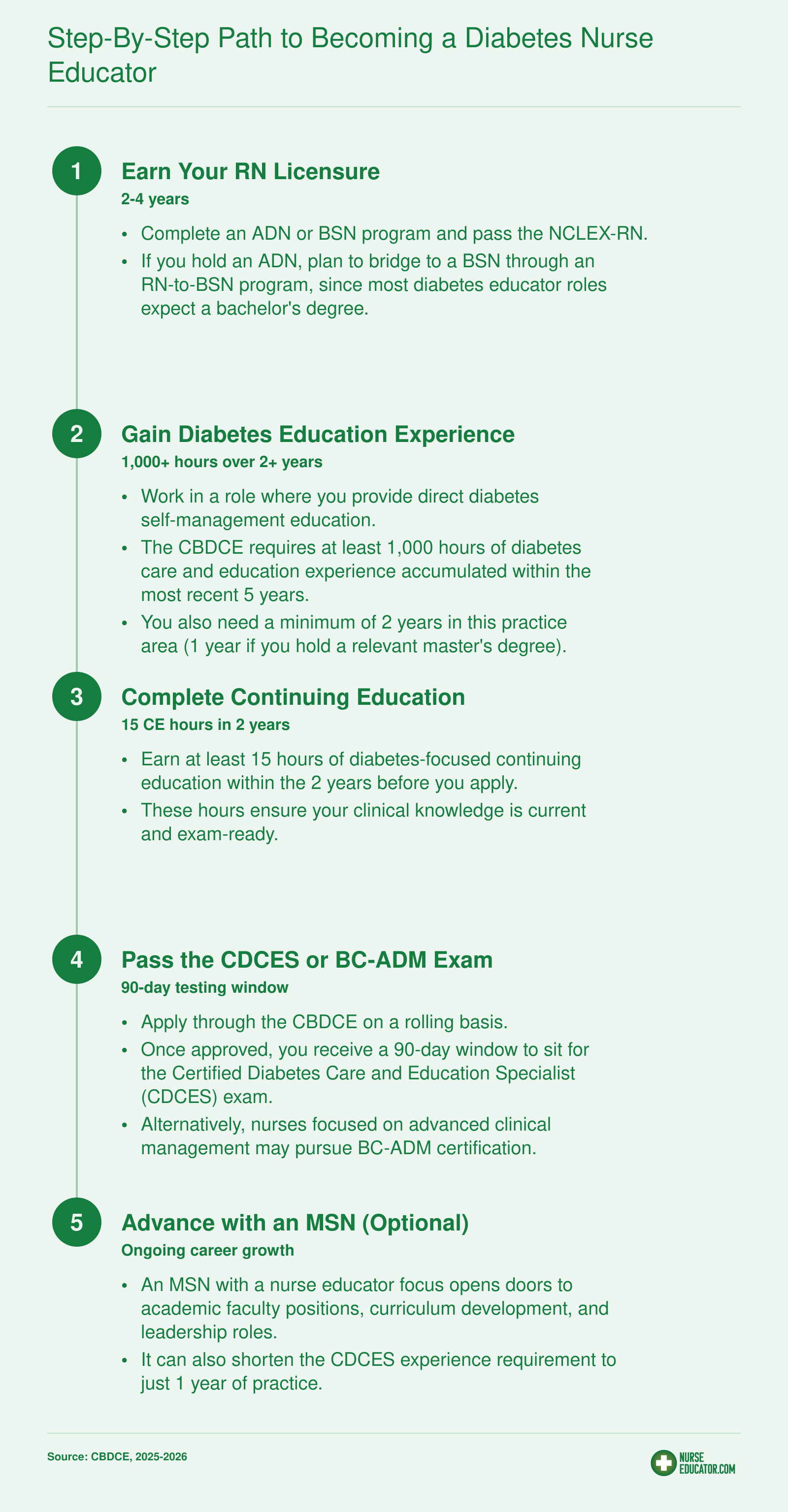
The road from bedside nurse to diabetes nurse educator follows a clear sequence. Depending on whether you start with an ADN or a BSN, the full journey typically takes 4 to 7 years from nursing school entry to certification. Here is the path at a glance.
Questions to Ask Yourself
CDCES Vs. BC-ADM: Choosing the Right Diabetes Certification
Two major credentials dominate the diabetes education landscape, and understanding the difference will help you invest your time wisely. The Certified Diabetes Care and Education Specialist (CDCES) is offered by the Certification Board for Diabetes Care and Education (CBDCE), while the Board Certified-Advanced Diabetes Management (BC-ADM) credential comes from the Association of Diabetes Care and Education Specialists (ADCES). Both are nationally recognized, but they serve distinct purposes.
The CDCES is the most widely pursued certification for nurses who focus on patient-centered diabetes self-management education. It is ideal if your primary role involves teaching individuals and communities how to manage blood glucose, nutrition, medication adherence, and lifestyle changes. Eligibility requires a minimum of 1,000 hours of diabetes care and education experience within the two years preceding your application, along with a current healthcare professional license.
The BC-ADM, on the other hand, targets advanced practice providers such as nurse practitioners, clinical nurse specialists, and pharmacists who manage complex diabetes treatment plans. If you hold an advanced degree and want a credential that reflects your clinical prescribing and management expertise, this is the better fit.
Here is a quick comparison to guide your decision:
- Best for bedside and community educators: CDCES
- Best for advanced practice clinicians managing treatment plans: BC-ADM
- Experience requirement: CDCES requires 1,000 hours; BC-ADM requires 500 hours of direct advanced diabetes management
- Renewal cycle: Both require renewal every five years
Many RNs start with the CDCES and later add the BC-ADM once they complete an advanced practice degree. If you are weighing other nursing certifications, the process of choosing between CNE and CNEcl for educator roles follows a similar decision framework. Some nurses also pursue a DNP in nursing education to expand into academic faculty positions where they teach diabetes care at the graduate level. Whichever path you choose, earning at least one of these credentials signals expertise that employers and patients trust.
Can You Become a Diabetes Educator Without a Degree?
This is one of the most common questions nurses ask when exploring this specialty, and the answer depends on which credential you are pursuing and what your current license allows.
CDCES Eligibility: License Matters More Than Degree Level
The Certified Diabetes Care and Education Specialist (CDCES) credential is intentionally multidisciplinary. It is open to registered nurses, registered dietitians, pharmacists, physicians, physician assistants, physical therapists, occupational therapists, and several other licensed health professionals. The Certification Board for Diabetes Care and Education requires that you hold an active, unrestricted professional license or registration, complete a minimum of 1,000 hours of diabetes care and education experience, and finish at least 15 hours of continuing education in diabetes within the two years before applying.
Notice what is not on that list: a bachelor's degree is not universally required. Eligibility rides on your professional credential, not a specific academic degree.
What This Means for RNs Specifically
For nurses, an ADN is sufficient to sit for the CDCES exam, provided you hold an active RN license and accumulate the required practice hours. That said, a BSN or MSN meaningfully expands where you can work, what you can earn, and how quickly you can move into leadership or advanced practice roles. Many hospital-based diabetes education programs and academic medical centers prefer or require a BSN for staff educator positions. If you are considering an advanced degree, exploring online nursing education degrees can help you compare programs that fit your schedule and goals.
Certificate Courses as a Bridge
Diabetes educator certificate courses, offered by organizations like the ADCES and various universities, are not degrees and do not replace the CDCES exam. They are useful stepping stones: they help nurses build foundational knowledge, document continuing education hours, and gain confidence while accumulating the 1,000 practice hours needed for certification eligibility.
BC-ADM Is a Different Story
If you are aiming for the Board Certified-Advanced Diabetes Management (BC-ADM) credential, the rules tighten considerably. BC-ADM requires a master's degree or higher in a clinical health field, so nurses pursuing this advanced certification must hold at least an MSN. There is no ADN or BSN pathway to BC-ADM. You can review masters in nursing education programs to find options that satisfy BC-ADM eligibility while preparing you for educator roles.
Education Requirements and the Msn–nurse Educator Pathway
A Master of Science in Nursing (MSN) with a Nurse Educator concentration is the most common graduate credential for RNs who want to teach diabetes content in academic, hospital, or community settings, and it also satisfies the advanced-degree portion of the BC-ADM eligibility requirements. The CDCES, by contrast, accepts a bachelor's degree, so the MSN is a pathway choice rather than a strict floor for diabetes educator work. If you are still comparing options, our guide to accredited online msn programs can help you narrow the field.
How to Vet a Program for Diabetes Relevance
Start with accreditation. Use the Commission on Collegiate Nursing Education (CCNE) and the Accreditation Commission for Education in Nursing (ACEN) program directories to confirm an MSN is accredited before you spend time reviewing curriculum. From there, look at the course catalog rather than the marketing page. You want to see:
- Pathophysiology and pharmacology depth: advanced courses that cover endocrine function, insulin therapy, and oral antihyperglycemics.
- Chronic disease management coursework: electives or required courses in population health, self-management support, or behavior change.
- Practicum flexibility: the ability to complete teaching practicum hours in a diabetes clinic, outpatient endocrinology setting, or inpatient diabetes service.
The Bureau of Labor Statistics entry for postsecondary nursing instructors and the Association of Diabetes Care & Education Specialists (ADCES) are useful cross-references for confirming that a program's focus aligns with what hiring employers expect. Understanding what subjects nurse educators teach can also help you evaluate whether a program's curriculum matches your diabetes specialization goals.
Programs to Examine
A few well-known MSN, Nurse Educator, and post-master's certificate options worth reviewing directly on the school websites:
- Johns Hopkins School of Nursing: offers an MSN with educator-oriented coursework and chronic disease electives, plus access to diabetes research faculty.
- University of Texas (Austin and Health Science Center campuses): MSN tracks include chronic illness management content and clinical placements in Texas diabetes programs.
- Vanderbilt University School of Nursing: post-master's certificate in nursing education that can be paired with prior endocrine or diabetes clinical experience.
When you contact admissions, ask two specific questions: whether the practicum can be completed in a diabetes-focused setting, and whether elective credits can be used for ADCES-recognized continuing education. The answers will tell you quickly whether the program is a genuine fit for a diabetes specialization or just a general educator track.
Diabetes Nurse Educator Salary: National Overview
The Bureau of Labor Statistics does not track diabetes nurse educators as a standalone occupation, so the closest proxies are the broader registered nurse and nursing instructor categories. The table below shows national median and percentile wages for related roles, giving you a realistic salary range to expect. Keep in mind that holding a specialty credential such as the CDCES or BC-ADM can push compensation toward the higher end of these ranges, particularly in outpatient or industry settings.
| Occupation | Total National Employment | 25th Percentile Salary | Median Salary | 75th Percentile Salary | Mean Salary |
|---|---|---|---|---|---|
| Registered Nurses | 3,282,010 | $78,610 | $93,600 | $107,960 | $98,430 |
| Nursing Instructors and Teachers, Postsecondary | 74,250 | $62,210 | $79,940 | $102,020 | $87,090 |
| Nurse Practitioners | 307,390 | $109,940 | $129,210 | $149,570 | $132,000 |
According to the CDC, approximately 38.4 million Americans were living with diabetes as of 2021, a figure that continues to climb. The Bureau of Labor Statistics projects registered nursing roles will grow around 5 percent through 2034, and rising disease prevalence suggests demand for specialized diabetes educators will grow alongside it.
Diabetes Nurse Educator Salary by State
Because the BLS does not track diabetes nurse educators as a standalone occupation, the table below draws on state-level data for two closely related categories: Nursing Instructors and Teachers (Postsecondary) and Registered Nurses. Comparing these figures gives you a practical sense of what diabetes nurse educators may earn in different regions, though actual compensation will vary based on your credential level, employer type, and whether you hold a CDCES or BC-ADM certification.
| State | Nursing Instructors, Postsecondary (Median) | Registered Nurses (Median) |
|---|---|---|
| California | $99,010 | N/A |
| Texas | $97,610 | $90,010 |
| New York | $93,640 | N/A |
| Alaska | $92,050 | N/A |
| Nevada | $84,660 | N/A |
| Montana | $84,550 | N/A |
| Florida | $83,940 | N/A |
| Delaware | $83,420 | $92,610 |
| North Dakota | $83,130 | N/A |
| Connecticut | $81,490 | N/A |
| New Hampshire | $81,260 | $96,830 |
| Maryland | $80,990 | $96,830 |
| Michigan | $80,740 | $85,670 |
| Colorado | $80,440 | $96,520 |
| Massachusetts | $80,140 | N/A |
| Rhode Island | N/A | $99,960 |
| Arizona | N/A | $96,890 |
| Pennsylvania | N/A | $87,610 |
| Illinois | N/A | $86,410 |
| Idaho | N/A | $86,100 |
| Wisconsin | N/A | $86,070 |
| Georgia | N/A | $86,560 |
| New Mexico | N/A | $88,260 |
| Virginia | N/A | $88,820 |
Where Do Diabetes Nurse Educators Work?
Roughly half of diabetes nurse educator roles now operate on a hybrid telehealth and in-person model, a shift that stabilized above pre-pandemic baselines and has reshaped where nurse educators work.1
Hospital-Based DSMES Programs
Accredited Diabetes Self-Management Education and Support (DSMES) programs inside hospital systems remain the largest single employer of diabetes educators. These roles typically follow standard hospital shift schedules, with inpatient consults, discharge teaching for newly diagnosed patients, and outpatient group classes folded into a 7-to-5 weekday rotation. Expect close coordination with endocrinology, dietitians, and case management.
Outpatient Clinics and Community Health Centers
Endocrinology practices, primary care clinics, and federally qualified community health centers offer more predictable hours and greater independent practice. In these settings, you carry your own panel, adjust insulin titrations under protocol, and own the patient relationship across months or years. Community health centers, in particular, lean heavily on diabetes educators to serve rural and underserved populations where access to endocrinology is limited.2
Telehealth and Remote Monitoring
Telehealth diabetes education has grown into a distinct career track.3 Day-to-day work includes remote CGM data review, virtual one-on-one visits, asynchronous messaging, and live group classes delivered through video platforms. Remote patient monitoring (RPM) programs, now supported by newer CMS billing codes including CPT 99445 and 99470, have created reimbursable pathways for ongoing CGM oversight, with documented improvements in HbA1c for enrolled patients.5 Vendor-specific certifications for CGM systems and insulin pump platforms are increasingly expected.6
Academic and Emerging Settings
School-based programs and university health services hire diabetes educators to support pediatric and young-adult populations. Beyond traditional clinical settings, diabetes technology companies (Dexcom, Abbott, Tandem, Insulet) recruit nurses as clinical trainers and field educators. Pharmaceutical manufacturers staff medical science liaison and patient education roles, and corporate wellness programs contract with educators to run employee diabetes prevention and management initiatives. If you are weighing clinical versus academic tracks, understanding the careers in nurse education landscape can help clarify your options.
Continuing Education and Career Advancement
Balancing certification maintenance with career growth can feel like a tug-of-war. You need continuing education to stay current, but you also want experiences that open doors to leadership and specialization. The good news is that the CE landscape for diabetes educators is designed to serve both goals, offering structured renewal pathways alongside clear avenues for advanced skill-building.
Understanding Certification Renewal Requirements
To renew the CDCES credential, you must complete 75 continuing education hours every five years, or retake the certification exam.1 At least 45 of those hours must be formal, accredited CE, and you are required to finish two activities focused on the ADA Standards of Care.2 Additionally, you need 1,000 hours of professional practice in diabetes education during the renewal cycle.3 For the BC-ADM, the picture is similar but not identical: you accrue 75 CE hours over five years, log 1,000 practice hours, and complete professional development across at least two specified categories.4 Unlike the CDCES, BC-ADM renewal does not offer a re-examination option. You must accumulate the hours, and there is a $500 fee, with a $50 surcharge if submitted late. CE hours for BC-ADM can go up to a maximum of 150, giving you room to front-load your learning.4
Top Continuing Education Resources
Stay ahead with the ADCES annual conference, which delivers cutting-edge sessions and peer networking. The annual ADA Standards of Care updates are essential reading and can fulfill required category activities. Diabetes technology training programs, covering insulin pumps, continuous glucose monitors, and automated delivery systems, are increasingly vital and often offered through device manufacturers or specialized workshops. Online platforms like Diabetes Education Services and the ADA's CE library provide flexible, on-demand modules that fit a working nurse's schedule.
Mapping Your Career Advancement
Leadership pathways are varied and rewarding. Directing a DSMES program lets you guide accreditation, staff, and clinical outcomes. A quality improvement lead role uses data to refine care delivery and meet population health targets. With an MSN, you can teach diabetes electives in nursing schools, shaping the next generation of clinicians and exploring nursing education topics you may not have considered before. DNP-prepared educators often pivot into clinical research, driving evidence-based practice and policy.
Skills That Set You Apart
Boost your advancement by mastering data analytics for population health, which helps you track outcomes and make the case for program resources. Earning a diabetes technology certification, such as the Certified Diabetes Technology Clinician, demonstrates specialized expertise that employers value. Proficiency in motivational interviewing enhances patient engagement and is increasingly expected in leadership and educator roles. Building strong nurse educator competencies will serve you whether you aim for the classroom or the C-suite. Aligning your CE choices with your long-term vision turns maintenance into momentum.
Frequently Asked Questions About Diabetes Nurse Educators
Below are answers to the most common questions nurses ask when exploring a career in diabetes education. Each response summarizes key details covered throughout this article, so you can quickly find what you need.