

In Brief
- Virginia nursing faculty earn a median annual salary above the national average, according to BLS state-level data.
- Two Virginia universities offer three enrollable nurse educator certificate pathways in online or hybrid formats.
- The CNE credential from NLN strengthens hiring prospects and is available after two years of faculty experience.
- Completing the full journey from BSN to faculty position typically takes 7 to 10 years.
Nearly one in three nursing faculty members in Virginia is over 55, and retirements are accelerating faster than new educators are entering the field. For RNs considering an MSN in nursing education, that demographic pressure means job openings are abundant and employers are competing for credentialed candidates.
A close look at ranked programs, cost comparisons, and certification steps shows that the investment is manageable and the return is clear. Virginia nurse educator programs are available online, on campus, and in hybrid formats, letting you earn the degree while continuing to work clinically.
The bottom line: demand for nursing faculty is growing while the supply of credentialed instructors lags. That reality puts newly certified nurse educators in a rare position. Employers are actively recruiting, starting salaries are strong, and the nursing faculty shortage shows no signs of easing.
Best Nurse Educator Programs in Virginia: Rankings Overview
Virginia offers a small but focused selection of graduate-level nurse educator programs, each with a distinct format and emphasis. The two universities below deliver three enrollable certificate pathways that range from fully online to hybrid, making it possible to build teaching credentials around a busy clinical schedule. Below, you'll find key details on tuition, delivery mode, and what sets each program apart so you can narrow your shortlist quickly.
- Program relevance to nursing education
- Institutional graduation and retention rates
- Tuition affordability and net price
- Practicum and clinical teaching depth
- Delivery format flexibility
- College Scorecard graduate earnings — collegescorecard.ed.gov
- NCES-IPEDS federal institutional data — nces.ed.gov
- Independent program research
- Internal program database
- #1
Old Dominion University
Norfolk, VA · $13,000 – $34,000/yr
Best for: Virginia RNs wanting flexible delivery options
Old Dominion University's Ellmer School of Nursing draws on more than 56 years of nursing preparation in Virginia, with deep clinical partnerships across Hampton Roads and the broader Commonwealth. The school is strategically expanding its nursing enrollment (including a new spring 2026 cohort), which means more practicum and teaching placement opportunities for nurse educator students. ODU's campus-based and fully online certificate options let you choose the format that fits your life, and traineeship grants may be available to offset tuition costs. The institution-wide graduation rate is 46.3%, so prospective students should look closely at graduate-level completion data when evaluating fit.
View 2 programs
- Graduate certificate: 3 semesters, fall start recommended
- Covers curriculum design, program evaluation, and assessment
- Includes semester-long teaching internship at a nursing school
- Courses in professional, ethical, and legal concepts in education
- Virginia resident tuition starts at $486 per credit
- Designed for nurses who already hold a graduate degree
- Both financial aid and scholarship support available
- Fully online format with occasional synchronous sessions
- 12 total credit hours across 4 graduate-level courses
- Accelerated 8-week course blocks for faster completion
- Community-based teaching practicum included
- Full-time and part-time enrollment tracks available
- Virginia in-state rate of $620 per credit
- Capstone project required for certificate completion
- #2
George Mason University
Fairfax, VA · $15,000 – $20,000/yr
Best for: Northern Virginia nurses stacking graduate credentials
George Mason University sits in the heart of Northern Virginia's dense healthcare corridor, giving certificate students access to academic medical centers and community health organizations across the D.C. metro region. The 15-credit Nursing Education Graduate Certificate is a hybrid program that pairs foundational education coursework with six credits of hands-on practicum under an expert preceptor. A standout feature is the option to pursue the certificate concurrently with an MSN, DNP, or PhD, letting you stack credentials without extending your timeline. The institution-wide graduation rate is 67.8%, and the university reports a median graduate debt of $19,500, one of the lower figures among Virginia public universities.
View program
- Hybrid format: online coursework plus in-person practicum
- 15 total credit hours with 6 credits of practicum experience
- Can be taken post-master's or concurrent with MSN, DNP, or PhD
- Full-time and part-time scheduling available
- Minimum 3.0 GPA required for admission
- Scholarships available through the College of Public Health
- Competitive application process with holistic review
- Prepares graduates for teaching in academic and clinical settings
What Is an MSN Nurse Educator Degree?
A Master of Science in Nursing (MSN) with a nurse educator concentration is a graduate degree designed for registered nurses who want to move from clinical practice into teaching roles. The program blends advanced nursing theory, evidence-based pedagogy, and hands-on clinical education experience so graduates are prepared to train the next generation of nurses in academic and healthcare settings.
Most MSN nurse educator programs require between 30 and 45 credits and take 18 to 36 months to complete, depending on whether you enroll full-time or part-time.1 Specific programs range from 35 credits at some universities to 40 or more at others, so it is worth comparing curricula carefully.23 Core coursework typically covers curriculum design, assessment and evaluation methods, instructional technology, and advanced pathophysiology or pharmacology. If you are exploring nurse educator degree options broadly, you will notice that these foundational courses appear across nearly every accredited program.
A critical component of every MSN nurse educator program is the supervised practicum. Practicum requirements vary widely: some programs require as few as 135 hours, while others mandate 500 hours of faculty-mentored teaching practice.5 These clinical hours let you apply classroom theory in real educational environments, whether that means leading a skills lab, facilitating simulation exercises, or co-teaching a didactic course.
For nurses who already hold an MSN in another specialty, a post-master's nurse educator certificate offers a shorter pathway into teaching. These certificates typically require 10 to 20 credits and can often be completed in about 12 months. You can learn more about whether a post-master's certificate in nursing education aligns with your goals before committing to a full degree.
Upon graduation, MSN nurse educators in Virginia are eligible to sit for the Certified Nurse Educator (CNE) examination, a nationally recognized credential that strengthens your candidacy for faculty positions at colleges, universities, and hospital-based education departments. Understanding how to become a nurse educator from start to finish can help you map out the right timeline for licensure, certification, and career advancement.
Online vs. On-Campus Nurse Educator Programs in Virginia
Choosing between online and on-campus delivery is one of the most consequential decisions you will make when selecting a nurse educator program. Both formats can prepare you equally well for faculty and academic leadership roles, but your day-to-day experience as a student will look very different. Here is how the two options stack up for working RNs in Virginia.
Pros
- Online programs let you keep working full time at the bedside, preserving your income and benefits while you earn your credential.
- Flexible scheduling means you can complete coursework evenings or weekends, fitting study around 12-hour clinical shifts.
- Clinical practicum hours are typically arranged at a site near you, so online students rarely need to relocate or commute to a distant campus.
- Old Dominion University offers its Graduate Certificate in Nurse Education fully online, while George Mason University uses a hybrid model, giving Virginia nurses real choices in delivery format.
- Online tuition can be lower overall because you eliminate commuting costs, parking fees, and time away from paid work.
Cons
- On-campus and hybrid formats provide stronger in-person networking with faculty mentors and cohort peers, which can open doors to teaching appointments.
- Some students find that face-to-face classroom discussion deepens their grasp of pedagogical theory more than asynchronous forums do.
- Hybrid programs like George Mason's require periodic campus visits, which can be difficult if you live far from Fairfax or work rotating shifts.
- Self-paced online study demands strong time management; without a fixed class schedule, coursework can slip when clinical responsibilities intensify.
- Hands-on teaching practicums still require in-person hours regardless of program format, so you will need to coordinate a local placement on your own timeline.
Questions to Ask Yourself
Admission Requirements and Prerequisites for Virginia Nurse Educator Programs
Most MSN nurse educator programs in Virginia share a core set of admissions expectations, but the details vary from school to school. Understanding the baseline requirements will help you build a competitive application and choose the right pathway for your background.
Standard Entry Requirements for the MSN Nurse Educator Track
Admission to a nurse educator program typically requires an unencumbered RN license and a BSN from an accredited institution.1 A minimum undergraduate GPA of 3.0 is the most common cutoff, though some programs may consider a lower GPA with additional supporting materials.2 Professional work experience is often expected: many schools list one year of clinical RN practice, though this is not always a hard prerequisite. Unlike some graduate disciplines, the GRE is generally not required; most Virginia programs have waived the exam entirely.4 A background check is typically required after admission, and candidates must hold RN licensure in good standing in the state where they will complete clinical and practicum experiences.5
Which Pathway Fits You: BSN-to-MSN, RN-to-MSN, or Post-Master's Certificate?
Virginia schools offer several routes into the nurse educator specialty. The standard BSN-to-MSN is the most direct path for RNs who already hold a bachelor's degree. For RNs with an associate degree or nursing diploma, an RN-to-MSN bridge option condenses the BSN and MSN into one continuous program, with bridge coursework added at the start. If you already have an MSN in another nursing role, a post master's certificate nursing education lets you add the educator specialization without repeating a full MSN, a popular choice for experienced clinicians. The availability of each pathway differs by institution, so confirm your desired format early in your search.
Common Application Materials and Prerequisite Coursework
A strong application typically includes a professional resume, two to three letters of recommendation (often a mix of academic and clinical references), and a written goal statement explaining your interest in nursing education. If you need help polishing your CV, our nurse educator resume examples offer a solid starting point. Most programs require a basic or undergraduate statistics course as a prerequisite; if you don't have this, you may be asked to complete it before enrolling. Some schools also expect a personal interview. Always review the specific checklist from each program, as some may add writing samples or a short recorded introduction.
Clinical Hours and Teaching Practicum Placements
While MSN nurse educator programs are primarily focused on curriculum design, assessment, and teaching strategies, they do include a required teaching practicum, typically 120 to 180 hours, completed under the mentorship of an experienced nurse educator. Practicums cover many of the same nursing education topics you studied in coursework, applied in real classroom and clinical settings. The school usually arranges the clinical site and preceptor, often near your own community as long as an appropriate setting is available. You won't need to secure your own placement, but some programs ask you to submit site preferences or help with initial coordination. Practicums are most often completed in academic settings, but staff development or patient education roles may be acceptable alternatives.
Why You Should Always Check Each Program's Requirements
Admission standards are not uniform across Virginia. GPA floors, work experience expectations, and even licensure details can vary. Some programs accept an ADN with bridge courses; others insist on a completed BSN. Certain schools may have rolling admissions while others use cohort starts. The best practice is to request the most current application packet from the programs you are considering, since what applied last year may have been revised.
Tuition, Financial Aid, and Return on Investment
Cost is one of the most practical factors in choosing a nurse educator program, and right now Virginia offers a range of price points that make graduate nursing education more accessible than many RNs expect.
What You Can Expect to Pay at Virginia Schools
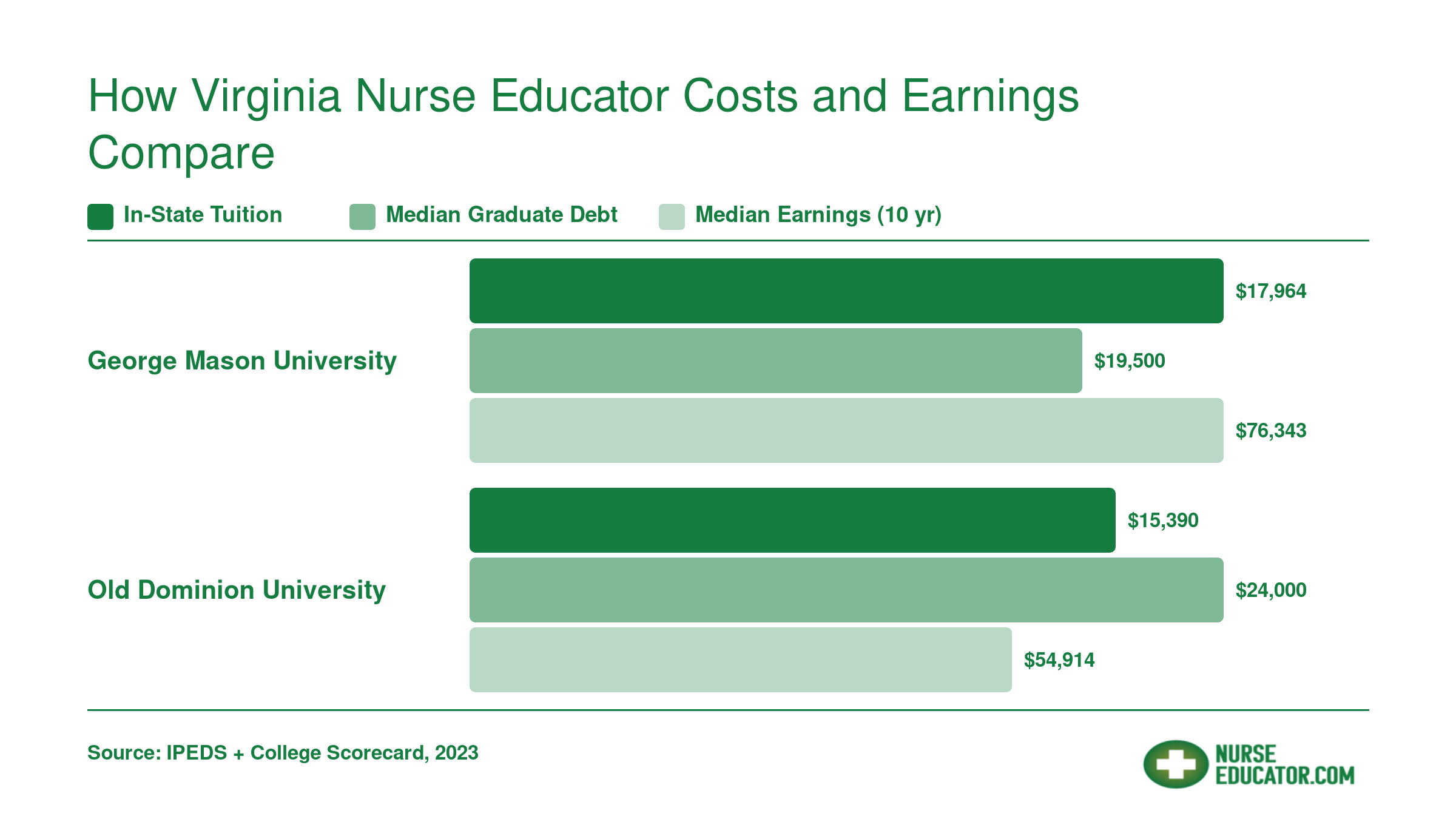
Public universities in Virginia carry a clear cost advantage for in-state residents. George Mason University, for example, lists in-state tuition for its nursing education graduate certificate at roughly $17,964, while out-of-state students would pay closer to $40,308. The institution-wide average net price, which accounts for grants and aid, runs around $17,915 for public-sector students. Old Dominion University shows a similar pattern: in-state tuition comes in near $15,390, with an institution-wide average net price around $14,638 after aid. ODU's per-credit rate for in-state graduate students is approximately $620, which gives working nurses a predictable per-semester cost when they enroll part-time.
Out-of-state and private school tuition gaps can be substantial, sometimes exceeding $20,000 per year compared to in-state rates. If you are considering relocating or enrolling in a private institution, build that difference into your ROI calculation before committing. Comparing affordable online nurse educator MSN programs nationally can also help you benchmark Virginia's costs against other options.
Program-level earnings data for these specific certificates is not yet published, so direct income comparisons to program cost require some estimation on your part. Nationally, nurse educators working in postsecondary settings earn salaries that allow for manageable loan repayment, particularly when debt is kept in the $19,500 to $24,000 range that appears in institutional data for these two programs.
Federal Loan Programs Worth Knowing
HRSA's Nurse Faculty Loan Program (NFLP) is the most targeted federal option for this career path. It offers loans of roughly $30,000 to $40,000 per year and cancels up to 85% of the total balance if you fulfill a service commitment as full-time nurse faculty.12 The cancellation schedule is structured as 20% after each of the first three years and 25% after the fourth year, with service beginning within 12 months of completing your degree.1 Eligible programs include MSN degrees in nursing education, DNPs, PhDs, and post-master's certificates.2
Two additional HRSA programs round out the picture:
- Nurse Corps Loan Repayment Program: Repays 60% of outstanding nursing education debt in exchange for two years of service at a qualifying critical shortage facility or as nurse faculty.3
- Faculty Loan Repayment Program: Awards up to $40,000 toward educational debt for faculty from disadvantaged backgrounds who commit to two years of service at an eligible health professions school.4
Employer Tuition Reimbursement and State Aid
Many Virginia-based health systems offer tuition reimbursement programs for RNs pursuing graduate degrees, and these benefits can significantly reduce out-of-pocket costs when paired with NFLP or other federal loans. Ask your employer's HR department specifically whether MSN or post-master's certificate programs qualify, since some reimbursement policies are limited to direct-patient-care credentials.
Virginia does not currently offer a state-specific graduate nursing education scholarship at the scale of some other states, and federal Pell Grant eligibility does not extend to graduate study. At the graduate level, your best institutional aid opportunities are departmental scholarships, graduate assistantships, and the federal loan programs described above.
Estimating Your Payback Timeline
If you graduate with $20,000 to $24,000 in debt and begin a full-time faculty role, standard 10-year repayment would put your monthly loan payments in the $200 to $250 range. That is a modest obligation relative to nurse educator salaries, and NFLP forgiveness can cut that balance substantially in under five years. The ROI calculus improves further when employer reimbursement covers a portion of tuition before you borrow at all. Running these numbers against your specific program cost and likely starting salary is one of the most useful things you can do before finalizing your school choice.
How Virginia Nurse Educator Costs and Earnings Compare
Understanding the financial picture helps you weigh your return on investment. Below, in-state tuition, median graduate debt at completion, and institution-wide median earnings (10 years after entry) are shown side by side for the two ranked Virginia nurse educator programs. Program-specific post-graduation earnings are not yet available for these certificates, so the institution-level figure offers a useful baseline. With median debt ranging from $19,500 to $24,000, most graduates are well positioned to recoup their investment within a few years of entering a nurse educator role.
Nurse Educator Certification and Licensure in Virginia
Employer expectations for nursing faculty credentials have tightened steadily over the past decade, making it important to understand both national certification and Virginia-specific requirements before you begin teaching.
Certified Nurse Educator (CNE) Credential
The Certified Nurse Educator designation, awarded by the National League for Nursing (NLN), is the most widely recognized voluntary credential for nurse educators in the United States.1 As of 2026, you can qualify through one of two pathways:
- Pathway A: Hold a master's or doctoral degree in nursing with a major emphasis in nursing education (or a post-master's certificate, or at least nine graduate-level education credits). No prior teaching experience is required under this pathway. Note that graduate-level research or statistics courses do not count toward the nine-credit threshold.1
- Pathway B: Hold a master's or doctoral degree in nursing with a non-education emphasis, plus at least two years of teaching experience within the past five years.1
Both pathways require an active, unencumbered RN license.1 The CNE exam itself is a computer-based test covering core competencies such as curriculum design, learner assessment, and the scholarship of teaching. Certification is valid for five years and can be renewed through continuing education or re-examination. For a deeper look at eligibility details and exam preparation, see our certified nurse educator certification guide.
Virginia Board of Nursing Faculty Requirements
Virginia regulates who may teach in its approved nursing programs through the Board of Nursing. Faculty at programs awarding a BSN or higher generally must hold at least a master's degree in nursing, and the Board expects documented expertise in the subject area being taught. Clinical faculty may have additional practice-hour requirements. These state-level rules are separate from, and in addition to, holding the CNE. In other words, earning the CNE does not replace meeting the Board's own qualifications for faculty appointment, and vice versa.
Continuing Education
Virginia requires all registered nurses, including those serving as educators, to complete continuing competency requirements for RN license renewal. Nurse educators who also hold the CNE must independently satisfy the NLN's renewal criteria, which typically involve accruing professional development hours specific to the educator role. Keeping both sets of requirements on your radar prevents any lapse in either your state license or your national certification.
Why the CNE Matters for Hiring
Although the CNE is voluntary, many Virginia colleges and universities list it as preferred or required in faculty job postings. Holding the credential signals that you have met a nationally benchmarked standard for teaching competence, which can set you apart in a competitive applicant pool. If you are unsure whether the CNE or the CNEcl (Clinical Nurse Educator) credential is the better fit, our CNE vs CNEcl certification comparison breaks down the key differences. For nurses transitioning from clinical practice, earning the CNE early in your educator career can also help offset a thinner teaching resume. If you are weighing whether the investment is worthwhile, consider that the credential often strengthens salary negotiations and qualifies you for faculty development grants tied to certified educator status.
Steps to Becoming a Nurse Educator in Virginia
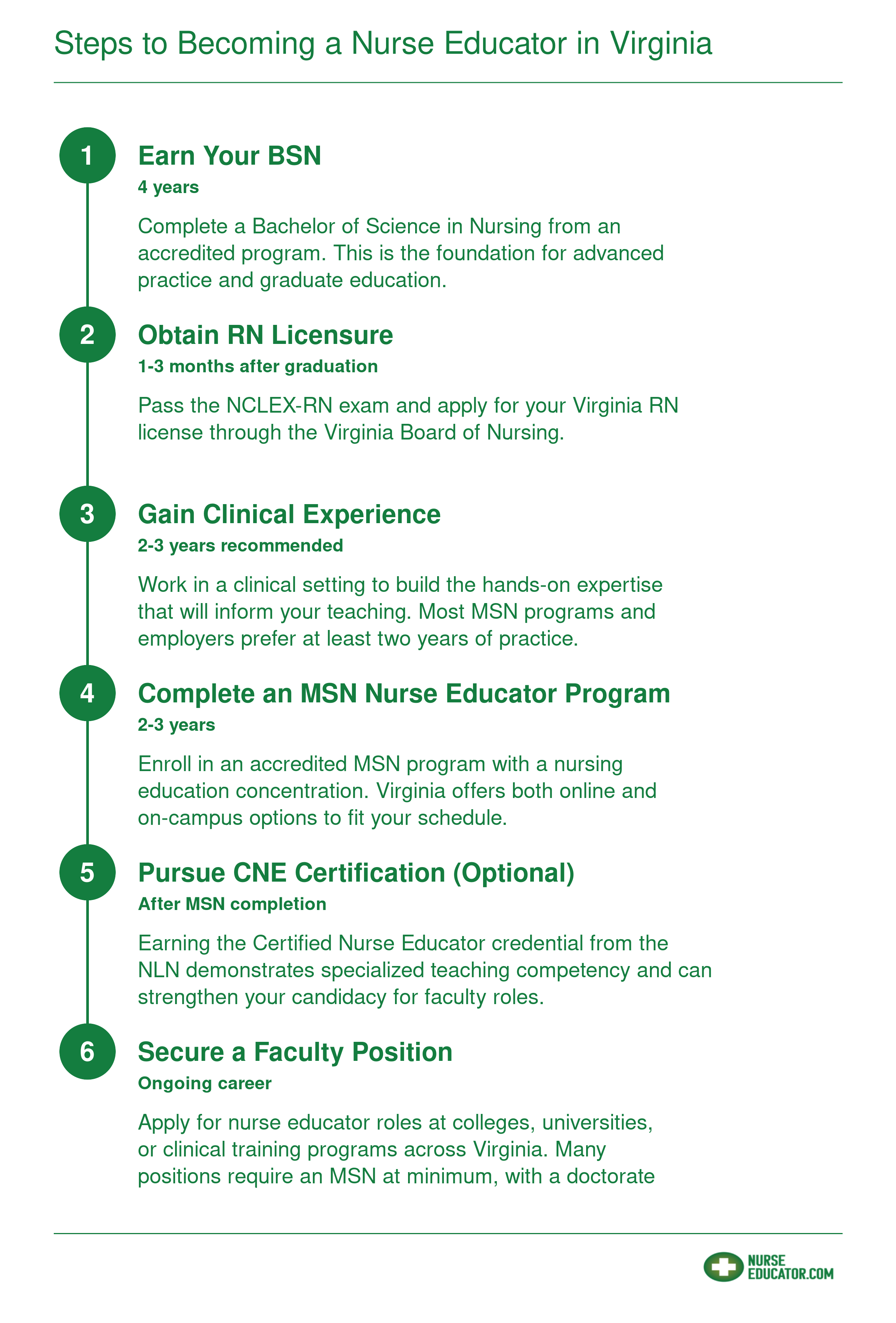
The path from bedside nursing to the classroom follows a clear sequence. Most nurses can expect the full journey from earning a BSN to landing a faculty position to take roughly 7 to 10 years, depending on clinical experience and whether you pursue your MSN full-time or part-time.
Nurse Educator Salary and Job Outlook in Virginia
Virginia offers nurse educators a compensation picture that sits notably above the national baseline, making it one of the more financially rewarding states to pursue this career path. The data below draws from the Bureau of Labor Statistics Occupational Employment and Wage Statistics program (SOC 25-1072) for 2024.1
What Virginia Nurse Educators Earn
The median annual wage for postsecondary nursing instructors and teachers in Virginia is $86,980, compared to the national median of $79,940.1 That $7,000 gap is meaningful over a career, and it reflects both the cost of living in high-demand corridors like Northern Virginia and the competitive hiring environment at the state's research universities.
Here is how the full Virginia wage distribution breaks down:
- 10th percentile: $53,240 (entry-level or part-time adjunct roles)
- 25th percentile: $64,980
- Median (50th percentile): $86,980
- 75th percentile: $106,340
- 90th percentile: $126,690
The spread from bottom to top is wide, which reflects the difference between adjunct community college positions and tenured faculty roles at doctoral-granting institutions. Nurses moving into education mid-career, with a strong clinical background and an MSN in hand, commonly land between the median and 75th percentile.
How Virginia Compares to Neighboring States
State-specific BLS wage data for neighboring states shifts the picture. Virginia's median ($86,980) outpaces the national figure ($79,940) by roughly 9%.1 Maryland and the District of Columbia tend to post higher wages for this occupation given their proximity to federal health agencies and dense academic medical centers, while North Carolina generally tracks closer to or slightly below the national median. If location flexibility is part of your planning, the Northern Virginia-DC corridor in particular offers access to some of the highest-paying academic positions on the East Coast. For a broader look at geographic variation, see our breakdown of states with highest demand for nurse educators.
Job Outlook and the Faculty Shortage
Nationally, the Bureau of Labor Statistics projects 16.8% growth for postsecondary nursing instructors and teachers between 2024 and 2034, a rate classified as much faster than average.2 Virginia currently employs approximately 1,600 nursing instructors and teachers, placing it among the mid-tier states by total employment volume.1
Behind those numbers sits a structural problem that shapes hiring conditions directly: a persistent nursing faculty shortage. According to American Association of Colleges of Nursing data from 2021, nursing programs across the country turned away nearly 92,000 qualified applicants in a single year, with faculty shortages cited as the primary reason.2 Roughly 74% of nursing schools reported difficulty filling faculty positions. That shortage has not resolved since then, which means the pipeline into nurse educator roles remains wide open for qualified candidates.
Top Employers in Virginia
Virginia's nurse educator job market is anchored by a mix of research universities, regional institutions, and healthcare systems:
- Research universities: Virginia Commonwealth University, the University of Virginia, and George Mason University all maintain active nursing faculty rosters and prioritize candidates with research credentials.
- Private institutions: Liberty University runs one of the largest online nursing programs in the country and represents a significant employer for distance-education faculty.
- Community colleges: Virginia's community college system covers every region of the state and regularly hires nursing faculty, often offering more predictable schedules than university research roles.
- Hospital education departments: Major health systems including Inova, Sentara, and VCU Health employ clinical nurse educators who focus on staff development rather than academic instruction, a parallel career track worth considering.
For nurses weighing the transition from clinical practice to education, Virginia's combination of above-median pay, strong institutional variety, and persistent nurse educator demand creates a genuinely favorable entry window.
Did You Know?
Section content unavailable.
Frequently Asked Questions About Virginia Nurse Educator Programs
Below are answers to some of the most common questions nurses ask when exploring nurse educator programs in Virginia. Each answer draws on current state requirements, program data, and national credentialing standards so you can plan your next steps with confidence.