

What you’ll learn in this article…
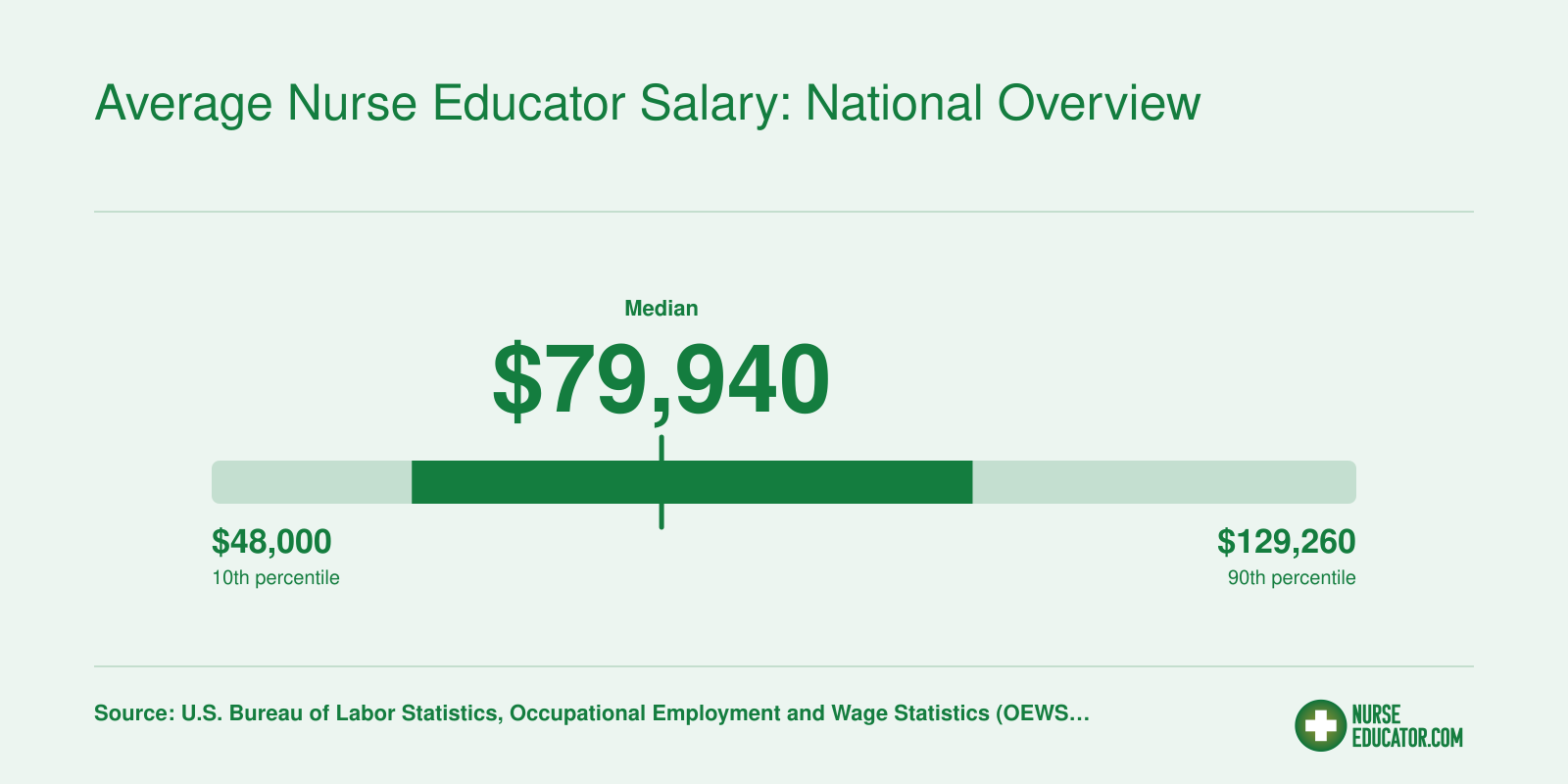
- The national median nurse educator salary is approximately $79,940, with top earners exceeding $130,000 annually.
- State salaries range from about $64,000 in Arkansas and South Dakota to over $100,000 in California and New York.
- Clinical nurse educators average roughly $115,932 in total compensation, often outpacing academic faculty in base pay.
- Earning a DNP or PhD significantly boosts salary potential and opens doors to senior faculty and leadership roles.
How much do nurse educators actually make? According to the Bureau of Labor Statistics, the national median salary for postsecondary nursing instructors and teachers is approximately $79,940, based on 2024 wage estimates. That figure, however, is only the starting point.
Pay varies considerably depending on degree level, work setting, geographic region, and years of experience. An MSN-prepared clinical educator at a community hospital earns a very different salary than a DNP-holding tenured professor at a research university, even though both hold the title of nurse educator.
The practical tension for most RNs considering the switch is real: transitioning to education can mean a short-term pay adjustment relative to bedside overtime earnings, while doctoral credentials and academic rank open access to substantially higher compensation over time. Understanding the qualities of a good nurse educator that employers value can also help you position yourself for stronger offers from the start.
Average Nurse Educator Salary: National Overview
According to the Bureau of Labor Statistics, the national median salary for Nursing Instructors and Teachers, Postsecondary was approximately $79,940 as of their most recent published data (reflecting 2024 wage estimates). The middle 50% of earners fell between roughly $62,210 and $102,020, illustrating a wide pay band shaped by factors like degree level, institution type, and geographic region. With about 74,250 professionals employed nationally in this classification, the field is sizable, though the BLS postsecondary category may not capture every clinical nurse educator role in hospital or healthcare settings.
Nurse Educator Salary by Degree Level: BSN Vs. MSN Vs. Dnp/phd
The national mean annual wage for nursing faculty sits at $136,889, but that figure masks wide variation across degree levels and academic ranks.1 A master's degree (MSN) serves as the practical entry requirement for most full-time educator positions, while doctoral preparation unlocks substantially higher pay ceilings and tenure-track opportunities.
MSN: The Standard Entry Point
For the vast majority of nurse educator roles, an MSN is the non-negotiable floor. The American Association of Colleges of Nursing (AACN) and most state boards of nursing require a master's degree for faculty teaching in diploma, associate, and baccalaureate programs. While precise MSN-specific salary data is less frequently isolated in national surveys, market analysis shows that MSN-prepared nurse educators typically earn between $70,000 and $110,000 annually, depending on geographic region, institution type, and years of experience. This range aligns with the lower half of the national nursing faculty wage spectrum, reflecting the fact that many entry-level and clinical teaching positions fall into this bracket. Experienced MSN educators in leadership or specialized clinical areas often push into the $90,000 to $110,000 bracket, especially at larger universities or in states with stronger healthcare infrastructure. If you are exploring MSN nurse educator program options, know that the salary for a nurse educator with an MSN generally starts in the low $70,000s and can reach six figures with seniority, particularly in high-cost metropolitan areas.
Doctoral Preparation and the Pay Premium
Earning a DNP or PhD in nursing pushes earning power well beyond the MSN ceiling. Recent AACN data for doctorally prepared nursing faculty breaks down by rank: assistant professors average $108,278, associate professors $123,379, and full professors $155,312.2 These figures highlight a clear premium. Doctoral faculty at the associate level already outearn the top of the typical MSN range, and full professors nearly double the lower end. The doctorate also serves as a gatekeeper to tenure-track appointments, administrative roles such as dean or program director, and high-profile research positions, all of which command higher compensation. Even non-tenure-track clinical faculty with a doctorate can expect a noticeable bump over MSN-only colleagues, often adding $15,000 to $25,000 to starting offers. Nurses weighing this investment can compare DNP nurse educator programs to find the right fit. At the extreme high end, nursing faculty in the San Jose, CA metro area report a mean wage of $270,272, underscoring how location can dramatically amplify earning power.1 For a full state-by-state breakdown, see our look at the highest paid nurse educators.
Why the BSN Isn't Enough for Full-Time Faculty
BSN-prepared nurses are largely confined to adjunct clinical instructor or preceptor roles, which pay hourly or per-course stipends rather than full-time salaries. These positions rarely offer benefits or a path to faculty rank. While they provide valuable teaching experience, the lack of a graduate degree limits earning potential (often to the $50,000 to $65,000 range on an annualized basis) and blocks access to the comprehensive salary structures described above. For any nurse aiming to build a career in education, earning an MSN is the realistic first step toward a livable, full-time academic wage.
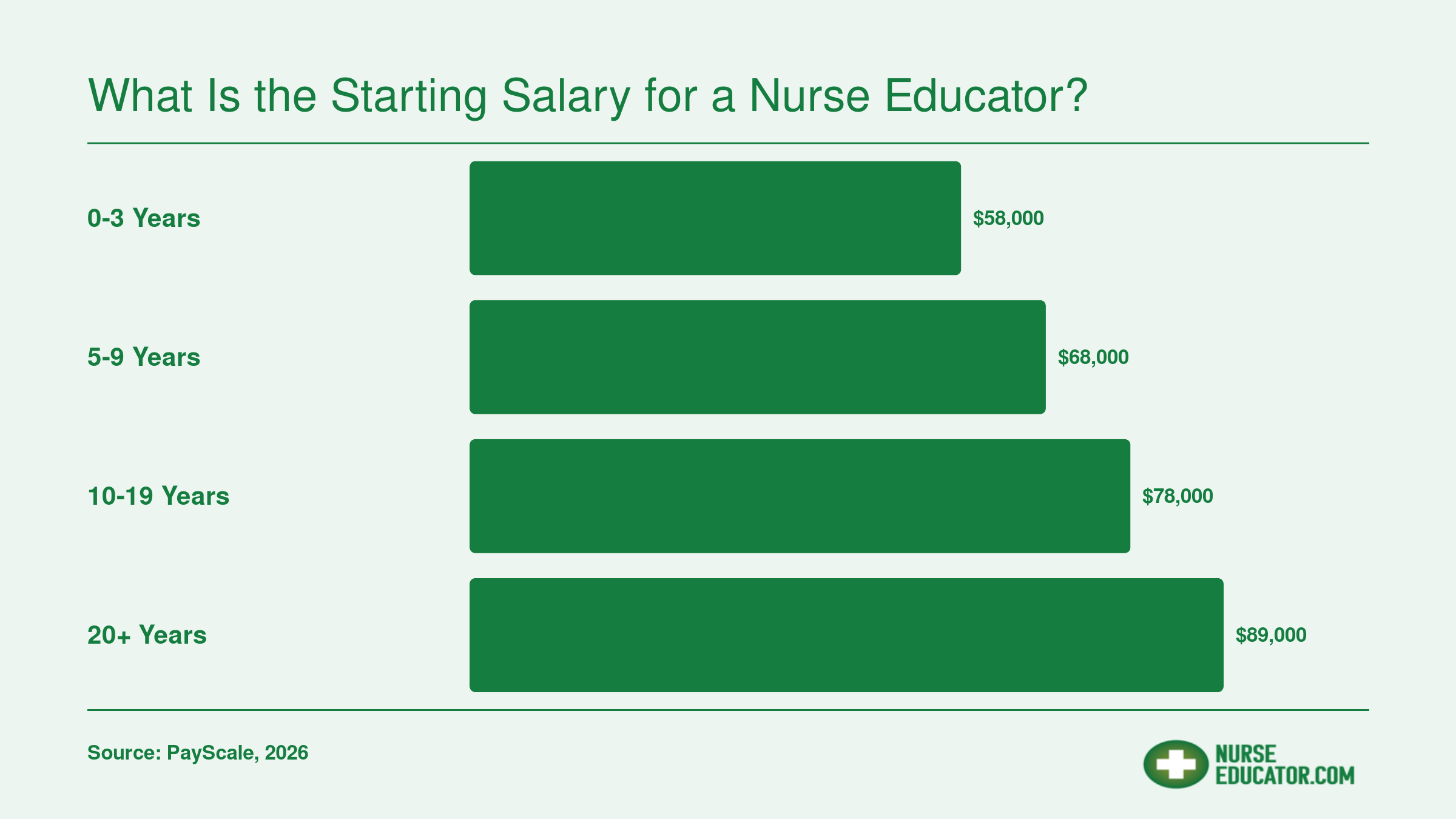
What Is the Starting Salary for a Nurse Educator?
Pinning down an exact starting salary for nurse educators takes a bit of detective work, because published figures vary by source and methodology. The most reliable approach is to cross-reference multiple data points. Start with the BLS Occupational Employment and Wage Statistics page for "Postsecondary Nursing Instructors and Teachers," which breaks compensation into percentiles and regional detail. Professional organizations like the National League for Nursing and the American Association of Colleges of Nursing publish periodic faculty salary surveys that segment pay by years of experience, rank, and degree. Public university job postings and state transparency reports often list exact salary bands for assistant or clinical instructor roles, giving you real entry-level numbers. Salary aggregators such as Glassdoor and Indeed can supplement this picture, but keep in mind they frequently lump nurse educator positions together with related titles, so always verify against official sources.
Nurse Educator Salary by Years of Experience
Experience pays off in nursing education, but salary growth follows a distinctive curve. Entry-level nurse educators start near $74,000, and earnings climb to over $86,000 after 20 years, with a notable plateau in the middle of your career.12
Earnings by Experience Tier
- Entry-level (0, 1 year): $73,849, New nurse educators typically begin in this range, often while completing a graduate degree like an msn nurse educator or transitioning from bedside roles.
- Early-career (1, 4 years): $83,138, After gaining some classroom confidence, pay jumps noticeably as you take on more course coordination.
- Mid-career (5, 9 years): $77,257, A slight dip can occur here, reflecting common career pauses, part-time work, or lateral moves before advancement.
- Experienced (10, 19 years): $80,624, Seasoned educators often recoup earning momentum through leadership roles, tenure, or clinical specialization.
- Late-career (20+ years): $86,587, The highest reported tier, where senior faculty, program directors, and deans can exceed $100,000 depending on the institution, and a polished nurse educator resume can help you land those leadership roles.
Planning Your Financial Trajectory
These 2026 PayScale figures give a realistic view of how nurse educator pay matures. While the national average salary for nurse educators sits around $87,000 to $89,000, individual earnings vary widely based on degree level, employer, and geographic region.3 For context, the overall salary range for the profession spans $72,000 to $123,000, so pushing into that late-career bracket places you well above the floor.4 Keep in mind that these numbers represent base pay only, additional income from summer teaching, consulting, or clinical practice can further boost your total compensation. The takeaway: your biggest earning years as a nurse educator arrive after two decades of experience, making this profession both stable and financially rewarding, with a positive nurse educator ROI.
Nurse Educator Salary by State
Where you teach matters almost as much as what you teach. According to the latest BLS data for Nursing Instructors and Teachers (Postsecondary), median salaries for nurse educators range from roughly $64,000 in Arkansas and South Dakota to over $100,000 in California, Hawaii, and the District of Columbia. The table below covers all 50 states (plus D.C. and Puerto Rico) so you can compare your state at a glance.
| State | Total Employed | Median Annual Salary | 25th Percentile | 75th Percentile |
|---|---|---|---|---|
| District of Columbia | 130 | $103,780 | $85,070 | $122,260 |
| Hawaii | 370 | $102,180 | $82,380 | $109,370 |
| California | 6,120 | $99,010 | $65,510 | $124,290 |
| Texas | 5,940 | $97,610 | $73,670 | $123,360 |
| New York | 5,380 | $93,640 | $63,540 | $128,930 |
| Alaska | 190 | $92,050 | $82,800 | $105,590 |
| Nevada | 920 | $84,660 | $63,070 | $97,040 |
| Montana | 230 | $84,550 | $66,280 | $105,390 |
| Florida | 4,990 | $83,940 | $66,100 | $104,120 |
| Delaware | 250 | $83,420 | $65,190 | $106,410 |
| North Dakota | 120 | $83,130 | $64,360 | $102,080 |
| Connecticut | 1,160 | $81,490 | $63,780 | $101,600 |
| New Hampshire | 530 | $81,260 | $65,850 | $83,790 |
| Maryland | 860 | $80,990 | $64,780 | $103,350 |
| Michigan | 1,680 | $80,740 | $60,640 | $101,450 |
| Colorado | 1,160 | $80,440 | $63,330 | $103,140 |
| Massachusetts | 2,860 | $80,140 | $72,920 | $102,140 |
| Pennsylvania | 4,860 | $79,920 | $59,330 | $98,430 |
| South Carolina | 1,150 | $79,900 | $62,920 | $95,750 |
| Wisconsin | 1,620 | $79,810 | $51,930 | $94,090 |
| Nebraska | 360 | $79,120 | $62,760 | $95,360 |
| Illinois | 2,450 | $78,870 | $60,840 | $100,550 |
| Virginia | 1,950 | $78,850 | $63,940 | $95,950 |
| Vermont | N/A | $78,800 | $62,460 | $92,070 |
| Maine | 410 | $78,770 | $61,630 | $99,030 |
| North Carolina | 2,360 | $78,740 | $61,880 | $98,680 |
| Minnesota | 1,470 | $78,110 | $64,220 | $98,520 |
| Washington | 1,340 | $78,000 | $64,370 | $105,880 |
| New Mexico | 360 | $77,850 | $57,030 | $86,870 |
| Alabama | 1,370 | $77,270 | $63,340 | $97,090 |
| Indiana | 1,460 | $77,270 | $59,420 | $99,640 |
| Tennessee | 1,310 | $76,620 | $64,230 | $83,840 |
| Georgia | 1,610 | $75,950 | $60,480 | $82,740 |
| West Virginia | 360 | $75,550 | $60,760 | $90,460 |
| Idaho | 370 | $75,420 | $63,820 | $100,850 |
| Utah | 740 | $75,380 | $59,980 | $95,940 |
| Wyoming | 130 | $75,280 | $60,690 | $83,150 |
| Kentucky | 1,260 | $74,850 | $60,830 | $92,690 |
| Rhode Island | 280 | $74,720 | $60,850 | $94,930 |
| Ohio | 4,260 | $74,570 | $47,750 | $96,760 |
| Missouri | 1,330 | $74,000 | $58,270 | $93,540 |
| Puerto Rico | 530 | $73,500 | $50,500 | $94,860 |
| Mississippi | 1,000 | $73,160 | $63,110 | $84,800 |
| Louisiana | 490 | $72,990 | $52,420 | $81,070 |
| Iowa | 800 | $71,910 | $59,000 | $78,570 |
| Kansas | 470 | $70,960 | $56,850 | $88,150 |
| Arizona | 1,920 | $68,360 | $62,380 | $81,650 |
| Oklahoma | 600 | $65,100 | $59,660 | $76,100 |
| Arkansas | 800 | $64,330 | $61,740 | $76,870 |
| South Dakota | 240 | $63,940 | $56,960 | $78,010 |
Questions to Ask Yourself
Highest-Paying Metro Areas for Nurse Educators
Location plays a major role in nurse educator compensation, and certain metro areas consistently pay well above the national median. The table below ranks the top metro areas by median annual salary for postsecondary nursing instructors and teachers, based on BLS data. Keep in mind that higher salaries in coastal and major metro areas often correlate with a higher cost of living, so weigh take-home purchasing power alongside the raw numbers.
| Metro Area | Total Employed | Median Salary | 25th Percentile | 75th Percentile | Mean Salary |
|---|---|---|---|---|---|
| Riverside-San Bernardino-Ontario, CA | 670 | $112,480 | $103,210 | $135,060 | $127,830 |
| Houston-Pasadena-The Woodlands, TX | 1,510 | $107,190 | $78,700 | $131,980 | $115,090 |
| New York-Newark-Jersey City, NY-NJ | 4,050 | $103,790 | $76,910 | $136,560 | $112,750 |
| Dallas-Fort Worth-Arlington, TX | 1,250 | $101,690 | $79,660 | $121,730 | $107,210 |
| Denver-Aurora-Centennial, CO | 540 | $101,070 | $77,420 | $123,010 | $100,530 |
| Los Angeles-Long Beach-Anaheim, CA | 2,530 | $91,310 | $63,700 | $112,150 | $93,260 |
| San Francisco-Oakland-Fremont, CA | 730 | $90,570 | $60,440 | $128,900 | $103,280 |
| Washington-Arlington-Alexandria, DC-VA-MD-WV | 730 | $90,150 | $67,640 | $103,570 | $87,920 |
| Miami-Fort Lauderdale-West Palm Beach, FL | 1,510 | $87,810 | $66,680 | $107,580 | $92,570 |
| Orlando-Kissimmee-Sanford, FL | 660 | $85,340 | $63,880 | $105,660 | $88,870 |
| Las Vegas-Henderson-North Las Vegas, NV | 690 | $84,440 | $61,980 | $97,040 | $85,950 |
| Philadelphia-Camden-Wilmington, PA-NJ-DE-MD | 2,230 | $82,100 | $63,020 | $101,020 | $86,560 |
| Tampa-St. Petersburg-Clearwater, FL | 690 | $81,860 | $74,100 | $99,030 | $88,760 |
| Austin-Round Rock-San Marcos, TX | 510 | $81,750 | $63,960 | $104,080 | $92,920 |
| Chicago-Naperville-Elgin, IL-IN | 1,600 | $81,430 | $61,190 | $102,170 | $86,310 |
| San Jose-Sunnyvale-Santa Clara, CA | 670 | $81,430 | $62,030 | $103,930 | $85,130 |
| Seattle-Tacoma-Bellevue, WA | 740 | $80,840 | $66,830 | $110,390 | $90,500 |
| Kansas City, MO-KS | 520 | $81,320 | $59,480 | $94,900 | $82,090 |
| St. Louis, MO-IL | 670 | $79,910 | $58,690 | $93,550 | $77,720 |
| Milwaukee-Waukesha, WI | 660 | $79,810 | $53,050 | $93,830 | $77,730 |
| Boston-Cambridge-Newton, MA-NH | 2,160 | $79,550 | $65,190 | $102,140 | $91,210 |
| Indianapolis-Carmel-Greenwood, IN | 530 | $79,440 | $59,420 | $101,840 | $83,920 |
| Minneapolis-St. Paul-Bloomington, MN-WI | 890 | $78,670 | $65,820 | $98,870 | $84,610 |
| Atlanta-Sandy Springs-Roswell, GA | 670 | $77,370 | $62,200 | $81,950 | $73,380 |
| Columbus, OH | 920 | $75,130 | $39,350 | $98,640 | $74,060 |
| Cleveland, OH | 580 | $75,490 | $38,610 | $96,760 | $73,840 |
| Rochester, NY | 580 | $74,630 | $74,630 | $99,910 | $82,450 |
| Pittsburgh, PA | 1,490 | $72,900 | $55,420 | $92,800 | $79,090 |
| Phoenix-Mesa-Chandler, AZ | 1,490 | $68,360 | $60,560 | $78,420 | $74,110 |
| Cincinnati, OH-KY-IN | 1,100 | $63,880 | $36,980 | $94,970 | $68,990 |
Academic Vs. Clinical Nurse Educator Salary
Clinical nurse educators working inside hospitals and health systems earn roughly $80,000 to $115,000 in base pay, with average total compensation landing near $115,932 in 2026.2 Academic nurse educators in colleges and universities typically earn $60,000 to $100,000.1 The comparison is not as one-sided as those numbers suggest once you account for schedule, benefits, and the actual length of the work year. For a deeper look at these two tracks, see our guide to the academic vs clinical nurse educator path.
Academic Nurse Educators: Lower Base, Different Lifestyle
Academic appointments often run 9 to 10 months rather than 12, which means the published salary covers fewer working months than a hospital role. Faculty work predominantly weekdays, with occasional early clinical rotations, and the calendar includes winter and summer breaks that can be used for consulting, per diem clinical work, or research.
Typical titles include Nursing Instructor, Clinical Instructor, and the tenure-track ladder of Assistant, Associate, and full Professor. The focus is teaching, curriculum design, accreditation work, and (at research-intensive schools) scholarship. Benefits skew toward education: tuition remission for the employee, dependent tuition discounts, generous retirement contributions, and sabbatical eligibility at some institutions.
Clinical Nurse Educators: Higher Base, Year-Round Schedule
Clinical nurse educators work 12 months a year on a hospital payroll, which is the single biggest driver of the higher base. Job titles vary by system: Clinical Nurse Educator, Professional Development Specialist, Clinical Education Specialist, and Staff Development Coordinator are the most common. You can explore additional nurse educator job titles and where they lead in our careers overview. The work centers on onboarding new graduates, running competency programs, supporting unit-based education, and contributing to quality and safety initiatives.
Schedules are mostly weekdays, but expect flexibility for off-shift, night, and weekend coverage when staff need training. Compensation packages include standard hospital benefits, PTO that accrues year-round, retirement match, capped tuition reimbursement, and sometimes shift differentials or bonuses tied to system performance.
Month for month, the two roles pay more similarly than the headline numbers imply. The real choice comes down to an academic rhythm versus a hospital rhythm.
Nurse Educator Salary Vs. Bedside RN Salary
One of the most common questions nurses ask when considering a move into education is whether the pay cut is real, and if so, how significant it is. The short answer: yes, most nurse educators earn less than bedside RNs on paper, but the full picture is more nuanced than a single number suggests.
According to the Bureau of Labor Statistics, the median annual wage for registered nurses nationwide was $93,600 as of May 2024, with a median hourly rate of $45.00.1 That figure, however, reflects straight-time wages only and excludes overtime, shift differentials, and bonuses. Many bedside RNs rely on those extras to push their total compensation well above the median, sometimes by $10,000 to $20,000 or more per year.
Nurse educators working in academic settings typically earn base salaries that fall below the RN median, particularly in the early years of their teaching careers. Entry-level faculty positions at community colleges or smaller universities may start in the $60,000 to $75,000 range, while experienced professors at research institutions can exceed $100,000. Clinical nurse educators employed by hospitals often land closer to the bedside RN median because their pay scales follow the same institutional structure.
What the raw numbers miss is the value of predictability and work-life balance. Bedside RNs frequently work 12-hour rotating shifts, weekends, and holidays. Nurse educators generally follow a more predictable schedule with summers that allow for consulting, research, or additional income. When you factor in the absence of mandatory overtime and the reduced physical toll, the compensation gap narrows considerably.
If you are weighing the trade-offs between clinical practice and education, understanding the difference between a nurse and a nurse educator can help you evaluate whether the lifestyle benefits offset the salary difference. Many nurses also discover that common nurse educator salary myths overstate the financial sacrifice involved in making the switch.
What Factors Affect Nurse Educator Pay?
Two nurse educators with identical degrees can earn dramatically different salaries depending on employment structure, credentials, specialty, and institution type. Understanding these variables helps you target roles, and negotiate offers, more strategically.
Adjunct vs. Full-Time Employment
Adjunct nurse faculty are typically paid per course or per credit hour, with rates that vary widely by region and institution. Indeed data for Galen College of Nursing in Nashville lists adjunct nursing faculty at roughly $32 per hour, which is a reasonable midpoint for the role but does not include benefits, paid time off, or retirement contributions.1 Full-time nursing faculty nationally average around $81,600 annually, and that figure typically comes bundled with health insurance, tuition remission, sabbatical eligibility, and employer retirement matching, benefits that can add 25 to 35 percent to total compensation.2
Adjuncting is rarely a path to financial stability on its own. A Chronicle of Higher Education survey across all disciplines found that only about 7 percent of adjunct faculty use that work as their primary source of income.3 For most nurse educators, adjunct teaching supplements a clinical job or eases the transition into academia. If you are weighing that shift, it helps to understand why nurses become nurse educators in the first place.
Certification, Specialty, and Institution Type
The Certified Nurse Educator (CNE) credential from the NLN is increasingly used as a hiring differentiator, particularly at institutions pursuing or maintaining accreditation. While published salary-premium figures specific to the CNE are limited, search committees frequently treat the credential as evidence of teaching expertise, which can strengthen your position in salary negotiations and promotion reviews.
Specialty expertise also moves the needle. Faculty who can teach simulation, informatics, psychiatric-mental health, or other hard-to-staff content areas often command higher offers because programs struggle to fill those courses. To see the full range of subjects nurse educators teach, it helps to know where shortages hit hardest. Clinical specialties tied to current workforce shortages, which are well documented in AACN data, tend to carry the most leverage.4
Institution type matters too. Unionized campuses and public universities usually publish salary scales tied to rank and years of service, making pay predictable and transparent. Private and for-profit schools vary more widely, which cuts both ways: less floor protection, but more room to negotiate.
Negotiation Leverage
When an offer is on the table, the strongest leverage points are a peer-reviewed publication record, active grant funding, recent high-acuity clinical experience, and willingness to teach high-demand or undesirable time slots (evenings, weekends, clinical rotations at distant sites). Because nurse educators are in high demand across most regions, qualified candidates often have more bargaining power than they realize. Documenting these strengths before the conversation, rather than during it, consistently produces better outcomes.
Nurse Educator Job Outlook and Career Growth
If you are weighing a move from clinical practice to the classroom, the job outlook offers plenty of encouragement. The Bureau of Labor Statistics projects that employment for postsecondary teachers will grow by 7% between 2024 and 2034, with roughly 114,000 openings expected each year across all disciplines.1 Nursing education roles are a significant slice of that total, driven by expanding enrollment targets at schools of nursing nationwide.
Several forces are accelerating demand specifically for nurse educators. An aging population needs more nurses, yet programs cannot admit enough students without qualified faculty to teach them. The ongoing nursing faculty shortage compounds the problem: when seasoned educators retire, the pipeline of replacements is not keeping pace. That gap means institutions are actively recruiting, and many are sweetening compensation packages, offering tenure-track positions, and expanding remote teaching options to attract candidates.
For your career growth, these dynamics translate into concrete advantages. Entry-level positions in clinical instruction or simulation labs can lead to full-time faculty appointments, department leadership, or curriculum design roles. Pursuing an advanced degree, whether an MSN or a doctoral program, typically unlocks higher salary bands and eligibility for administrative titles like program director or dean. Many careers in nurse education also offer the flexibility to maintain a part-time clinical practice, so you do not have to choose one path or the other.
Beyond traditional academia, nurse educators are increasingly sought in hospital-based staff development, continuing education companies, and health-policy organizations. Each of these settings presents its own salary range and advancement trajectory, but the common thread is strong demand and a favorable hiring environment. If you are considering reasons to become a nurse educator, the combination of projected growth, workforce shortages, and diverse career pathways makes this an opportune time to invest in the transition.
Frequently Asked Questions About Nurse Educator Salaries
Below are answers to some of the most common questions nurses ask when weighing a move into education. Each response draws on the salary benchmarks, comparisons, and trends discussed throughout this article.
How much do nurse educators make per year?
According to the Bureau of Labor Statistics, the national median annual wage for postsecondary nursing instructors and teachers was approximately $80,780 as of May 2024. Actual pay varies significantly by state, metro area, degree level, and work setting. Educators in high cost of living regions or with doctoral credentials often earn well above the median.
What is the salary for a nurse educator with an MSN?
An MSN is the most common entry credential for nurse educator roles. Nurse educators holding a Master of Science in Nursing typically earn salaries ranging from the mid $70,000s to the low $90,000s nationally, depending on geography and experience. Those who later add a DNP or PhD often see an additional pay bump as they qualify for senior faculty or leadership positions.
Do nurse educators make more than bedside nurses?
It depends on specialty and setting. The BLS reports a national median of $86,070 for registered nurses (May 2024), which slightly exceeds the nursing instructor median. However, nurse educators frequently enjoy more predictable schedules, summers with reduced obligations, tuition benefits, and retirement packages that can close or reverse the total compensation gap over a full career.
What is the starting salary for a nurse educator?
Entry level nurse educators, typically those with an MSN and limited teaching experience, can expect starting salaries in the range of roughly $60,000 to $70,000 at many institutions. Geographic location, whether the role is at a community college versus a university, and local demand for nursing faculty all influence where a starting offer lands within that range.
Is CNE certification required to be a nurse educator?
No. The Certified Nurse Educator (CNE) credential from the National League for Nursing is voluntary. Most employers require an MSN at minimum but do not mandate CNE certification. That said, earning the CNE can strengthen your candidacy, may qualify you for higher pay tiers at some institutions, and signals a commitment to teaching excellence that hiring committees value.
Do clinical nurse educators make more than academic nurse educators?
Clinical nurse educators employed by hospitals or health systems often earn higher base salaries than their counterparts in academic settings, partly because healthcare employers benchmark pay against clinical nursing wages. Academic faculty, however, may offset lower base pay with benefits such as tenure eligibility, sabbaticals, tuition waivers, and pension contributions.
How much do adjunct nursing faculty make per course?
Adjunct pay varies widely, but a common range is roughly $2,500 to $5,000 per course at many community colleges and universities. Some institutions in high demand markets pay more, especially for clinical courses. Because adjunct roles rarely include benefits, many nurse educators pursue full time positions or combine adjunct teaching with clinical work to build a more stable income.